Intel LGA-1954 May Support Nova Lake and Future CPUs
Intel’s upcoming LGA-1954 desktop socket could remain relevant across multiple CPU generations, potentially giving PC builders a longer upgrade path than recent Intel desktop platforms.
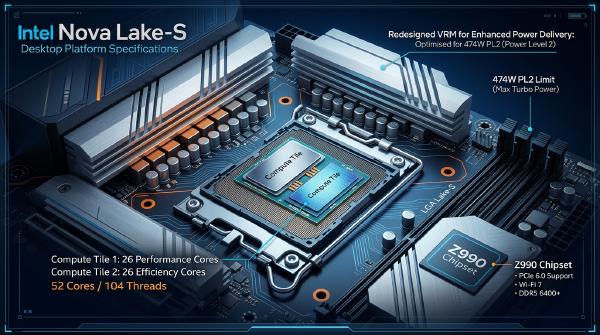
A leaked Intel partner presentation reportedly indicates that LGA-1954 will launch with Nova Lake-S desktop processors and may later be reused by successor product families, including Razor Lake and Hammer Lake. The latter generations are reportedly not expected before Q4 2027.
If the plan ultimately reaches retail products, LGA-1954 could mark a significant change in Intel’s recent desktop-platform strategy. Instead of requiring a new motherboard with every major CPU generation, users could potentially upgrade processors while retaining the same motherboard and cooling platform.
However, the multi-generation support information currently comes from leaked partner material. Intel has not officially confirmed the complete LGA-1954 compatibility roadmap.
🔌 LGA-1954 Could Extend Intel’s Desktop Socket Lifespan #
The leaked information centers on Intel’s next-generation desktop socket, LGA-1954.
The socket is expected to debut with Nova Lake-S, Intel’s upcoming desktop processor family. Its 1,954-contact configuration has previously appeared in Intel-related testing information, providing additional context for the leaked platform documentation.
More significantly, the leaked partner material reportedly lists multiple generations against the same socket:
- Nova Lake-S — initial LGA-1954 generation.
- Razor Lake — subsequent product generation reportedly planned for the same socket.
- Hammer Lake — another future generation reportedly listed for LGA-1954.
The leaked roadmap reportedly places Razor Lake and Hammer Lake no earlier than Q4 2027, although final launch schedules can change.
If these plans translate into shipping products, LGA-1954 would provide a longer-lived platform than Intel’s recent consumer desktop sockets.
💰 What Longer Socket Support Means for PC Upgrades #
Socket longevity matters because the motherboard is often one of the most expensive components that must be replaced during a CPU platform upgrade.
A multi-generation socket could allow a user to purchase a motherboard for Nova Lake-S and later upgrade to a newer compatible processor without replacing the entire platform.
Depending on future chipset and BIOS requirements, users could potentially retain:
- The motherboard.
- The CPU cooler.
- DDR memory, assuming memory standards remain compatible.
- Storage and other platform components.
The exact upgrade experience will ultimately depend on Intel’s chipset, firmware, power-delivery, and CPU compatibility policies.
Intel’s Recent Socket History #
Intel’s consumer desktop platform has gone through several socket transitions in recent years:
- LGA-1200
- LGA-1700
- LGA-1851
- LGA-1954, expected for Nova Lake-S
Frequent socket transitions can make CPU upgrades more expensive because moving to a new processor generation may also require a new motherboard.
A longer-lived LGA-1954 platform could therefore change the economics of Intel desktop upgrades, particularly for enthusiasts who prefer to replace CPUs incrementally rather than rebuild complete systems.
🧭 Intel Has Already Signaled Interest in Longer Platform Support #
The leaked LGA-1954 roadmap is not the only indication that Intel is considering longer socket lifetimes.
In an interview with Club386, Robert Hallock, Intel’s Vice President and General Manager of the Enthusiast Channel, was asked whether future Intel sockets could support a greater number of CPU generations.
Hallock responded affirmatively and indicated that enthusiast feedback on platform longevity is important to Intel’s team.
That statement provides broader context for the leaked LGA-1954 information, but it does not constitute confirmation that Nova Lake-S, Razor Lake, and Hammer Lake will all use LGA-1954.
No specific number of supported generations was announced.
⚠️ The Important Caveats Around the LGA-1954 Leak #
The biggest limitation is the source of the information.
The multi-generation LGA-1954 roadmap currently comes from a leaked Intel partner document, rather than an official Intel product announcement.
Several important details therefore remain unknown.
CPU and Chipset Compatibility #
A common socket does not automatically guarantee universal compatibility between processors and motherboards.
Future CPUs could require:
- New chipset generations.
- BIOS or UEFI updates.
- Different power-delivery requirements.
- Updated memory support.
- Platform-specific motherboard validation.
Consequently, “same socket” and “same motherboard compatibility” should not yet be treated as interchangeable terms.
Number of Supported Generations #
The leaked material reportedly identifies future processor families, but Intel has not officially established a guaranteed number of CPU generations that every LGA-1954 motherboard will support.
Compatibility could also vary between motherboard generations.
Final Product Plans May Change #
Roadmaps represent plans rather than immutable product commitments.
Launch schedules, socket compatibility, chipset requirements, and platform segmentation can all change before products reach the market.
For now, LGA-1954 should therefore be viewed as a potential multi-generation Intel desktop platform, rather than a confirmed long-term upgrade guarantee.
🏁 Conclusion #
The leaked LGA-1954 roadmap suggests Intel may be preparing a longer-lived desktop socket for the Nova Lake era.
If the reported plans hold, Nova Lake-S, Razor Lake, and Hammer Lake could share LGA-1954, allowing enthusiasts to upgrade CPUs across multiple generations without necessarily replacing their motherboards.
That would represent a meaningful change from Intel’s recent pattern of relatively frequent desktop socket transitions and could lower the total cost of incremental PC upgrades.
However, the most important details remain unconfirmed. Intel has yet to officially specify LGA-1954’s supported CPU generations, chipset compatibility, BIOS requirements, or the exact upgrade path between Nova Lake-S and its successors.
For now, the strongest conclusion is straightforward: LGA-1954 appears positioned for a potentially longer platform lifespan, but its promised multi-generation compatibility still needs official confirmation from Intel.