Intel Nova Lake-S Leak: 24-Core, 28-Core CPUs With AVX-512
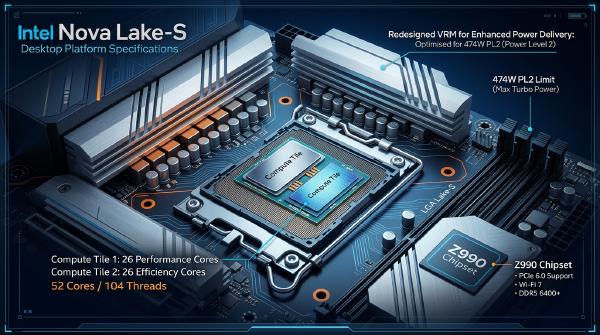
Intel’s next-generation Nova Lake-S desktop processors have reportedly appeared in engineering-sample listings, revealing two configurations with 24 cores and 28 cores.
More notably, the leaked parameter markings appear to indicate AVX-512 support, a feature Intel previously disabled on its hybrid desktop processors because of architectural differences between core types.
The information remains preliminary. Engineering samples are used for internal and partner validation, and their configurations, frequencies, feature sets, and firmware behavior can differ substantially from final retail processors.
Nevertheless, the appearance of these samples provides an early look at Intel’s Nova Lake-S development and raises an important question: could AVX-512 return to Intel’s mainstream desktop platform?
🔎 Nova Lake-S Engineering Samples Surface #
Two Nova Lake-S engineering samples have reportedly appeared with different core configurations.
The leaked samples are identified as:
- 24-core configuration
- 28-core configuration
The available information also contains parameter markings associated with AVX-512.
However, these should not yet be interpreted as confirmed retail specifications.
Engineering samples are not final products #
Engineering samples exist primarily to validate processor designs and the surrounding platform.
Intel and its partners can use them to test:
- CPU core functionality
- Motherboard compatibility
- Firmware and microcode
- Memory support
- Power delivery
- Thermal behavior
- Operating frequencies
- System stability
- Instruction-set functionality
Features can be enabled, disabled, or modified throughout this process.
A feature appearing in an engineering-sample database therefore does not guarantee that consumers will receive the same capability.
The same applies to the reported core counts. These configurations could represent early development products, partially disabled dies, or processors targeting specific market segments.
🧬 AVX-512 Could Be the Most Important Detail #
The most interesting part of the leak is not necessarily the number of cores.
It is the apparent AVX-512 designation.
AVX-512 extends Intel’s vector instruction capabilities and can accelerate workloads capable of processing large amounts of data in parallel.
Potential beneficiaries include:
- Scientific computing
- Numerical simulation
- Cryptography
- Media processing
- Signal processing
- Databases
- Machine-learning workloads
- High-performance computing
For workloads optimized around wide vector operations, AVX-512 can deliver substantial performance improvements compared with narrower instruction paths.
Why AVX-512 disappeared from Intel’s hybrid desktops #
Intel previously disabled AVX-512 on hybrid desktop processors because the architecture combined different CPU core types with different instruction-set capabilities.
Supporting AVX-512 consistently across the platform created technical and validation complications.
In particular, Intel’s hybrid architecture combines high-performance cores with efficiency-oriented cores, making feature symmetry an important consideration.
The appearance of AVX-512 markings on Nova Lake-S engineering samples therefore deserves attention.
However, it remains unclear whether the feature is intended for production hardware or simply enabled for development and validation purposes.
The marking does not confirm retail support #
Several explanations remain possible.
The AVX-512 designation could represent:
- A genuine feature planned for specific Nova Lake-S configurations.
- A temporary engineering-mode capability.
- A developer or validation configuration.
- A feature that may eventually be disabled before commercial release.
Only Intel’s final documentation and retail silicon can establish whether AVX-512 will actually be supported.
🧩 24 and 28 Cores Do Not Tell the Whole Performance Story #
The reported core counts may initially appear modest compared with some rumored high-end Nova Lake configurations.
However, core count alone is a poor indicator of processor performance, particularly for Intel’s heterogeneous CPU architectures.
Different core types have different roles #
Hybrid Intel processors can combine multiple types of CPU cores optimized for different workloads.
Performance-oriented cores are designed for demanding latency-sensitive workloads and high single-thread performance.
Efficiency-oriented cores provide additional throughput for heavily multithreaded workloads while targeting a different performance-per-watt profile.
Low-power efficiency cores, where implemented, can further handle background or low-priority workloads.
Consequently, two processors with identical core counts can produce significantly different performance depending on:
- Core architecture
- Core distribution
- Clock frequency
- Cache hierarchy
- Memory latency
- Inter-core communication
- Power limits
- Workload characteristics
A 28-core Nova Lake-S engineering sample therefore cannot be meaningfully compared with another 28-core CPU without understanding its underlying core configuration.
🎮 Core Count Matters Less for Mainstream Gaming #
Gaming performance is another area where simply counting cores can be misleading.
Most games do not scale perfectly across dozens of CPU cores.
Once a processor provides sufficient parallel resources, additional cores may deliver diminishing returns unless the game engine and surrounding workloads can use them efficiently.
For gaming, factors such as:
- Single-thread performance
- IPC
- Boost frequency
- Cache latency
- L3 cache capacity
- Memory latency
- Inter-core communication
- Scheduling efficiency
can have a larger impact on frame rates.
This means a lower-core-count processor with stronger performance cores and better latency characteristics can outperform a processor with more total cores in gaming workloads.
AVX-512 is not a major gaming feature #
AVX-512 is similarly unlikely to transform mainstream gaming performance.
Most game engines do not rely heavily on AVX-512 for their primary rendering workloads.
The instruction set is much more relevant to specialized computational workloads where wide vector processing can directly accelerate the underlying algorithms.
Professional users running scientific, engineering, media, cryptographic, or other heavily vectorized workloads could benefit substantially more than typical gamers.
📊 The Most Important Nova Lake-S Specifications Are Still Missing #
The current leak does not provide enough information to establish the actual performance characteristics of the reported processors.
Several critical specifications remain unknown.
| Specification | Current Status |
|---|---|
| Core count | 24 and 28 cores reported |
| AVX-512 | Markings reported, retail support unconfirmed |
| Clock speeds | Unknown |
| Cache configuration | Unknown |
| Power limits | Unknown |
| Memory support | Not confirmed |
| PCIe configuration | Not confirmed |
| Integrated graphics | Not confirmed |
| Retail segmentation | Unknown |
| Final performance | Unknown |
Without clock speeds, cache details, power limits, and architectural information, benchmark results from these samples would provide limited insight into final retail performance.
Engineering-sample benchmarks can also be heavily influenced by immature firmware, early microcode, incomplete power management, and unoptimized BIOS configurations.
🧪 Engineering Samples Can Change Significantly #
Early CPU leaks often create confusion because engineering hardware can look very different from the products eventually sold to consumers.
Intel may modify:
- Core counts
- Frequency targets
- Voltage curves
- Cache behavior
- Power limits
- Instruction-set support
- Integrated graphics
- Firmware behavior
before mass production.
A sample may also contain disabled or partially functional resources that are unrelated to the final product segmentation.
Therefore, the 24-core and 28-core configurations should be viewed primarily as evidence that these Nova Lake-S configurations exist in some form during development.
They should not yet be treated as confirmation of Intel’s final product stack.
🖥️ Nova Lake’s Desktop Strategy Remains the Bigger Story #
Intel has indicated that its new CPU core architectures associated with Nova Lake will initially reach desktop platforms.
That makes Nova Lake-S particularly important for Intel’s next desktop generation.
The company will need to balance several competing objectives:
- Higher single-thread performance
- Greater multithreaded throughput
- Power efficiency
- Memory performance
- Cache efficiency
- Platform scalability
- AI acceleration
- Competitive gaming performance
The reported AVX-512 capability adds another potential dimension to that strategy, particularly for professional users who rely on vectorized workloads.
Whether Intel intends to make AVX-512 a mainstream feature again, however, remains unclear.
🎯 Nova Lake-S Could Be More Interesting for Workstations Than Gaming #
If AVX-512 ultimately reaches production Nova Lake-S processors, its impact could be strongest outside conventional desktop gaming.
Professional workloads that can efficiently exploit wide vector instructions could see meaningful performance gains.
Scientific simulations, numerical analysis, media processing, cryptography, and specialized AI workloads are much more likely to benefit than typical games.
For gaming systems, the more important Nova Lake variables will likely remain single-thread performance, cache architecture, memory latency, clock behavior, and scheduling efficiency.
This distinction is important because the headline “28 cores with AVX-512” sounds more significant than it may actually be for everyday desktop users.
🧭 Nova Lake-S Remains a Work in Progress #
The leaked 24-core and 28-core Nova Lake-S engineering samples provide an intriguing early glimpse into Intel’s next desktop architecture.
The apparent AVX-512 support is the most noteworthy detail, particularly given Intel’s previous decision to disable the instruction set on hybrid desktop processors.
But engineering samples are not final products.
Until Intel publishes official specifications, the reported core configurations, AVX-512 support, clock speeds, cache hierarchy, power limits, and performance should all be treated as provisional.
The real significance of Nova Lake-S will ultimately depend not on core count alone, but on how Intel combines its different CPU core types, cache architecture, memory subsystem, power management, and instruction-set capabilities.
If AVX-512 survives into production, Nova Lake-S could become particularly interesting for professional compute workloads. For mainstream gaming, however, architectural efficiency and latency will likely matter considerably more than the headline number of CPU cores.