Intel’s 3-Year CPU Roadmap: 14A Process Debuts in Mobile
Recent leaks surrounding Intel’s next three years of CPU development have reignited discussion across the global PC hardware community. The roadmap outlines Intel’s strategy for deploying its 14A manufacturing node, transitioning toward a unified core architecture, and introducing a long-lived desktop socket designed to support multiple generations of upgrades.
After years of manufacturing instability—including repeated 10nm delays and heavy reliance on TSMC outsourcing—Intel’s roadmap now reflects a noticeably more conservative and stability-focused approach. Rather than aggressively chasing headline specifications, the company appears to be prioritizing yield maturity, predictable rollout schedules, and platform longevity.
For consumers planning future desktop or laptop upgrades, these roadmap details provide valuable insight into Intel’s likely direction through 2029.
⚙️ Intel’s 14A Process Will Debut in Mobile Chips #
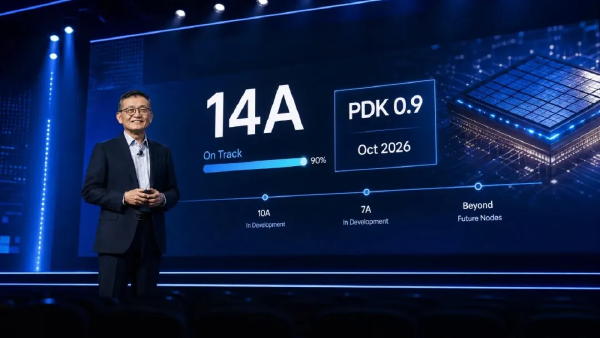
Intel’s 14A process represents one of the company’s most important manufacturing milestones in over a decade.
Recent high-end Intel processors have increasingly depended on TSMC-produced compute dies, while Intel’s internal nodes were used primarily for supporting tiles or lower-tier products. Enthusiasts have long been waiting for Intel Foundry technology to re-enter direct competition at the leading edge.
High-NA EUV and Performance Density #
Intel has publicly stated that the 14A node is designed around High-NA EUV lithography, one of the most advanced semiconductor manufacturing technologies currently available.
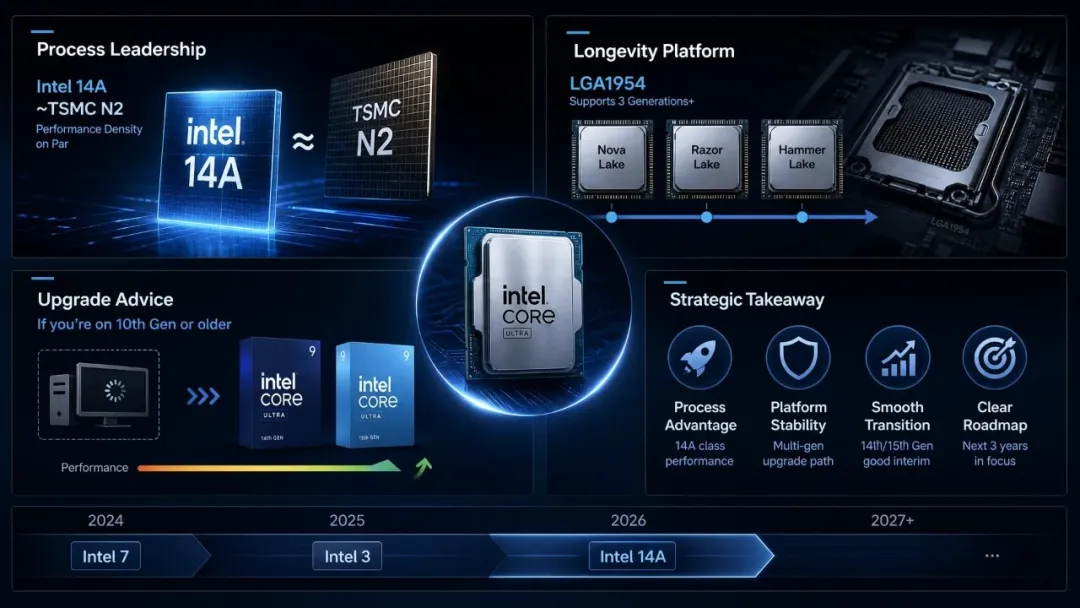
The company claims that 14A’s transistor density and efficiency targets are intended to compete directly with TSMC’s future 2nm-class processes.
Mobile-First Rollout Strategy #
According to the leaked roadmap:
- The first 14A-based product will reportedly be the low-power Razor Lake-UL mobile processor in 2028.
- Desktop adoption will arrive later and remain limited initially.
- Most mainstream desktop Razor Lake chips will still rely heavily on TSMC manufacturing.
This strategy aligns with standard semiconductor industry practice.
Launching new process nodes on smaller mobile SoCs offers several advantages:
- Smaller dies improve early yields
- Lower defect density reduces manufacturing risk
- Validation cycles are shorter
- Production ramp costs are lower
TSMC has long followed the same model by introducing new nodes first in smartphone-class silicon before scaling toward larger desktop and server dies.
Select Desktop Chips Will Use Intel 14A #
While most desktop Razor Lake products are expected to remain outsourced, one rumored desktop SKU stands out:
- Native 8 P-core design
- Massive L3 cache configuration
- Intel-manufactured compute die
- Gaming-oriented positioning
This suggests Intel may initially reserve its in-house 14A production for specialized premium desktop products with strong margin potential.
🧠 Titan Lake and Intel’s Unified Core Architecture #
One of the most significant long-term changes in the roadmap is Intel’s move toward a unified core architecture beginning with the Titan Lake mobile series.
Moving Beyond Traditional Hybrid Design #
Since Alder Lake, Intel’s hybrid architecture has combined:
- Performance (P) cores
- Efficient (E) cores
However, these two core types used fundamentally different architectures, instruction behavior, and scheduling characteristics.
This created ongoing challenges for:
- Operating system schedulers
- Legacy software compatibility
- Thread prioritization
- Gaming consistency
Unified Core Philosophy #
Titan Lake reportedly shifts toward a more AMD-like design philosophy:
- P-cores and E-cores share the same base architecture
- E-cores become scaled-down variants with smaller cache and lower power targets
- Scheduling complexity is dramatically reduced
This design simplifies workload distribution at the hardware level rather than relying heavily on software-level scheduling optimization.
Benefits of Unified Core Design #
Potential advantages include:
| Benefit | Impact |
|---|---|
| Simpler Scheduling | Fewer thread placement issues |
| Better Compatibility | Improved legacy software behavior |
| Lower OS Overhead | Reduced scheduler complexity |
| Improved Efficiency | Better mobile battery life |
| Consistent IPC Behavior | More predictable performance |
For laptops especially, unified cores could substantially improve real-world responsiveness and battery efficiency.
🔌 LGA1954 Socket Brings Long-Term Upgrade Stability #
Intel’s desktop platform strategy also appears to be shifting.
The new LGA1954 socket is reportedly designed to support at least three generations of processors:
- Nova Lake
- Razor Lake
- Hammer Lake
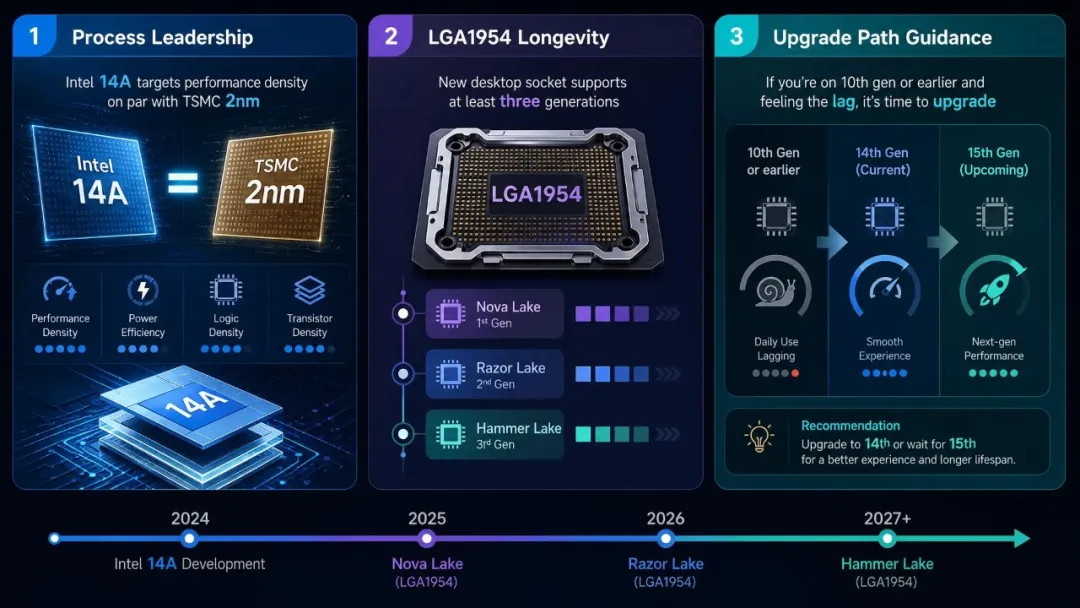
Why This Matters #
Frequent socket changes have frustrated Intel users for years. Previous roadmap adjustments often shortened upgrade paths unexpectedly, forcing users to replace motherboards more frequently than anticipated.
Longer socket support provides several advantages:
- Lower platform upgrade costs
- Better motherboard investment longevity
- Easier CPU-only upgrades
- Improved enthusiast ecosystem stability
For DIY builders and gaming enthusiasts, platform longevity can significantly reduce total system costs over time.
🧵 Hyper-Threading Is Expected to Return #
Another major roadmap detail is the reported return of Hyper-Threading.
Initial Return in Servers #
According to the leak:
- Hyper-Threading returns first in server products by late 2028
- Consumer desktop integration follows with Hammer Lake in 2029
Intel previously reduced emphasis on Hyper-Threading in certain product lines as efficiency-core scaling became a larger focus.
However, the return suggests Intel still sees value in simultaneous multithreading for:
- High parallel workloads
- Productivity applications
- AI acceleration
- Server consolidation
- Content creation
Combined with unified core architecture, Hyper-Threading could re-emerge as a central pillar of Intel’s performance strategy.
💻 What This Means for Consumers #
The roadmap offers several practical upgrade implications depending on current hardware generation.
🎮 Recommendation for 12th and 13th Gen Users #
Users currently running:
- Alder Lake
- Raptor Lake
already possess systems capable of handling:
- Modern gaming
- Productivity workloads
- AI-assisted applications
- Everyday desktop usage
For most users, waiting for Razor Lake in 2027 likely makes more sense than upgrading to transitional intermediate platforms.
✈️ Mobile Users Should Watch Titan Lake Closely #
Laptop users may benefit the most from Intel’s architectural changes.
Titan Lake’s unified cores could deliver:
- Improved battery life
- Better thermal efficiency
- Smoother scheduling behavior
- Enhanced mobile responsiveness
Frequent travelers and mobile professionals should pay particular attention to Titan Lake’s launch window in 2028.
🖥️ Older Platform Users Should Upgrade Earlier #
Users still running:
- 10th Gen Intel
- Older Skylake-derived systems
may not benefit from waiting several more years.
If current systems already show signs of aging:
- Gaming bottlenecks
- Sluggish multitasking
- Weak power efficiency
- DDR4 limitations
then upgrading to current-generation or near-term platforms may provide far more immediate value.
🏭 Intel’s Strategy Has Clearly Changed #
The broader takeaway from this roadmap is not merely about individual CPU products—it reflects a strategic shift inside Intel itself.
Over the past decade, Intel frequently pursued aggressive roadmap promises that ultimately suffered delays due to manufacturing challenges.
The current roadmap instead emphasizes:
- Smaller-scale node validation
- Mobile-first deployment
- Gradual scaling
- Platform stability
- Predictable delivery timelines
This more cautious approach may ultimately prove healthier for both Intel and consumers.
Rather than risking another cycle of major delays chasing theoretical leadership, Intel appears increasingly focused on delivering stable, incremental progress with higher certainty.
If executed successfully, that strategy could help restore confidence across the broader PC hardware ecosystem over the next several years.