
In an era of accelerating digital transformation, data security has become paramount. Broadcom’s Emulex Secure HBA, equipped with Post-Quantum Encryption (PQC), represents a major leap forward in secure storage networking—addressing emerging cyber threats that could undermine current encryption standards.
The Quantum Threat to Classical Encryption #
Quantum computing introduces immense computational power that could render classical encryption methods like RSA and ECC obsolete.
These algorithms, fundamental to Public Key Infrastructure (PKI), rely on mathematical problems such as integer factorization and discrete logarithms—tasks that quantum algorithms like Shor’s could solve efficiently once practical quantum computers arrive.
While large-scale quantum computers remain in development, their potential has already triggered global efforts to prepare for the post-quantum era.
What Is Post-Quantum Cryptography (PQC)? #
Post-Quantum Cryptography is built on mathematical problems believed to be resistant to quantum attacks—such as lattice-based or hash-based systems.
The goal: to ensure data confidentiality and integrity, even in a world where quantum decryption becomes feasible.
Broadcom’s Emulex Secure HBA integrates PQC algorithms at the hardware level, positioning it as a first-mover in quantum-safe storage networking.
Encryption Algorithm Compliance #
Emulex Secure HBA encryption algorithms comply with:
- U.S. CNSA 2.0 – Mandates PQC algorithms for national systems by 2025.
- EU DORA and NIS2 – Require Zero Trust and quantum-safe encryption in critical infrastructure.
- Industry Standards – Supports financial, healthcare, and government sectors under new cybersecurity mandates.
This global compliance readiness ensures that enterprises meet regional regulatory standards without additional complexity.
Addressing the Weakness in Traditional SAN Security #
Traditional Fibre Channel (FC) Storage Area Networks rely on FC-SP encryption (e.g., AES-GCM), which protects against classical but not quantum attacks.
Worse, unencrypted data paths—such as between HBAs and switches—remain exploitable.
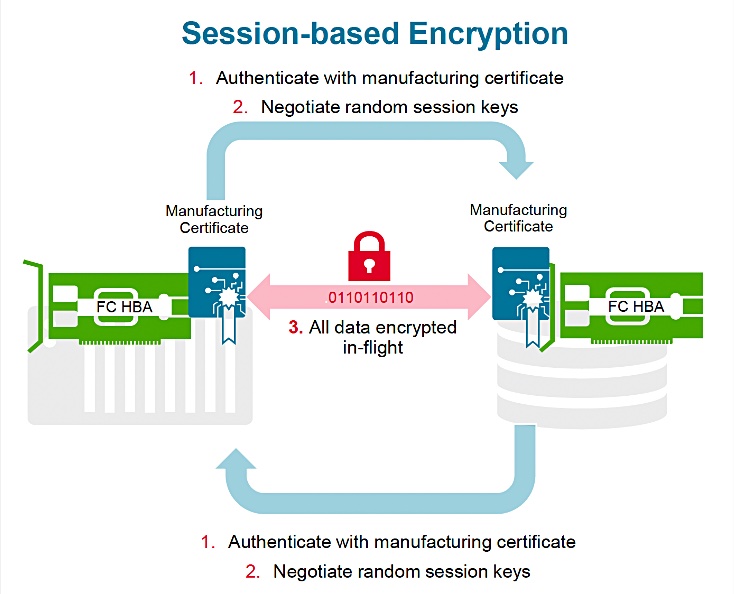
Broadcom’s Emulex Secure HBA closes this gap with end-to-end encryption, extending protection from the host to the storage array.
Key Feature: Zero Trust Architecture #
The HBA implements Zero Trust principles through hardware-enforced authentication and isolation:
- SPDM (Security Protocol and Data Model): Enables mutual device authentication and trust assessment.
- Silicon Root of Trust: Validates firmware integrity during boot-up, preventing tampering.
- Secure Boot & T10-DIF: Protects against firmware and storage data integrity attacks.
Unlike legacy network models, Zero Trust assumes no implicit trust—requiring continuous identity verification and authorization.
Hardware Acceleration and PQC Integration #
- Lattice/Hash-Based Algorithms: Includes CRYSTALS-Kyber, standardized by NIST for post-quantum protection.
- Hardware Acceleration: Custom ASICs/FPGAs handle encryption workloads, maintaining 32G/64G FC throughput.
- Full Path Coverage: Protects the entire I/O path—not just switch-to-switch links.
This design achieves quantum resistance without performance loss.
Seamless Integration and Management #
Broadcom prioritizes backward compatibility and ease of deployment:
- Drop-in replacement for existing HBAs—no SAN redesign needed.
- Dynamic, session-based key management integrated with VMware, Kubernetes, and enterprise orchestration platforms.
- Transparent encryption preserves deduplication and compression, optimizing both security and efficiency.
Compliance with NIST SP 800-193 ensures firmware security and system integrity from boot to runtime.
Market Comparison #
| Vendor/Solution | Encryption Scope | Quantum Resistance | Zero Trust Support | Performance Impact |
|---|---|---|---|---|
| Broadcom Emulex Secure | HBA-to-Storage End-to-End | PQC Algorithms Supported | SPDM + Silicon Root of Trust | Hardware Offload, No Loss |
| Cisco MDS 9000 | Inter-Switch (FC-SP Only) | Not Supported | Partial Authentication | CPU Dependent, Reduced Throughput |
| Marvell QLogic | Endpoint Encryption | Not Supported | Hardware Root of Trust | Partial Hardware Acceleration |
Differentiators #
- Broadcom integrates PQC and Zero Trust directly into HBA silicon.
- Cisco lacks PQC support and depends on additional encryption gateways.
- Marvell offers limited endpoint encryption without quantum resistance.
Business and Regulatory Implications #
Corporate Procurement Priorities #
- Regulatory Compliance: Enterprises in finance and defense must adopt CNSA 2.0/NIS2-compliant HBAs by 2025.
- Lower TCO: Hardware encryption reduces software licensing and operational overhead.
Supply Chain Assurance #
- Silicon Root of Trust boosts supply chain transparency.
- Mitigates geopolitical risks tied to chip origin and firmware integrity.
Technology Outlook and Challenges #
Technical Hurdles #
- Algorithm Evolution: PQC standards continue to mature, raising potential backward compatibility issues.
- Key Lifecycle Management: Large-scale SANs require new automation tools for secure key orchestration.
Global Policy and Ecosystem Trends #
- Export controls on PQC tech may lead to regional cryptographic ecosystems.
- The EU encourages open-source collaboration through DORA and related frameworks.
Long-Term Developments #
- Quantum Security as a Service (QSaaS): Cloud-based PQC HBA offerings.
- Convergence of Compute and Storage: Integration with DPUs for real-time encrypted analytics.
Conclusion: A Quantum Leap for Data Security #
The Broadcom Emulex Secure HBA redefines data protection at the hardware layer, moving from passive defense to proactive quantum resistance.
By merging Post-Quantum Cryptography with Zero Trust, Broadcom delivers a secure, standards-compliant, and performance-optimized storage solution.
This advancement not only strengthens enterprise resilience today but sets the foundation for quantum-era data center security, where control over hardware-level encryption standards could shape the next generation of global IT infrastructure.