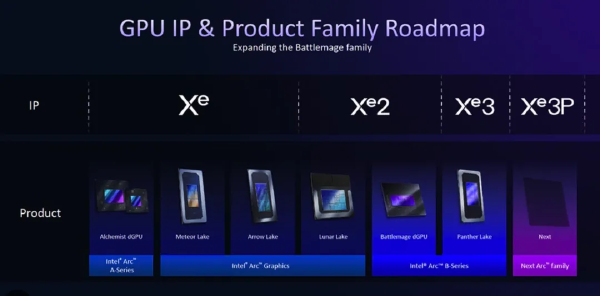
Intel Crescent Island: Xe3P GPU Architecture and AI Upgrades
Intel has disclosed additional architectural details about its next-generation data center GPU, codenamed Crescent Island, at Hot Chips 2026. Built on the Xe3P architecture, the accelerator is designed primarily for AI inference workloads, particularly long-context and highly concurrent inference for large language models (LLMs) and agentic AI systems.
Unlike many high-end AI accelerators that rely on high-power configurations and liquid-cooled infrastructure, Crescent Island takes a different approach. The GPU is designed as a 350W air-cooled PCIe card, enabling deployment in conventional enterprise servers without requiring specialized cooling systems or data center power retrofits.
Its most distinctive characteristic is memory capacity. Intel’s native-branded boards provide 160 GB of LPDDR5X, while ODM configurations can scale to 480 GB. Combined with Xe3P’s expanded local storage, larger register files, upgraded XMX matrix engines, and full-rate FP64 capability, Crescent Island targets a broader workload envelope than a conventional inference-only accelerator.
The underlying strategy is straightforward: provide enterprises with substantially more inference capacity and memory while minimizing the infrastructure changes required to deploy it.
🧭 Crescent Island Targets the Inference Layer #
Intel is positioning Crescent Island as a dedicated inference node within a broader compute architecture for agentic AI.
As AI systems evolve from single-turn interactions toward persistent agents, inference requirements are changing. Models increasingly need to maintain long contexts, serve many concurrent requests, process multiple agents simultaneously, and support increasingly complex reasoning workflows.
These workloads can place significant pressure on accelerator memory capacity.
A GPU may have sufficient compute throughput yet still struggle with workloads whose model weights, key-value caches, intermediate data, or concurrent sessions exceed available memory. For these scenarios, additional memory capacity can be more valuable than simply increasing peak compute performance.
Crescent Island therefore emphasizes three characteristics:
- High memory capacity for large models and long-context workloads
- Conventional PCIe deployment for easier enterprise integration
- AI-oriented compute enhancements for low-precision inference
The result is a product designed less as a universal accelerator and more as a targeted inference platform within Intel’s larger AI infrastructure strategy.
💾 Up to 480 GB of LPDDR5X Memory #
Memory is arguably Crescent Island’s most unusual feature.
Intel’s native-branded boards are specified with 160 GB of LPDDR5X, while ODM designs can scale to as much as 480 GB.
That capacity places Crescent Island among the highest-capacity AI accelerators disclosed in its class that do not rely on HBM.
| Feature | Crescent Island |
|---|---|
| Architecture | Xe3P |
| Form factor | PCIe accelerator |
| Board power | 350W |
| Cooling | Air-cooled |
| Native memory | 160 GB LPDDR5X |
| ODM memory | Up to 480 GB LPDDR5X |
| Xe cores | 32 |
| Unified L2 cache | 32 MB |
| Per-Xe-core L1/SLM | 512 KB |
| Register file per Xe core | 1 MB |
| Matrix engine | XMX |
| Low-precision formats | FP8, FP4, MXFP4 |
| FP64 | Full-rate |
The capacity advantage could be particularly relevant for LLM inference.
Large language models can consume substantial memory not only for model parameters but also for runtime state such as KV caches. As context windows expand and the number of simultaneous inference sessions increases, memory capacity can become a limiting factor even when raw compute resources remain available.
However, capacity alone does not determine inference performance.
Intel has not yet publicly disclosed the complete memory subsystem specifications, including final memory bandwidth figures. Consequently, the practical balance between capacity, bandwidth, latency, and compute throughput remains to be established through workload testing.
This distinction is important. A large memory pool can enable larger models or more concurrent sessions, but inference performance still depends on how efficiently the accelerator can move data through that memory hierarchy.
🧱 Xe3P Architecture Upgrades #
Crescent Island is based on Xe3P, an evolution of Intel’s Xe architecture that introduces several changes specifically relevant to AI and data center workloads.
Xe Core and Cache Configuration #
The GPU integrates 32 Xe cores connected to a 32 MB unified L2 cache.
Compared with Xe3, Intel has also expanded the local memory resources available to each Xe core.
Per-Xe-core L1/shared local memory capacity increases from 384 KB to 512 KB, while the register file doubles to 1 MB.
These changes provide more on-chip storage for working data and intermediate results, potentially reducing pressure on external memory for suitable workloads.
The larger register file is particularly relevant to highly parallel compute kernels, where additional registers can help retain intermediate values close to the execution units and reduce unnecessary data movement.
XMX Matrix Engine #
The XMX matrix engine receives a substantial architectural update.
Its systolic array depth increases to 16, compared with 4 in Xe3, representing a significant expansion of the matrix-processing structure.
Crescent Island also introduces native support for low-precision formats including:
- FP8
- FP4
- MXFP4
These formats are increasingly important for AI inference because lower numerical precision can substantially increase computational efficiency and reduce memory traffic when model accuracy remains within acceptable limits.
For inference workloads, the combination of larger XMX resources and low-precision support is intended to improve the amount of useful AI computation delivered per unit of power.
🔬 Full-Rate FP64 Expands the Workload Envelope #
Crescent Island also retains full-rate FP64 floating-point capability.
This is an unusual characteristic for an accelerator primarily positioned around AI inference.
Modern AI inference workloads generally emphasize lower-precision formats such as FP8 and FP4 because neural-network operations can tolerate reduced numerical precision in many scenarios. Scientific computing and traditional HPC workloads, by contrast, often depend on double-precision FP64 calculations.
Full-rate FP64 therefore gives Crescent Island a second workload dimension beyond AI.
Potential applications include:
- Scientific simulations
- Numerical computing
- HPC workloads
- Engineering applications
- Mixed AI/HPC environments
This does not necessarily mean Crescent Island is intended to compete directly with every dedicated HPC accelerator. Rather, FP64 support gives enterprises additional flexibility and allows the hardware to address workloads that would otherwise require a different accelerator class.
The result is a product architecture that combines aggressive low-precision AI capabilities with unusually strong traditional floating-point support.
🖥️ 350W PCIe Design Simplifies Deployment #
Crescent Island’s physical design is central to its product positioning.
At 350W, the accelerator is designed for conventional air cooling and standard PCIe server integration.
This contrasts with high-end AI platforms that can require substantially higher rack power densities, specialized thermal solutions, or liquid cooling infrastructure.
For enterprises, the deployment implications can be significant.
A conventional PCIe accelerator can potentially be installed into existing server infrastructure without redesigning the entire data center around the accelerator. This reduces the infrastructure barrier associated with expanding AI inference capacity.
The design is therefore optimized not only around silicon performance but also around deployment accessibility.
For organizations that need additional inference capacity but cannot easily retrofit liquid cooling or high-density power infrastructure, this can be an important differentiator.
🤖 Role in Intel’s Agentic AI Architecture #
Crescent Island does not operate as an isolated product in Intel’s roadmap.
Intel is positioning it as one layer within a broader architecture for agentic AI:
| Platform | Primary Role |
|---|---|
| Diamond Rapids Xeon | High-performance orchestration and CPU compute |
| Crescent Island | Data center AI inference and acceleration |
| Wildcat Lake | Client and edge AI workloads |
This division reflects the increasingly heterogeneous nature of AI systems.
Agentic workloads can require multiple types of compute simultaneously. CPUs may handle orchestration, scheduling, operating-system services, and general-purpose processing, while accelerators execute computationally intensive model inference.
At the edge, client SoCs can provide local intelligence where latency, privacy, connectivity, or power constraints prevent workloads from being sent to the cloud.
Crescent Island therefore fills the middle layer: high-capacity, data center inference without the infrastructure requirements of the highest-power accelerator systems.
⚡ Capacity, Efficiency, and Deployment Convenience #
Intel’s Crescent Island strategy differs from an approach based exclusively on maximizing peak compute throughput.
Instead, the platform emphasizes a combination of:
- Large memory capacity
- Low-precision AI acceleration
- Moderate power consumption
- Standard PCIe deployment
- Air cooling
- Broad numerical-format support
This combination makes the accelerator particularly interesting for inference.
Training workloads often justify extremely high-end accelerator configurations because training performance directly affects model-development cycles. Inference economics are different.
Once a model enters production, operators care about metrics such as:
- Cost per token
- Tokens per second
- Requests per second
- Concurrent sessions
- Memory utilization
- Power efficiency
- Infrastructure cost
- Deployment density
A platform that can accommodate larger models or more concurrent contexts within a conventional server may therefore be competitive even without matching the peak compute throughput of the most powerful accelerator platforms.
🧪 Performance Remains to Be Validated #
Despite the architectural improvements, several important questions remain unanswered.
Intel has not yet disclosed the complete memory bandwidth characteristics of Crescent Island, which makes it difficult to predict how effectively the accelerator can utilize its large LPDDR5X capacity.
This matters because AI inference can be either compute-bound or memory-bound depending on the model, batch size, context length, quantization strategy, and serving architecture.
For example, a large-memory configuration may be highly advantageous for long-context inference but deliver less benefit for workloads that are already limited by matrix compute throughput.
Similarly, support for FP4, FP8, and MXFP4 establishes the hardware capability, but software support determines how easily developers can exploit those formats in production.
Important validation areas will therefore include:
- LLM tokens-per-second performance
- Long-context inference throughput
- Multi-user concurrency
- KV-cache efficiency
- FP4/FP8 utilization
- Memory bandwidth efficiency
- Power efficiency
- Software stack maturity
- Framework and model compatibility
Until these results are available, Crescent Island’s architectural specifications provide a useful indication of its intended workload profile but not a definitive measure of competitive performance.
🌐 Software and Ecosystem Will Determine Adoption #
Hardware specifications are only one part of an AI accelerator’s value proposition.
Crescent Island’s success will depend heavily on Intel’s software ecosystem, including compiler support, runtime integration, inference frameworks, optimized kernels, model libraries, and deployment tooling.
This is particularly important for agentic AI.
Agentic workloads typically combine multiple software layers, including model inference, orchestration, retrieval, tool execution, networking, memory management, and application-level logic. The accelerator therefore needs to integrate smoothly into heterogeneous software pipelines rather than operating as an isolated compute device.
Compatibility with widely used AI frameworks and efficient support for quantized models will be especially important if Intel wants Crescent Island to become a practical alternative for enterprise inference deployments.
🚀 Crescent Island’s Strategic Position #
Crescent Island represents a different interpretation of what an AI accelerator should optimize.
Rather than targeting maximum performance through extreme power consumption and specialized infrastructure, Intel is emphasizing memory capacity, inference efficiency, numerical flexibility, and deployment simplicity.
Its Xe3P architecture introduces larger per-core local storage, expanded register capacity, deeper XMX matrix engines, and native low-precision formats. The 350W PCIe form factor further allows the accelerator to fit into existing air-cooled server environments.
The combination of up to 480 GB of LPDDR5X and full-rate FP64 also gives Crescent Island a workload profile that extends beyond conventional low-precision inference.
However, the platform’s ultimate position remains unresolved. Intel has not yet announced a formal market launch schedule, complete memory specifications, pricing, or comprehensive performance results.
Those factors will determine whether Crescent Island can translate its architectural advantages into meaningful enterprise adoption.
For now, its design signals a clear strategic direction: as AI inference becomes more memory-intensive and increasingly distributed across enterprise infrastructure, large memory capacity and deployment practicality can be as important as raw accelerator compute.
Crescent Island is Intel’s attempt to exploit that opportunity with a Xe3P-based inference accelerator that can enter existing data centers without requiring them to be rebuilt around the hardware.