NVIDIA Vera Rubin Sets a Record for AI Data Center Ramp
NVIDIA’s next-generation Vera Rubin platform is entering commercial deployment at a pace rarely seen in the data center industry. According to NVIDIA’s Q2 FY2027 financial disclosures, the platform has begun commercial shipments and is expected to generate approximately $20 billion in revenue during Q3 FY2027.
That figure would represent roughly 20% of NVIDIA’s data center revenue for the quarter, making Vera Rubin the fastest-ramping data center product in NVIDIA’s history.
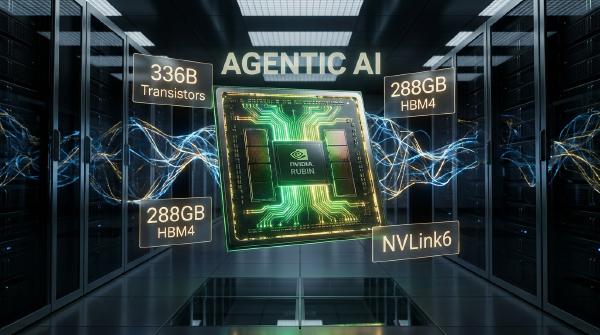
The scale of the initial deployment is particularly significant because Vera Rubin is not a conventional GPU launch. It is a complete rack-scale AI computing and networking platform spanning CPUs, GPUs, DPUs, NVLink infrastructure, and associated system components.
NVIDIA’s ability to secure orders from major hyperscalers, AI cloud providers, and system OEMs before the platform reaches full production scale demonstrates the unusually strong demand for next-generation AI infrastructure.
📊 $20 Billion in Revenue in a Single Quarter #
During its Q2 FY2027 earnings call, NVIDIA provided Q3 guidance of approximately $108 billion in total revenue, plus or minus 2%, excluding data center compute revenue from China.
Within that outlook, Vera Rubin is expected to contribute approximately $20 billion, equivalent to around one-fifth of the company’s data center business for the quarter.
This is an exceptional ramp profile for a newly introduced data center platform.
Traditional enterprise and hyperscale infrastructure platforms typically require multiple quarters to transition from initial deployments to substantial revenue contribution. Vera Rubin is instead moving from early-stage shipments to a revenue contribution measured in tens of billions of dollars within a single quarter.
NVIDIA CFO Colette Kress also stated that the company had received purchase orders from major hyperscale cloud providers, AI cloud service providers, and system OEMs.
The combination of strong pre-deployment demand and rapid manufacturing expansion gives Vera Rubin an unusually aggressive launch trajectory.
🧩 Vera Rubin Is a Complete Data Center Platform #
Vera Rubin should not be viewed simply as NVIDIA’s next GPU generation.
The platform represents a broader compute and networking architecture designed for large-scale AI infrastructure. Its major components include:
- Vera CPUs for host and general-purpose compute workloads
- Rubin GPUs for accelerated AI and HPC workloads
- BlueField-4 DPUs for data processing and infrastructure offload
- NVLink 6 switches for high-bandwidth GPU interconnect
- NVL72 rack-scale systems integrating the compute and networking components
- MGX-based systems enabling different configurations around the platform architecture
This system-level approach is increasingly important as AI workloads scale beyond individual accelerators.
Training and inference clusters require high-bandwidth communication between large numbers of GPUs, efficient CPU-GPU coordination, network acceleration, storage connectivity, and infrastructure-level workload management.
Consequently, the competitive unit is shifting from an individual accelerator toward the entire AI data center platform.
🏭 Production Expansion and First Commercial Shipments #
NVIDIA began expanding production capacity for Vera Rubin platform components during the spring of 2026.
The first commercial shipments of the VR200 NVL72 rack-scale systems began in August, marking the transition from product development and qualification toward actual customer deployment.
Microsoft became the first customer to deploy the commercial system.
The significance of the NVL72 architecture lies in its rack-scale design. Instead of treating each GPU server as an independent unit, the system integrates a large number of accelerators into a tightly interconnected compute domain.
This approach is particularly suited to large AI workloads where model parallelism and distributed computation place extreme demands on accelerator-to-accelerator bandwidth and latency.
The result is a platform optimized not merely for individual GPU performance, but for cluster-level AI throughput.
⚡ Why Vera Rubin’s Ramp Is So Fast #
The most notable aspect of the Vera Rubin launch is not simply its revenue scale, but the speed at which that revenue is expected to materialize.
A conventional platform ramp generally follows a sequence such as:
- Product development
- Customer qualification
- Initial system deployments
- Manufacturing expansion
- Broader hyperscaler adoption
- Large-scale production
Vera Rubin is compressing this timeline substantially.
Moving from negligible or early-stage revenue in the previous fiscal period to approximately $20 billion in quarterly sales represents a dramatic acceleration.
Several factors help explain the ramp.
Hyperscaler Demand #
Major cloud providers are aggressively expanding AI infrastructure to support increasingly large training and inference workloads. These customers can absorb large numbers of systems immediately once a platform reaches production readiness.
Platform-Level Integration #
Because Vera Rubin encompasses CPUs, GPUs, networking, and rack-scale systems, NVIDIA can capture more of the infrastructure value associated with each deployment rather than relying exclusively on individual accelerator sales.
High-Value AI Systems #
Large AI racks have exceptionally high average selling prices. A relatively small number of rack-scale systems can therefore translate into billions of dollars in quarterly revenue.
Existing NVIDIA Ecosystem #
Customers already operating large NVIDIA-based AI clusters have established software stacks, deployment processes, networking architectures, and engineering expertise around NVIDIA’s ecosystem.
This reduces the friction associated with adopting another generation of NVIDIA infrastructure.
🔢 Estimating Vera Rubin Shipment Volumes #
NVIDIA has not publicly disclosed exact Vera Rubin unit shipment figures corresponding to the Q3 FY2027 revenue outlook.
A rough baseline can nevertheless be constructed using the projected revenue contribution and estimated pricing for VR200 NVL72 rack-scale systems.
Assuming an estimated $5 million to $7.8 million per rack, approximately $20 billion in quarterly revenue would correspond to roughly:
| Metric | Estimated Range |
|---|---|
| Vera Rubin revenue | ~$20 billion |
| Estimated NVL72 price | $5M–$7.8M per rack |
| Implied NVL72 shipments | ~2,550–3,975 racks |
| Vera CPUs | ~91,700–143,100 |
| Rubin GPUs | ~183,500–286,100 |
These figures should be treated as illustrative estimates rather than NVIDIA-reported shipment numbers.
The calculation assumes that the entire $20 billion revenue contribution comes from VR200 NVL72 rack-scale systems, which is not the actual structure of NVIDIA’s business.
📦 Actual Component Shipments Could Be Much Higher #
The rack-based calculation establishes only a baseline.
NVIDIA also sells Vera CPUs, Rubin GPUs, and MGX-based systems as individual components or configurable platforms. Therefore, not every Vera Rubin-related sale will appear as a complete NVL72 rack.
As a result, actual shipment volumes for individual CPUs, GPUs, and other platform components could substantially exceed the baseline calculated from rack-scale systems alone.
The important point is that AI infrastructure economics do not require enormous unit volumes to generate very large revenue.
For example, at multi-million-dollar system ASPs, several thousand rack-scale deployments can represent tens of billions of dollars in sales. This is fundamentally different from consumer electronics, where billions of relatively inexpensive units may be required to produce comparable revenue.
🌐 Orders Across the AI Infrastructure Ecosystem #
Another important indicator of Vera Rubin’s ramp is the breadth of its customer base.
NVIDIA has indicated that it has received purchase orders from:
- Major hyperscale cloud providers
- AI-focused cloud service providers
- System OEMs
This broad customer coverage reduces reliance on any single buyer and indicates that demand is distributed across multiple segments of the AI infrastructure market.
Hyperscalers can deploy Vera Rubin internally to support their own AI services, while AI cloud providers can expose the infrastructure directly to customers through GPU and accelerator rental services.
System OEMs, meanwhile, can integrate Vera Rubin components into customized enterprise and data center configurations.
Together, these channels provide multiple routes for the platform to scale.
🔭 From GPU Products to AI Factory Platforms #
Vera Rubin illustrates a broader change in NVIDIA’s strategy.
The company is increasingly positioning its products as complete AI factory infrastructure, rather than simply selling increasingly powerful GPUs.
At the accelerator level, performance depends on compute throughput, memory bandwidth, and power efficiency. At cluster scale, however, overall performance is also determined by interconnect bandwidth, networking, CPU coordination, data movement, software optimization, and system-level efficiency.
This makes components such as NVLink, DPUs, CPUs, and rack-scale architectures strategically important.
The value proposition therefore shifts from:
“How fast is the GPU?”
to:
“How much useful AI computation can the entire infrastructure deliver?”
That distinction becomes increasingly important as models grow larger and inference workloads become more distributed.
🚀 Vera Rubin’s Ramp Signals a New AI Infrastructure Cycle #
Vera Rubin’s projected Q3 FY2027 contribution of approximately $20 billion represents more than a strong product launch. It demonstrates how rapidly AI infrastructure demand is translating into purchases of complete computing platforms.
With commercial VR200 NVL72 shipments underway, major hyperscalers and AI cloud providers placing orders, and NVIDIA expanding production capacity across the platform, Vera Rubin is entering the market with an unusually large installed-demand pipeline.
The exact number of systems shipped will depend on the mix of rack-scale deployments, standalone components, and MGX-based configurations. Nevertheless, even conservative rack-level calculations imply thousands of high-value AI systems and hundreds of thousands of core compute components.
The bigger story is the changing economics of AI infrastructure.
As AI models become larger, inference becomes more pervasive, and data centers evolve into dedicated AI factories, customers increasingly need tightly integrated compute, networking, and acceleration platforms rather than standalone processors.
Vera Rubin is designed around precisely this requirement.
If NVIDIA’s Q3 guidance is achieved, Vera Rubin will not merely become another generation of AI hardware. It will establish a new benchmark for how quickly a large-scale data center computing platform can transition from launch to tens of billions of dollars in quarterly revenue.