Intel Nova Lake Targets Biggest Desktop CPU Launch Yet
Intel is positioning its upcoming Nova Lake desktop processors as a major reset for its consumer CPU strategy, with the company confirming that the next-generation CPU core architecture will debut on desktop before reaching data center products.
The strategy contrasts with AMD’s decision to introduce its Zen 6 architecture through data center EPYC processors before bringing the architecture to consumer desktop platforms. According to Intel Vice President and General Manager of Enthusiast Channel Business Robert Hallock, Intel intends to take the opposite approach with Nova Lake.
The desktop-first strategy comes at a pivotal moment for the PC industry. AI infrastructure is reshaping semiconductor demand, production priorities, and product segmentation, while rising component costs are creating an increasingly pronounced divide between mainstream and enthusiast hardware.
Intel is now signaling that Nova Lake will be central to its effort to rebuild desktop momentum and restore confidence among gamers and enthusiasts.
🚀 Nova Lake Will Debut on Desktop First #
Hallock confirmed that Intel’s next CPU core architecture is scheduled to arrive on desktop first, before expanding into data center products.
The announcement is strategically significant because AMD has increasingly prioritized data center processors as demand for high-performance compute and AI infrastructure continues to grow. AMD’s Zen 6 architecture is debuting with EPYC “Venice” processors, while consumer desktop implementations are expected later.
Intel’s approach gives desktop users earlier access to its newest CPU architecture. For enthusiasts, that could mean Nova Lake becomes an important test of whether Intel can deliver a meaningful generational improvement after the mixed reception of its recent desktop platforms.
Hallock also indicated that Intel has a desktop product roadmap extending through 2030, with four successive generations of gamer- and desktop-focused processors already in development.
🧭 Intel Looks to Rebuild Desktop Momentum #
Nova Lake arrives after a difficult period for Intel’s desktop business.
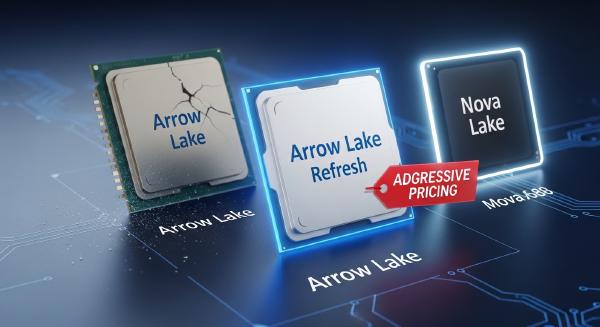
Arrow Lake received a relatively lukewarm response from gamers, particularly because its gaming performance did not consistently surpass the previous-generation Raptor Lake platform. That created skepticism around Intel’s ability to regain leadership in enthusiast desktop CPUs.
Intel has attempted to address those concerns through Arrow Lake Refresh, including processors such as the Core Ultra 5 250K Plus and Core Ultra 7 270K Plus.
According to Hallock, the refresh was developed by a substantially reorganized team covering product management, marketing, and business leadership. The same organizational structure is expected to guide Nova Lake.
That continuity could be important because Intel is not simply treating Nova Lake as another incremental product cycle. The company is presenting it as a major architectural and strategic milestone for its desktop business.
💰 Rising Costs Could Split the PC Market #
Nova Lake’s technical ambitions are arriving alongside increasing pressure on PC component pricing.
Hallock described the current PC market as increasingly bifurcated. Enthusiast and high-end buyers with sufficient purchasing power are better positioned to absorb rising costs, while mainstream and entry-level consumers face significantly greater affordability constraints.
This dynamic could influence how Intel structures its future desktop product stack.
A high-end platform can accommodate more expensive silicon, advanced packaging, larger caches, and higher-end platform features, while mainstream systems require aggressive cost optimization to remain accessible.
Hallock expects this division to become increasingly common throughout the industry, with vendors potentially maintaining separate high-end and mainstream sockets rather than attempting to serve the entire market through a single platform.
🧩 Nova Lake Could Introduce a Two-Socket Desktop Strategy #
For Intel, this market polarization could result in a clearer separation between mainstream and enthusiast platforms.
Current reports associate mainstream systems with the existing LGA 1700 ecosystem, while next-generation high-end Nova Lake processors are rumored to use an LGA 1954 socket.
LGA 1954 has also been linked to several unconfirmed Nova Lake features, including bLLC, reportedly Intel’s approach to increasing large cache capacity in a manner comparable in concept to AMD’s 3D V-Cache technology.
Rumors have additionally suggested flagship Nova Lake configurations could reach as many as 52 cores. These specifications remain unconfirmed, however, and should not be treated as final product specifications until Intel publishes official technical documentation.
The broader socket strategy reflects the economics of modern CPU development. Maintaining separate platform tiers allows manufacturers to optimize mainstream products for cost while reserving more advanced technologies and platform capabilities for higher-margin enthusiast systems.
🐧 Linux Logs Indicate Nova Lake-S Is Already Booting #
Recent Linux kernel logs provide additional evidence that Nova Lake-S engineering hardware has progressed beyond early silicon development.
The logs reportedly identify two engineering platforms:
bat-nvls-1bat-nvls-2
Both platforms were associated with BIOS builds compiled in July 2026 and reportedly achieved successful system boots.
The reported engineering samples include different CPU configurations. bat-nvls-1 is identified with 24 cores and 24 threads at a 3.4 GHz base clock, while bat-nvls-2 reportedly contains 28 cores and 28 threads with a 3.2 GHz base clock.
Instruction Set Support #
The Linux logs also reportedly expose XSAVE-related feature flags associated with AVX-512 and APX register states.
Support visible at the engineering-sample level is useful for confirming architectural capabilities, although firmware and silicon configurations can change before retail production.
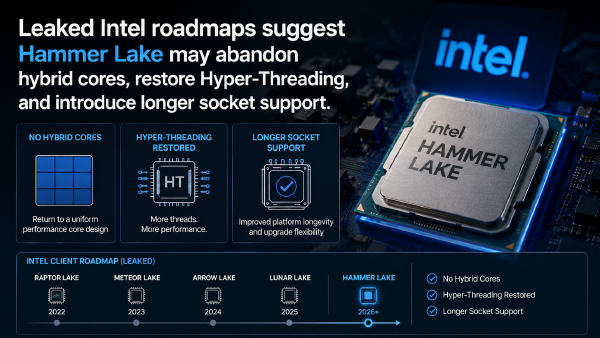
The reported 1:1 core-to-thread configurations are also noteworthy. They could indicate that native Hyper-Threading is no longer enabled, although early engineering BIOS configurations can disable features that are present in the underlying silicon.
Consequently, the current logs are not sufficient to establish whether Nova Lake will ship without Hyper-Threading in retail desktop processors.
What the Boot Milestone Means #
Successful operating-system boots on engineering samples indicate that Nova Lake-S silicon has reached a relatively mature validation stage.
Historically, desktop processor silicon power-on can occur many months before commercial availability. A typical development cycle may place engineering-sample validation roughly 12–18 months ahead of a retail launch, although actual schedules vary substantially by product and manufacturing status.
🎮 Intel Is Also Expanding Into Gaming Handhelds #
Intel’s next-generation strategy extends beyond conventional desktop systems.
The company is reportedly preparing a Panther Lake processor specifically targeting gaming handhelds. The proposed SoC uses a “4+0+4” CPU configuration consisting of four Performance cores, no standard Efficient cores, and four Low-Power Efficient cores.
The processor is also expected to integrate four Xe3 GPU cores, producing an eight-core CPU configuration paired with a relatively compact integrated graphics subsystem.
This chip would reportedly sit below Intel’s higher-end Arc G3 and G3 Extreme handheld processors, providing a lower-cost option for gaming devices.
The move reflects a broader industry trend toward highly specialized client silicon. Rather than designing one architecture around desktop PCs alone, Intel is increasingly expected to optimize different configurations for enthusiast desktops, mainstream systems, AI PCs, and power-constrained gaming devices.
🔬 Nova Lake Represents a High-Stakes Desktop Reset #
Intel’s desktop-first strategy for Nova Lake is more than a response to AMD’s Zen 6 launch strategy. It represents an attempt to reestablish the desktop platform as a priority at a time when the semiconductor industry is increasingly driven by AI and data center demand.
The combination of a new CPU architecture, potential high-end platform segmentation, engineering-sample Linux boots, and a multi-generation desktop roadmap suggests Intel is preparing for a substantial transition.
The challenge will be execution. Intel must deliver meaningful gaming and application performance improvements while controlling platform costs in a market where mainstream buyers are increasingly price-sensitive.
If Nova Lake meets Intel’s expectations, the platform could mark a significant return to form for the company’s enthusiast desktop business. If costs rise faster than performance, however, the same market polarization Intel has identified could leave the most advanced Nova Lake configurations increasingly accessible only to high-end buyers.