Intel May Drop Hybrid CPUs as Hammer Lake Restores Hyper-Threading
A newly leaked Intel CPU roadmap suggests the company may be preparing for one of the most significant architectural shifts in its modern processor history.
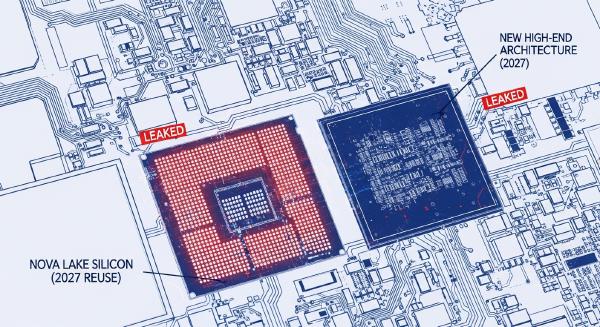
According to information shared by prominent hardware leaker Moore’s Law Is Dead (MLID), Intel is reportedly planning to gradually phase out its hybrid core architecture in favor of a unified core design. The future Hammer Lake series is also rumored to restore Hyper-Threading technology while introducing longer platform lifespan support through the shared LGA 1954 socket.
If accurate, these changes would represent a major strategic adjustment aimed at improving software compatibility, simplifying thread scheduling, and reducing upgrade costs for PC users.
As of now, the information remains unofficial and has not been confirmed by Intel.
🧩 Intel’s Hybrid Core Era May Be Approaching Its End #
Intel first introduced its hybrid architecture in 2021, combining:
- Performance cores (P-cores)
- Efficiency cores (E-cores)
The design significantly improved multi-core performance and power efficiency, particularly in heavily threaded workloads. However, it also introduced scheduling complexity due to the coexistence of fundamentally different core types.
Over the past several generations, users and developers have frequently reported compatibility issues involving:
- Older games failing to properly recognize E-cores
- Frame rate inconsistencies
- Professional software instability
- Uneven thread allocation
- Manual E-core disabling for optimal performance
These problems became especially noticeable in latency-sensitive workloads such as gaming, real-time rendering, and professional content creation.
According to the leaked roadmap, Intel now appears ready to transition away from this approach.
Titan Lake as a Transitional Platform #
The leak claims Intel will first deploy a unified-core architecture through a mobile-focused platform called Titan Lake.
Titan Lake is reportedly intended as a validation platform for Intel’s next-generation unified core strategy and may remain exclusive to mobile devices during its initial rollout.
The desktop market, meanwhile, would later adopt the architecture through the upcoming Hammer Lake lineup.
⚙️ Hammer Lake May Restore Hyper-Threading #
One of the most notable claims in the leak is the reported return of Hyper-Threading, Intel’s simultaneous multithreading technology that was reduced or removed in several recent product generations.
Hammer Lake is expected to use second-generation Thunder Hawk unified cores while reintroducing Hyper-Threading support across the platform.
According to the leak, Intel’s unified-core strategy will involve two variants:
- A performance-focused version
- A high-density version optimized for die area efficiency
Importantly, both variants would reportedly share the same underlying microarchitecture. This differs significantly from the current hybrid approach, where P-cores and E-cores are architecturally distinct.
Why Unified Cores Matter #
A unified-core design could potentially resolve many of the scheduling conflicts that emerged with hybrid CPUs.
Potential advantages include:
- More predictable thread allocation
- Improved software compatibility
- Reduced scheduler overhead
- Consistent gaming performance
- Simplified optimization for developers
For desktop systems, the leak claims mainstream processors such as future Core Ultra 3 and Core Ultra 5 models may completely eliminate traditional E-cores in favor of performance-oriented unified cores.
The return of Hyper-Threading would also improve:
- Multitasking efficiency
- Content creation workloads
- Parallel processing performance
- Productivity applications
This combination could allow Intel to maintain strong multi-threaded throughput without relying on mixed-core configurations.
💻 Mobile CPUs May Still Use High-Density Variants #
While desktop products may fully transition to performance-focused unified cores, Intel’s mobile lineup is reportedly expected to retain high-density unified cores for efficiency purposes.
This approach would allow Intel to balance:
- Battery life
- Thermal constraints
- Multi-core scalability
- Thin-and-light laptop design requirements
The leak also suggests that certain high-end mobile configurations could integrate NVIDIA RTX chiplets, potentially enabling advanced ray tracing and discrete-GPU-class graphics performance in thinner laptop designs.
If implemented successfully, this strategy could allow Intel to differentiate desktop and mobile platforms without maintaining separate underlying CPU architectures.
🔌 Longer Socket Lifespan Could Reduce Upgrade Costs #
Another major detail from the leak involves platform compatibility.
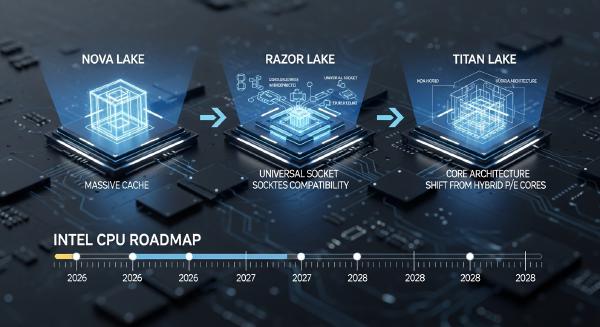
According to the disclosed roadmap, three CPU generations:
- Nova Lake
- Razor Lake
- Hammer Lake
may all share the LGA 1954 desktop socket.
This would represent a significant departure from Intel’s historically shorter socket lifecycles.
A Longstanding Pain Point for Intel Users #
For years, Intel users have frequently faced situations where upgrading to a new CPU generation also required replacing the motherboard.
This increased overall upgrade costs and often shortened the practical lifespan of premium motherboards.
A shared multi-generation socket could offer several advantages:
- Lower upgrade expenses
- Longer motherboard usability
- Improved platform stability
- Greater ecosystem consistency
- Better long-term value for enthusiasts
For desktop builders and gamers, extended socket compatibility is often viewed as a major platform advantage.
🚀 Strategic Implications for Intel #
If these leaks prove accurate, Intel’s architectural transition may signal a broader reassessment of the hybrid-core strategy introduced during the Alder Lake era.
Rather than prioritizing maximum heterogeneous scaling, Intel may now be focusing more heavily on:
- Software compatibility
- Scheduler simplicity
- Gaming consistency
- Platform longevity
- Cost efficiency
At the same time, the move could also reflect changing competitive pressures in the CPU market, particularly as workloads become increasingly sensitive to latency consistency and software optimization quality.
The rumored return of Hyper-Threading further suggests Intel may believe traditional multithreading approaches remain highly valuable alongside advances in AI acceleration and heterogeneous computing.
🛠️ Final Specifications Remain Unconfirmed #
Despite the growing attention surrounding the leak, all current information remains unofficial.
Intel has not formally confirmed:
- Hammer Lake specifications
- Core counts
- Launch timelines
- Pricing
- Socket support details
- Hyper-Threading implementation plans
As with all roadmap leaks, specifications may change substantially before release.
For users planning future PC builds or upgrades, the rumored transition toward unified cores and longer socket support could make upcoming Intel platforms particularly worth monitoring, especially for gaming and productivity-focused systems where scheduling consistency and platform longevity remain important considerations.