NVIDIA RTX Spark PCs Launch: Local AI, Blackwell Graphics, and Windows Development
NVIDIA RTX Spark PCs are now available, introducing a new category of Windows computers designed to combine high-performance graphics, local AI inference, creative workloads, and modern software development in portable and compact systems.
Announced by NVIDIA, the new platform integrates NVIDIA Blackwell RTX graphics technology, an NVIDIA Grace CPU, and a unified memory architecture with configurations offering up to 128 GB of memory. Developed in collaboration with major PC manufacturers, these systems target developers, AI engineers, content creators, and power users who need substantial computing resources without relying exclusively on cloud infrastructure.
The initial product lineup spans premium laptops and compact desktop systems from ASUS, Dell, Lenovo, Microsoft, and MSI, with additional ecosystem partners contributing to the broader platform.
🚀 RTX Spark: A New Architecture for Windows PCs #
RTX Spark combines CPU and GPU capabilities in a tightly integrated system designed to support demanding AI and graphics workloads. Rather than treating local AI as an occasional accelerator task, the platform is intended to make AI inference and agent-based workflows practical on everyday Windows computers.
Blackwell RTX Graphics and Grace CPU Integration #
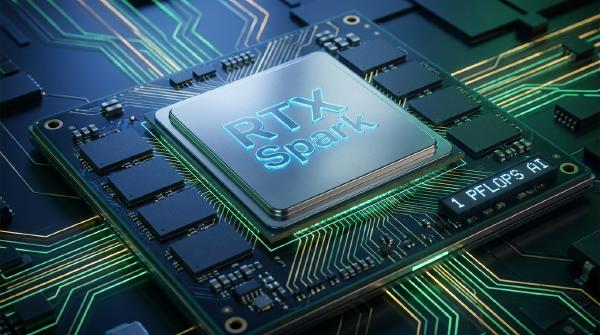
The platform combines NVIDIA Blackwell RTX graphics technology with an NVIDIA Grace CPU to provide compute capabilities for AI inference, graphics processing, and parallel workloads.
Key platform characteristics include:
- Blackwell RTX GPU architecture: Accelerates AI inference, graphics rendering, and GPU-compute workloads.
- NVIDIA Grace CPU: Provides the host processing capabilities required for operating systems, applications, and development environments.
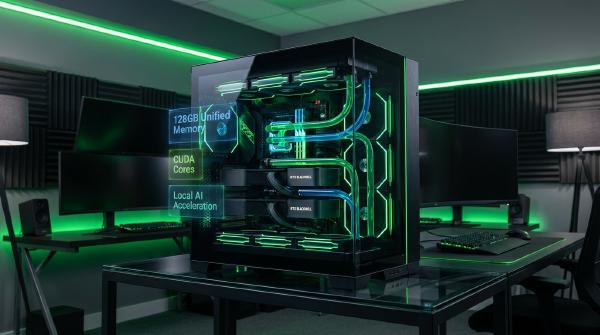
- Unified memory architecture: Allows the CPU and GPU to access a shared memory pool, reducing the need to maintain separate CPU and GPU memory allocations.
- Up to 128 GB of unified memory: Enables workloads that require substantial model weights, context, intermediate tensors, and application data to reside in memory.
- NVIDIA software ecosystem: Connects the hardware to CUDA, AI development frameworks, graphics technologies, and application-level acceleration.
The platform is designed to deliver up to 1 petaflop of AI performance using FP4 precision. This figure describes low-precision AI computation rather than general-purpose CPU performance or conventional gaming throughput.
Actual performance depends on the processor configuration, model architecture, numerical precision, memory requirements, thermal limits, and application-level optimization.
Why Unified Memory Matters for Local AI #
Memory capacity is a critical constraint when running large language models and other generative AI workloads locally.
Model weights consume memory according to parameter count and numerical precision. Additional capacity is required for the KV cache, runtime buffers, intermediate activations, and concurrent applications.
A unified memory pool of up to 128 GB can make larger local models and more complex AI workflows practical than on systems with smaller memory budgets. It can also reduce the overhead associated with moving data between separate CPU and GPU memory pools.
However, unified memory does not eliminate bandwidth constraints, guarantee that every model will fit, or make all workloads faster. Developers still need to consider quantization, context length, batch size, inference engines, and memory bandwidth when selecting a model and optimizing deployment.
🤖 Local AI Agents and On-Device Inference #
RTX Spark PCs are designed to support a growing range of AI applications that can execute directly on the device.
Local execution is particularly valuable for developers building AI agents, coding assistants, retrieval-augmented generation (RAG) systems, and other applications that benefit from access to local files, private datasets, or persistent workflows.
Running AI Models Without Constant Cloud Dependence #
With sufficient unified memory and GPU acceleration, RTX Spark systems can support local inference workloads that would otherwise require a dedicated workstation or remote GPU infrastructure.
Potential applications include:
- Running compatible large language models locally.
- Developing and testing AI agents that interact with desktop applications.
- Building retrieval pipelines over local documents and code repositories.
- Prototyping AI-powered development tools.
- Experimenting with model quantization and inference optimization.
- Evaluating application behavior before deploying models to production infrastructure.
Local inference can reduce dependence on external API availability, network connectivity, and usage-based cloud inference costs. It can also improve data locality when applications process sensitive information.
Nevertheless, local execution does not automatically guarantee privacy or security. Applications still need appropriate access controls, secure model handling, and safeguards for tools that can read files or execute actions.
Agentic Workflows on Windows #
AI agents increasingly require more than a single model invocation. They may need to interpret instructions, plan tasks, call tools, retrieve context, and perform multiple operations before producing a result.
RTX Spark PCs provide a hardware foundation for experimenting with these workflows locally. Developers can investigate how model size, inference latency, context capacity, and tool execution affect the reliability and responsiveness of an agent.
For engineering teams, this creates opportunities to prototype AI-assisted development environments and desktop automation systems without making cloud inference a mandatory part of every development iteration.
🎨 Creative Applications and GPU-Accelerated Workloads #
Creative professionals can benefit from the combination of Blackwell RTX graphics, high memory capacity, and local AI acceleration.
Image generation, video processing, 3D rendering, compositing, and other demanding creative workflows can require significant GPU resources and large working datasets. A unified memory architecture can be particularly useful when applications need to keep substantial assets and intermediate data accessible to the CPU and GPU.
AI-Assisted Content Creation #
Compatible creative applications can use GPU acceleration and AI models for tasks such as image manipulation, intelligent selection, media enhancement, and generative editing.
Local processing can also help creators experiment with AI-assisted workflows while keeping source assets on their own systems.
The practical benefits depend on application support, available plugins, driver compatibility, and whether individual features are optimized for the RTX Spark platform.
High-Resolution Media and 3D Production #
High-resolution video, complex scenes, and large creative projects can impose substantial memory and compute requirements.
Systems offering up to 128 GB of unified memory provide additional capacity for workflows that combine large assets, GPU processing, and AI-assisted operations.
Developers and technical artists should still evaluate sustained GPU performance, storage throughput, display characteristics, and application-specific benchmarks rather than relying on peak AI throughput alone.
💻 Development Tools and the NVIDIA Software Ecosystem #
RTX Spark PCs also target software engineers who want to develop AI applications and GPU-accelerated software directly on Windows.
The combination of local compute resources and NVIDIA’s software ecosystem creates opportunities to build, profile, and test applications without immediately moving development workloads to a remote GPU server.
CUDA and GPU Computing #
CUDA provides a programming and execution ecosystem for GPU-accelerated applications. Developers can use compatible CUDA libraries and frameworks to build applications involving numerical computing, machine learning, image processing, and other parallel workloads.
For RTX Spark development, the relevant considerations include supported software versions, framework compatibility, available GPU features, and the execution environment provided by the platform.
Developers should verify the supported toolchain and deployment requirements before adopting existing CUDA workloads. Software compatibility should not be assumed solely because a system incorporates NVIDIA graphics technology.
Local AI Development and Prototyping #
A capable local AI development system can shorten iteration cycles by allowing engineers to run models, inspect outputs, profile inference, and experiment with application logic on their own hardware.
Typical workflows include:
- Evaluating model quantization and memory consumption.
- Testing local inference servers and application integrations.
- Developing RAG applications and embedding pipelines.
- Benchmarking model latency and throughput.
- Integrating AI features into desktop applications.
- Testing agent orchestration and tool-calling behavior.
For developers working with open-source models, local execution can also simplify reproducibility by keeping model artifacts, configuration files, and test datasets within a controlled development environment.
Windows on Arm Considerations #
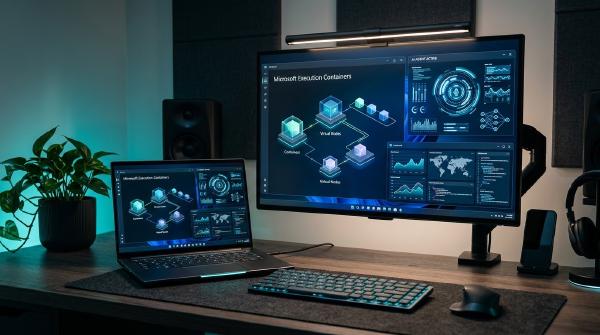
The RTX Spark platform introduces an important hardware and software combination for Windows PCs. Developers should distinguish native Arm64 applications from applications running through compatibility layers.
Performance and compatibility can differ depending on whether an application, dependency, driver, or development tool has native Arm64 support.
Teams migrating existing Windows software should validate their compiler toolchains, third-party dependencies, GPU libraries, installers, and runtime behavior on the target configuration.
🎮 Gaming and Real-Time Graphics #
RTX Spark PCs also target users who want a combination of AI capabilities and modern gaming performance in a single system.
NVIDIA’s graphics ecosystem provides technologies for rendering, image reconstruction, and other GPU-accelerated graphics workloads. The platform is intended to bring these capabilities to systems that also support local AI development and productivity applications.
Gaming Performance and Graphics Technologies #
Gaming performance depends on several factors, including GPU configuration, rendering resolution, graphics settings, game-engine behavior, memory bandwidth, and thermal limits.
NVIDIA graphics technologies can improve the experience in supported titles, but performance should be assessed using application-specific benchmarks rather than AI performance figures alone.
Developers working with real-time rendering can also use compatible GPU capabilities to investigate graphics pipelines, rendering optimization, and AI-assisted graphics techniques.
Balancing Gaming, Development, and AI #
The main appeal of RTX Spark is its potential to consolidate several demanding workloads within one system.
A compatible configuration may serve as a development machine during the day, a local AI experimentation environment for model testing, and a gaming system outside working hours.
The balance between these workloads depends on the particular device, memory configuration, cooling design, and supported software stack.
🖥️ RTX Spark PC Lineup and Availability #
NVIDIA RTX Spark systems are entering the market through a range of PC manufacturers, with configurations aimed at creative professionals, developers, and premium Windows PC users.
The initial ecosystem includes products from ASUS, Dell, Lenovo, Microsoft, and MSI, alongside additional manufacturers participating in the wider platform.
Initial Hardware Partners #
The announced product families include:
- ASUS ProArt: Creator-focused systems designed for demanding graphics, media production, and AI-assisted creative workflows.
- Dell XPS: Premium systems targeting users who need a combination of portability, high-end displays, and compute performance.
- Lenovo Yoga Pro: Performance-oriented systems for creative and productivity workloads.
- Microsoft Surface: Premium Windows devices that integrate RTX Spark capabilities into Microsoft’s hardware and software ecosystem.
- MSI Prestige: Systems aimed at professional productivity, creative work, and AI-assisted applications.
The exact processor configuration, memory capacity, storage, display, and availability vary by product.
Availability and Configuration Considerations #
NVIDIA announced that RTX Spark PCs would become available through participating manufacturers beginning October 16, 2026.
Buyers should check each manufacturer’s official product listings for current availability, regional pricing, configuration options, and shipping dates. Product availability and specifications may differ between markets.
Before purchasing, developers and technical users should evaluate the following factors:
| Consideration | Why It Matters |
|---|---|
| Unified memory capacity | Determines how much model data and application state can remain in memory. |
| CPU and GPU configuration | Influences application performance, parallel processing, and supported workloads. |
| Software compatibility | Determines whether existing development tools and applications run as intended. |
| Thermal design | Affects sustained performance during long inference, rendering, or compilation sessions. |
| Storage capacity and speed | Matters when working with large models, datasets, media assets, and development environments. |
| Display and portability | Important for mobile developers and creative professionals. |
| Price and regional availability | Determines the value of a configuration for a specific workload and market. |
For AI development, memory capacity and software compatibility may be more important than peak performance figures alone. For creative production, display quality, sustained GPU throughput, and storage can be equally important.
🔍 What RTX Spark Means for the Windows PC Ecosystem #
RTX Spark represents a broader shift toward Windows PCs that combine traditional computing, GPU acceleration, and local AI execution.
For developers, the ability to experiment with models and AI applications on a personal workstation can reduce friction during prototyping and testing. For creative professionals, it offers another approach to combining graphics-intensive applications with AI-assisted production. For power users, it creates a platform that can support several types of demanding workloads without requiring separate machines for every task.
The platform’s long-term value will depend on more than hardware specifications. Software ecosystem maturity, Arm64 compatibility, framework support, driver quality, application optimization, and real-world performance will determine how effectively these systems fit into existing workflows.
With Blackwell RTX graphics, an NVIDIA Grace CPU, and configurations offering up to 128 GB of unified memory, RTX Spark PCs establish a new option for users who want local AI capabilities integrated into a modern Windows computing environment.