NVIDIA RTX Spark PCs Launch: Blackwell Graphics and Local AI
NVIDIA has announced the market availability of its RTX Spark PC lineup, introducing a new category of Windows computers designed to combine high-performance graphics, accelerated computing, and local artificial intelligence. Developed with ASUS, Dell, Lenovo, Microsoft, and MSI, these systems integrate NVIDIA’s Blackwell RTX graphics architecture, CUDA software ecosystem, and AI acceleration into portable computing platforms.
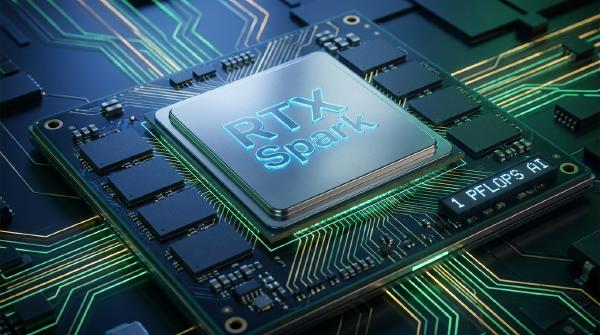
With up to 128 GB of unified memory and a claimed peak AI performance of up to 1 petaflop in FP4 precision, RTX Spark PCs target developers, content creators, and gamers who need substantial local computing resources without relying exclusively on cloud infrastructure.
The platform is designed to support demanding creative workloads, local large language models (LLMs), autonomous AI agents, and modern games within a familiar Windows environment. By combining hardware acceleration with software integrations across development and creative applications, NVIDIA aims to transform the PC from a conventional productivity device into a platform for persistent, locally executed AI workflows.
“NVIDIA RTX Spark” is the product designation used in the announcement. Its specifications, architectural details, and product availability should be evaluated against the corresponding manufacturers’ official documentation as individual configurations become available.
🚀 A New Architecture for Windows PCs #
RTX Spark brings NVIDIA’s accelerated computing capabilities to a new generation of portable Windows systems.
Blackwell RTX Graphics and Grace CPU Integration #
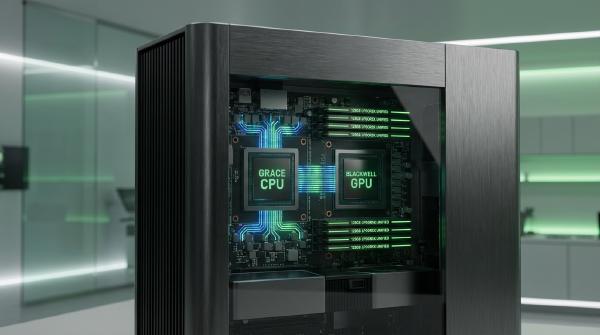
According to the announcement, the platform combines an NVIDIA Blackwell RTX GPU with an NVIDIA Grace CPU in a unified-memory architecture. MediaTek collaborated with NVIDIA on the custom CPU design, with an emphasis on power efficiency, performance, and connectivity.
Key platform specifications include:
- Unified memory: Up to 128 GB shared across supported computing workloads.
- AI performance: Up to 1 petaflop of peak FP4 AI performance, as claimed by NVIDIA.
- Graphics acceleration: Blackwell RTX technology for rendering, gaming, and GPU-accelerated applications.
- AI software support: CUDA, TensorRT, and related NVIDIA development frameworks.
- Portable design: Thin system configurations intended for mobile productivity and creative work.
Unified memory can reduce the need to transfer data between separate CPU and GPU memory pools. This is particularly relevant to local AI inference, large creative projects, and workloads that process substantial datasets.
However, unified memory capacity alone does not determine application performance. Memory bandwidth, GPU compute resources, thermal limits, model architecture, and software optimization remain important factors.
NVIDIA’s Accelerated Computing Ecosystem #
RTX Spark integrates multiple technologies from NVIDIA’s graphics and computing platforms, including:
- CUDA for general-purpose GPU computing.
- DLSS for supported gaming and rendering workloads.
- OptiX for GPU-accelerated ray tracing.
- Reflex for reducing system latency in supported games.
- G-SYNC for compatible display synchronization.
- TensorRT for optimized AI inference.
- Hardware-accelerated video processing for supported media workflows.
NVIDIA claims that RTX Spark can deliver up to 9 times the gaming performance and up to 11 times the AI image-generation speed of the Windows system-on-chip platforms used as its comparison baseline. The announcement also describes support for AI agents using models with up to 125 billion parameters.
These figures depend on the specific comparison systems, software configurations, and workloads. They should not be interpreted as universal performance gains across all applications.
🤖 From Productivity Tool to Local AI Partner #
A central objective of RTX Spark is to make local AI agents practical for everyday computing. Instead of treating AI as a separate cloud service, the platform is designed to let agents interact with local applications, files, development tools, and creative workflows.
Simplified AI Agent Deployment #
The announcement identifies several AI agent and assistant platforms that users can install through guided setup processes and convenient installers, including:
- GitHub Copilot
- Hermes Agent
- OpenClaw
- Perplexity
- Pi
- WorkBuddy
These integrations aim to reduce the configuration work traditionally associated with running local models and agent frameworks. Users can access AI-assisted coding, research, content generation, and task automation without necessarily configuring every component through the command line.
Actual availability and compatibility may vary by application version, hardware configuration, and supported model runtime.
Local Models and Agent Orchestration #
NVIDIA is extending the ecosystem with models and tools intended for local execution. The announcement highlights Nemotron 3.5 Bolt 74B-A9B, described as a 74-billion-parameter model with a 9-billion-parameter active configuration and a reported 24 GB deployment target, optimized for tool calling and multistep tasks.
The model’s practical memory requirements and supported configurations depend on numerical precision, quantization, runtime overhead, and inference settings. The model’s total parameter count should not be confused with its active parameter count or its actual memory footprint.
Local execution can offer several advantages:
- Reduced dependence on cloud inference services.
- Greater control over sensitive files and locally processed context.
- Lower network latency for workloads that remain on-device.
- More predictable costs when tasks would otherwise incur usage-based inference charges.
- Greater flexibility for customizing models and agent workflows.
Local execution does not automatically guarantee complete privacy. Applications may still communicate with external services, synchronize data, or transmit telemetry depending on their configuration.
Agent Security and Creative Tool Integration #
NVIDIA OpenShell Secure Runtime and Microsoft Execution Containers are presented as mechanisms for controlling agent permissions and execution environments. NVIDIA Skills provides another integration layer, allowing compatible agents to interact with selected NVIDIA tools and libraries.
Potential workflows include controlling NVIDIA Broadcast effects during a live stream, processing recorded video clips, and interacting with Omniverse libraries.
NVIDIA PAIR also extends the platform’s role beyond a single computer by enabling compatible Windows, Linux, and macOS systems on a home network to access AI inference services hosted by an RTX Spark system.
These capabilities position the PC as a potential local AI server as well as a workstation. Their security and performance characteristics will depend on network configuration, application permissions, and the supported inference stack.
🎨 Accelerated Content Creation and Media Production #
RTX Spark targets creative workloads that benefit from GPU acceleration, substantial memory capacity, and efficient video processing.
The announcement identifies use cases such as editing 8K 4:2:2 footage and rendering large 3D scenes with asset sizes of up to 90 GB. Actual feasibility depends on codec support, memory allocation, application optimization, and project complexity.
Adobe Creative Cloud Acceleration #
Adobe is introducing NVIDIA TensorRT acceleration for selected AI-powered editing features across Photoshop, Premiere, and Substance 3D.
For Premiere, GPU acceleration is intended to improve demanding post-production operations, including playback, rendering, visual effects, and color grading. Photoshop and Premiere are expected to offer native support in beta at launch, with Substance integration following afterward.
The value of these integrations extends beyond raw GPU throughput. Optimized AI inference can reduce processing time for supported effects and improve responsiveness when creative applications repeatedly invoke AI models.
Developers and production teams should distinguish between features accelerated locally by the RTX hardware and features that still depend on external services or application-specific requirements.
Support for Additional Creative Applications #
The announced ecosystem includes several applications covering different production workflows:
- CapCut Pro: Video editing.
- Bilibili Live Companion: Live-streaming workflows.
- D5 Lite: Design and visualization.
- Filmora: Hardware-accelerated editing and exporting, with support announced for the end of the launch month.
Availability may differ across operating systems, application editions, and regional releases.
NVIDIA Broadcast and RTX Video #
NVIDIA Broadcast 2.3 adds capabilities for processing existing recordings, including background-noise removal and vocal-effect adjustments using supported audio presets.
The RTX Video beta is described as supporting up to 4K super-resolution and 4x multi-frame generation. In ComfyUI, new RTX Video nodes are intended to upscale AI-generated video from 15 frames per second to 60 FPS and convert supported content to HDR.
These features can help creators improve video quality without relying entirely on paid cloud inference. Results will depend on the source footage, supported models, processing settings, and hardware resources.
💻 A Unified Platform for Coding, Testing, and Deployment #
AI-assisted software development is increasingly shifting from manually writing every line of code toward directing agents that generate, modify, test, and review software. These workflows can require local development environments, cloud-hosted models, and virtual machines for testing.
RTX Spark aims to consolidate more of this work on a single device.
Native CUDA and Local Development #
Native CUDA support is a central part of the platform’s developer proposition. Running supported models and agents locally allows developers to keep code and contextual data on their own systems when their chosen tools do not require external services.
The resulting development workflow can combine:
- Local AI inference and code generation.
- GPU-accelerated testing and prototyping.
- Windows-based application development.
- Linux-compatible tooling through Windows Subsystem for Linux.
- Deployment to NVIDIA RTX AI PCs and cloud NVIDIA GPUs.
NVIDIA states that applications developed on the platform can be deployed across more than 150 million NVIDIA RTX AI PCs and compatible cloud GPUs. Actual portability depends on the application’s dependencies, GPU requirements, driver support, and deployment environment.
Windows on Arm Development Toolchain #
NVIDIA and Microsoft have announced development components targeting Windows on Arm, including a PyTorch-CUDA build, a Python build configured to run natively by default, and a native Conda installer.
The announcement states that the Python package ecosystem supports 97% of the 15,000 most commonly used Python packages. This figure should be understood as a reported compatibility metric rather than a guarantee that every package works in every configuration.
For developers, native execution can reduce the overhead associated with emulation and improve compatibility with platform-specific tooling. Nevertheless, projects using native extensions, custom GPU kernels, or architecture-specific dependencies may require additional porting and validation.
NVIDIA Skills for CUDA-X Development #
NVIDIA Skills is described as an open-source GitHub repository that teaches compatible AI agents how to use NVIDIA CUDA-X tools and libraries.
The objective is to help developers create GPU-accelerated applications without requiring them to memorize every API or implementation detail. Agent-generated code still requires review, profiling, correctness testing, and security validation, especially when it interacts with low-level GPU operations.
For teams exploring AI-assisted development, this approach may help connect code-generation agents with domain-specific GPU libraries and established NVIDIA software workflows.
🎮 Gaming on a Portable AI PC #
RTX Spark is also positioned as a gaming platform, combining Blackwell RTX graphics with NVIDIA’s established gaming technologies.
The launch announcement identifies support for titles including:
- Arknights: Endfield
- Cyberpunk 2077
- Genshin Impact
- Gears of War: E-Day
- Fortnite
- Marvel Rivals
- Neverness to Everness
- NARAKA: BLADEPOINT
- NBA 2K27
- Where Winds Meet
- Wuthering Waves
The broader lineup is described as supporting hundreds of games at launch. Compatibility and performance will vary with the specific title, graphics settings, resolution, drivers, and hardware configuration.
DLSS, Ray Tracing, and Frame Responsiveness #
NVIDIA’s gaming ecosystem combines several technologies with different purposes:
- DLSS: Uses supported AI-based rendering techniques to improve image quality or performance.
- Ray tracing: Simulates light transport to improve lighting, reflections, and shadows.
- G-SYNC: Synchronizes supported displays with GPU output to reduce tearing.
- Reflex: Reduces system latency in supported gaming configurations.
The announcement highlights NBA 2K27 as an example of advanced neural rendering, describing DLSS 5 as a 3D-guided neural-network rendering technology designed to improve lighting and texture details.
NVIDIA also claims that its new AI model runs twice as fast and can increase DLSS 5 frame rates by up to 1.4 times. These results are specific to the stated technology and test conditions and should not be generalized to every game.
For thin laptops and compact systems, sustained gaming performance will also depend on cooling capacity, power limits, and the balance between CPU and GPU workloads.
🛒 RTX Spark PC Lineup and Availability #
According to the announcement, RTX Spark systems are available globally through the official websites of ASUS, Dell, Lenovo, Microsoft, and MSI, as well as participating retailers. The stated starting price is RMB 18,999, with prices and configurations varying by market.
The announced product lineup includes:
| Manufacturer | Product |
|---|---|
| ASUS | ProArt Studiobook 16 RTX Spark |
| ASUS | ProArt Studiobook 14 RTX Spark |
| Dell | XPS 16 |
| Lenovo | YOGA Pro 15 RTX Spark |
| Microsoft | Surface Laptop Ultra |
| MSI | Prestige N16 Flip AI + 2026 |
Buyers should verify the final product names, regional availability, hardware specifications, and pricing directly with manufacturers. A shared platform designation does not necessarily mean that every model offers identical memory capacity, GPU power limits, display characteristics, or AI performance.
For additional technical context, see the NVIDIA developer platform and Windows on Arm development resources.
🔍 Conclusion: The Convergence of AI, Graphics, and Local Computing #
NVIDIA RTX Spark represents an attempt to bring AI inference, GPU-accelerated development, professional content creation, and gaming together within a portable Windows computing platform.
Its most significant proposition is the combination of substantial unified memory, NVIDIA’s accelerated computing software stack, and local AI execution. For developers, this could simplify experimentation with models and agents while keeping more workloads close to the development environment. For creators, GPU acceleration and local AI tools could shorten production workflows. For gamers, RTX technologies provide a familiar path toward improved rendering quality and responsiveness.
The broader impact will depend on real-world performance, software maturity, compatibility, thermal efficiency, and pricing across individual products. Unified memory and peak AI throughput are important specifications, but they are only part of the evaluation.
If NVIDIA and its PC partners deliver consistent software support and sustainable performance within portable power limits, RTX Spark could help establish a more capable class of Windows PCs in which AI is an integrated computing resource rather than an exclusively cloud-based service.