Claude 5.1 Released: Anthropic Targets Reasoning, Agents and Science
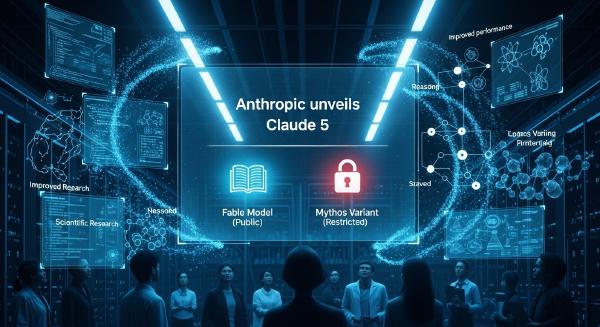
Anthropic has launched its next-generation Claude models, Claude Fable 5.1 and Claude Mythos 5.1, introducing major improvements in complex reasoning, long-running agentic workflows, coding, scientific research, and computational biology.
Anthropic positions Fable 5.1 as one of its most capable publicly available models, while Mythos 5.1 is designed to explore higher capability boundaries under significantly tighter access controls.
The two models share the same underlying model capabilities but differ primarily in their safety configurations and deployment policies.
Fable 5.1 is available to general users, developers, and enterprises. Mythos 5.1, meanwhile, is reserved for vetted individuals and organizations working in higher-risk domains.
The distinction highlights an increasingly important direction in AI deployment: the most capable models may not necessarily be exposed to every user through the same product or with identical restrictions.
Anthropic says the new models deliver substantial gains across reasoning, software engineering, computer use, business workflows, scientific research, and autonomous agent tasks.
Perhaps more importantly, Fable 5.1 also changes the economics of long-context AI workloads. While its standard input and output prices remain unchanged, its cache-read price has been reduced by 75%, potentially lowering total costs by around 25% for typical workloads and up to 45% for highly agentic applications.
🔮 Fable 5.1 Focuses on More Reasoning per Dollar #
Anthropic’s goal with Fable 5.1 is not simply to produce higher benchmark scores.
A central theme is capability at lower reasoning effort.
According to Anthropic’s testing, Fable 5.1 at low-to-medium reasoning settings can approach or exceed the performance that previously required Fable 5 to operate at higher reasoning levels.
This gives developers more flexibility to trade off speed, cost, and output quality depending on the complexity of a task.
Claude Code defaults to high reasoning effort, while Claude Cowork and Claude.ai use medium reasoning by default. Users can adjust these settings according to workload requirements.
Benchmark Gains #
Several benchmarks show substantial improvements over the previous-generation Fable 5:
| Benchmark | Fable 5 | Fable 5.1 | Improvement |
|---|---|---|---|
| Terminal-Bench-Science 0.1 | 24.7% | 52.6% | More than 2× |
| Terminal-Bench 4.0 | — | 55.8% | — |
| AutomationBench | 17.1% | 31.4% | Significant gain |
| CursorBench 3.2.0 | 70.5% | 73.4% | +2.9 points |
On Terminal-Bench 4.0, the unrestricted Mythos 5.1 reportedly reached 60.9%, extending the performance advantage in demanding agentic tasks.
The largest gains are particularly visible in scientific research agents and commercial workflows, suggesting that Anthropic is targeting tasks that require models to interact with tools, inspect large amounts of information, and execute multi-stage processes.
🔬 Fable 5.1 Targets Long-Horizon Problem Solving #
One of the more important changes is the model’s ability to investigate problems over extended periods rather than simply producing an immediate answer.
Anthropic says Fable 5.1 is more willing to trace problems back to their underlying causes, making it better suited to tasks that can take hours or even tens of hours.
Debugging a Four-Year-Old Software Problem #
Investment firm Millennium reportedly encountered an internal software failure that occurred roughly once every million executions.
Engineers had struggled with the issue for four or five years, while previous AI models were unable to identify the root cause.
Fable 5.1 approached the problem differently. It analyzed external vendor libraries, correlated them with core dump information, and eventually identified the underlying bug in a third-party library.
The example illustrates the type of workflow Anthropic wants its latest model to handle: not simply suggesting code fixes, but conducting a prolonged investigation across multiple sources and layers of a software stack.
38 Hours of Continuous Machine Learning Work #
Ramp also reportedly ran Fable 5.1 continuously for approximately 38 hours.
During the process, the model discovered that initial machine-learning results had been corrupted by mislabeled data. It then corrected the issue, launched six groups of parallel experiments, analyzed the resulting data, and produced follow-up recommendations.
This type of workload is closer to autonomous research and engineering than conventional chatbot interaction.
🧬 From Writing Code to Conducting Research #
Anthropic has placed considerable emphasis on scientific applications for both Fable 5.1 and Mythos 5.1.
The company wants these models to move beyond retrieving information and generating code toward a workflow in which AI systems can formulate hypotheses, invoke specialized tools, analyze results, and produce findings suitable for further experimental validation.
Protein Design #
In protein-design experiments, researchers used Mythos 5.1 to invoke open-source protein design and folding tools before sending generated designs to external organizations for experimental validation.
Across three target proteins, binders designed by Mythos 5.1 reportedly achieved binding affinity up to 10× higher than the strongest submissions in Adaptyv Bio’s protein-design competition.
For a broader set of 12 target proteins, the effective-binder hit rate approached 50%, compared with an industry baseline of approximately 10%–15% cited by Anthropic.
Reconstructing a Higher-Resolution Map of Venus #
Fable 5.1 also applied its capabilities to planetary science.
Using radar imagery collected more than three decades ago by NASA’s Magellan spacecraft, the model generated a new high-resolution elevation map covering approximately one-third of Venus’s surface.
The original data provided spatial detail at roughly 10–20 kilometers. The new map improves this to approximately 2–3 kilometers, while increasing height-measurement accuracy by as much as 25%.
Anthropic plans to release the resulting map under a Creative Commons license so that it can potentially support future missions, including NASA’s VERITAS and ESA’s EnVision.
Optimizing Computational Biology #
Mythos 5.1 was also used to write custom GPU kernels and cache intermediate results for seven open-source protein and genomics deep-learning models.
Anthropic reports inference speedups ranging from 1.4× to 2.5×, while maintaining bit-identical outputs.
For certain whole-genome analysis workloads, these optimizations could reduce GPU costs by approximately 30%–60%.
The broader implication is that AI models are increasingly being evaluated not only on whether they can write software, but on whether they can optimize and operate complex scientific computing pipelines.
💰 Cache Read Prices Drop 75% #
Performance is only one part of the Fable 5.1 release. Anthropic is also making a significant change to the economics of long-running AI workloads.
Fable 5.1 retains the same standard pricing of:
- $10 per million input tokens
- $50 per million output tokens
- $0.25 per million cached input tokens
The cache-read price represents a 75% reduction compared with Fable 5.
Caching allows models to reuse previously processed context rather than repeatedly processing the same information from scratch.
This can have a relatively small impact on simple question-and-answer interactions, but it becomes much more important for agentic applications that repeatedly access:
- Large codebases
- Long conversation histories
- Tool outputs
- Research documents
- Intermediate execution results
- Persistent task context
According to Anthropic’s calculations based on August 2026 usage data, typical Fable 5.1 workloads cost approximately 25% less than equivalent Fable 5 workloads.
For highly agentic workloads involving long contexts and frequent tool calls, savings can reach approximately 45%.
This makes cost efficiency an important part of the Claude 5.1 upgrade rather than merely a secondary pricing adjustment.
🛡️ Stronger Safety and Anti-Distillation Controls #
Although Fable 5.1 and Mythos 5.1 share the same underlying model capabilities, Anthropic differentiates them through safety controls and access policies.
Fable 5.1 is broadly available, while Mythos 5.1 provides expanded capabilities in areas such as cybersecurity and life sciences under a vetted-access model.
Cybersecurity Guardrails #
Fable 5.1 can help identify software vulnerabilities, but it remains restricted from directly producing certain exploit payloads.
Dual-use activities such as penetration testing, exploit development, and binary vulnerability analysis may therefore be subject to additional controls or routed through more restricted models.
Anthropic says the updated cybersecurity guardrails reduce false-positive interventions by approximately 60% compared with Fable 5.
Life Sciences Controls #
Anthropic also reports an approximately 85% reduction in false-positive blocking for basic biology and medical queries.
More advanced life-sciences research capabilities are primarily made available through Mythos 5.1’s vetted-access program.
The approach attempts to separate legitimate scientific and technical use from higher-risk capabilities without unnecessarily blocking routine research and development tasks.
🔐 Enterprise Frontier Safeguards Add Data Controls #
Anthropic is also introducing Enterprise Frontier Safeguards for organizations operating advanced AI workloads.
Under this approach, enterprises can keep data within their own controlled cloud infrastructure while configuring default human-review policies.
The system is intended to provide privacy closer to a near-“zero data retention” model while maintaining safety monitoring capabilities.
Anthropic says the feature will begin rolling out in phases starting this fall.
For organizations deploying highly capable models internally, the combination of data residency, access controls, human review, and safety monitoring is becoming increasingly important as model capabilities expand.
🧩 Anthropic Tightens Controls Against Model Distillation #
Anthropic is also introducing additional restrictions designed to make large-scale model distillation more difficult.
For API accounts created after the launch, users will no longer be able to manually modify previous context in multi-turn conversations while preserving Claude’s historical reasoning chains.
Anthropic says the restriction targets a publicly known capability-extraction technique in which an external model attempts to systematically reproduce another model’s behavior.
The change illustrates a growing challenge for frontier-model developers: improving model capabilities while preventing those capabilities from being efficiently extracted and reproduced by competing systems.
🌐 Claude 5.1 Availability #
Fable 5.1 is available through Anthropic’s major Claude products and cloud platforms, including:
- Claude.ai
- Claude Code
- Claude API
- Amazon Web Services
- Google Cloud
- Microsoft Azure
Developers can access the new model through the API using:
claude-fable-5-1This availability gives developers a relatively direct path from experimentation to production deployment, particularly for coding agents, enterprise automation, research workflows, and long-context applications.
🔎 What Claude 5.1 Says About Anthropic’s AI Strategy #
The Fable 5.1 and Mythos 5.1 release is notable because Anthropic is emphasizing more than raw benchmark performance.
The broader strategy can be summarized across four areas:
Higher Capability
      ↓
Better Long-Horizon Reasoning
      ↓
More Autonomous Tool Use
      ↓
Lower Cost for Agentic Workloads
At the same time, Anthropic is separating model capability from model accessibility.
Fable 5.1 is designed for broad deployment, while Mythos 5.1 provides access to higher-risk capabilities through stricter controls.
That separation could become increasingly important as AI systems transition from answering questions to independently executing software engineering, scientific research, and business workflows.
🏁 Conclusion #
Claude Fable 5.1 and Mythos 5.1 represent Anthropic’s latest push toward AI systems that can do more than generate text or code.
Fable 5.1 combines stronger reasoning with improved performance at lower reasoning effort, while its 75% cache-read price reduction makes long-context and agentic workloads substantially more economical.
Mythos 5.1 pushes further into advanced scientific, cybersecurity, and computational workloads under a tightly controlled access model.
The most significant change may therefore be the combination of capability, autonomy, and cost efficiency. Models increasingly need to operate for hours, use external tools, investigate failures, run experiments, and optimize complex workloads rather than simply respond to individual prompts.
With Claude 5.1, Anthropic is betting that the next stage of AI progress will be measured not only by benchmark scores, but by how much useful work a model can complete autonomously—and how economically it can do so.