Intel Xeon 8 Coral Rapids to Restore Hyper-Threading in 2028
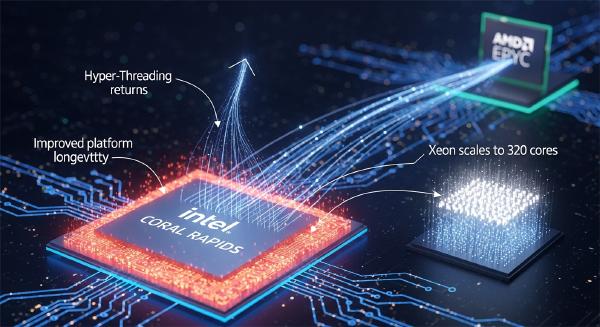
Intel has officially confirmed that Hyper-Threading will return with its Xeon 8 “Coral Rapids” data center processors, scheduled for release in 2028. The announcement marks a significant reversal of the company’s previous strategy to phase out simultaneous multithreading (SMT) across its processor portfolio. While the decision currently applies only to enterprise processors, it signals a notable shift in Intel’s long-term server CPU roadmap and provides organizations with new considerations for future infrastructure planning.
The move follows several years of gradually reducing Hyper-Threading support across both desktop and server products. Although Intel has not confirmed whether consumer processors will also regain the feature, the renewed investment in SMT suggests the company is reassessing the balance between core count, thread-level parallelism, and overall workload performance.
🖥️ Intel Confirms Hyper-Threading Returns with Xeon 8 #
Intel has announced that its Xeon 8 “Coral Rapids” platform will once again support simultaneous multithreading through the company’s proprietary Hyper-Threading technology.
The confirmation came during Intel’s Q2 2026 earnings call, where CEO Lip-Bu Tan outlined several initiatives intended to strengthen Intel’s position in both enterprise and client CPU markets. Restoring Hyper-Threading is one component of a broader strategy that also includes continued improvements in single-threaded performance.
The announcement came in response to questions regarding Intel’s long-term market share strategy over the next five years. While Tan avoided direct comparisons with AMD, he emphasized Intel’s commitment to rebuilding competitiveness across its processor portfolio. He also described Arm as an important partner, without framing the relationship in competitive terms.
At present, Intel has not disclosed whether Hyper-Threading will eventually return to desktop Core processors or future consumer platforms.
⚙️ How Intel Gradually Phased Out Hyper-Threading #
Hyper-Threading has been a defining feature of Intel processors for more than two decades, allowing a single physical core to execute two hardware threads simultaneously and improving utilization in highly parallel workloads.
Intel’s transition away from the technology began with the introduction of Alder Lake in 2021.
Hybrid Architecture Reduced Hyper-Threading Coverage #
Alder Lake introduced Intel’s hybrid CPU architecture, combining:
- Performance-cores (P-cores) with Hyper-Threading
- Efficient-cores (E-cores) operating with a single hardware thread
This design concentrated SMT support on high-performance cores while relying on E-cores to improve overall throughput through increased physical core counts rather than additional logical threads.
The strategy continued across subsequent processor generations as Intel increasingly prioritized higher core densities over simultaneous multithreading.
Arrow Lake Marked the Full Consumer Transition #
With the launch of Arrow Lake-S in 2024, Intel officially completed its transition away from Hyper-Threading in consumer processors.
The decision reflected Intel’s belief that modern processors equipped with significantly higher physical core counts could deliver superior performance and efficiency without the added complexity of SMT.
🏢 Server Roadmap Shows a Temporary Gap Before Coral Rapids #
Intel’s server portfolio illustrates the company’s evolving approach to Hyper-Threading across multiple Xeon generations.
Xeon 6 Granite Rapids #
Current Xeon 6 Granite Rapids processors continue to support Hyper-Threading on Performance-cores.
Key characteristics include:
- Up to 128 physical cores
- Up to 256 concurrent threads
- Hyper-Threading enabled on P-core designs
Granite Rapids remains one of the last major Xeon families to retain Intel’s traditional SMT implementation.
Xeon 6+ Clearwater Forest #
Xeon 6+ Clearwater Forest represents the opposite direction.
The processor family removes Hyper-Threading entirely and instead relies on large numbers of Efficient-cores manufactured using Intel’s 18A process technology.
Expected specifications include:
- Up to 288 single-threaded E-cores
- No simultaneous multithreading support
- Focus on maximum core density and power efficiency
Xeon 7 Diamond Rapids #
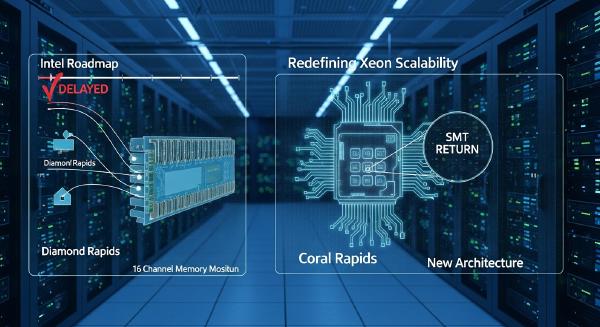
Intel’s upcoming Xeon 7 Diamond Rapids processors are also expected to omit Hyper-Threading despite featuring as many as 192 Performance-cores.
As a result, Hyper-Threading will remain absent from Intel’s server roadmap for at least two successive Xeon generations before returning with Coral Rapids in 2028.
🔬 Why Hyper-Threading Is Making a Comeback #
Hyper-Threading first appeared in the early 2000s with Pentium 4 and Xeon processors as Intel’s implementation of simultaneous multithreading.
The technology allows a processor core to execute multiple instruction streams concurrently, improving resource utilization and increasing throughput for heavily parallel applications such as:
- Virtualization
- Database systems
- Scientific computing
- Enterprise servers
- Cloud infrastructure
- High-performance computing
As physical core counts expanded dramatically over the past decade, Intel concluded that additional cores often provided greater performance benefits than SMT, leading to the gradual retirement of Hyper-Threading across newer architectures.
The decision to restore the technology suggests Intel now sees renewed value in combining high core counts with simultaneous multithreading to maximize performance across modern enterprise workloads.
📈 Strategic Implications for Enterprise Customers #
The return of Hyper-Threading represents more than a feature restoration—it reflects a broader adjustment in Intel’s long-term product strategy.
For enterprise IT planners and data center operators, the announcement provides greater visibility into Intel’s roadmap through the end of the decade. Organizations planning infrastructure refresh cycles can now factor renewed SMT support into future procurement strategies, particularly for virtualization, cloud-native deployments, and highly threaded workloads.
However, several questions remain unanswered.
Intel has not yet confirmed:
- Whether Hyper-Threading will return to consumer Core processors
- Whether the new implementation introduces architectural enhancements beyond previous generations
- Which future CPU architectures beyond Coral Rapids will continue supporting SMT
Additional details are expected as Intel releases more information about its next-generation server platforms over the coming years.
📌 Outlook #
Intel’s confirmation that Hyper-Threading will return with Xeon 8 Coral Rapids marks one of the company’s most notable strategic reversals in recent years. After steadily reducing and ultimately eliminating SMT across much of its processor portfolio, Intel is once again positioning the technology as an important component of enterprise CPU performance.
Although the decision currently affects only the Xeon roadmap, it underscores Intel’s evolving approach to balancing core counts, single-threaded performance, and parallel execution. Whether this shift eventually extends to consumer processors remains an open question, with further announcements expected as Intel’s future CPU architectures take shape.