Rumor: Nvidia RTX 5070 May Switch to Larger GB203 Die
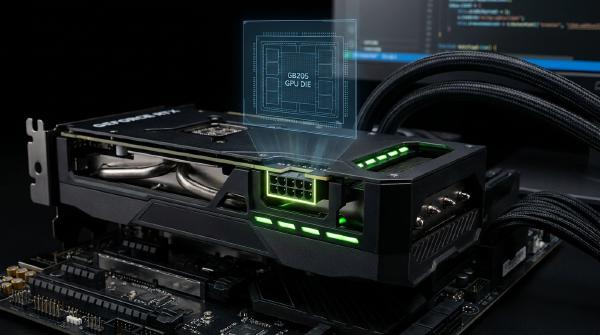
A new hardware rumor suggests Nvidia could introduce a GeForce RTX 5070 variant that replaces the native GB205 GPU die with a larger, heavily harvested GB203 die.
The change would be unusual because the GB203 is normally associated with higher-tier Blackwell GPUs such as the GeForce RTX 5070 Ti and RTX 5080. However, the rumored RTX 5070 implementation would not expose the additional compute resources of the larger die.
Instead, Nvidia would reportedly disable enough compute units and memory channels to bring the GB203 down to the same configuration as the existing RTX 5070.
If accurate, this would make the change primarily a manufacturing and yield-optimization strategy, rather than a performance upgrade.
The information originated from leaker @hongxing2020 and was subsequently reported by technology media outlets including Wccftech. Nvidia has not officially confirmed the rumored design.
🔍 GB203 vs. GB205: A Larger Die in the Same Performance Class #
The current GeForce RTX 5070 uses the GB205 GPU die, while the RTX 5070 Ti and RTX 5080 are based on the larger GB203.
Both belong to Nvidia’s Blackwell architecture, but their physical characteristics differ considerably.
- GB203: approximately 378 mm²
- GB205: approximately 263 mm²
- Die-size difference: GB203 is approximately 43% larger
A GB203-based RTX 5070 would therefore place a significantly larger piece of silicon into a product designed to deliver the same performance level as the existing GB205-based card.
However, the larger physical die does not automatically translate into higher performance.
Rumored configuration #
| Specification | Full GB203 | Standard RTX 5070 / GB205 | Rumored RTX 5070 / GB203 |
|---|---|---|---|
| CUDA Cores | 10,752 | 6,144 | 6,144 |
| CUDA Resources Disabled | — | — | ~42.8% |
| Memory Bus | 256-bit / 8 channels | 192-bit / 6 channels | 192-bit / 6 active channels |
| Memory Capacity | Up to 16GB GDDR7 | 12GB GDDR7 | 12GB GDDR7 |
The key point is that the rumored implementation would configure the GB203 to match the existing RTX 5070 rather than allowing the larger die to operate at its full capability.
⚙️ No Automatic Performance Boost #
A larger GPU die often implies greater computational capability, but only if the additional hardware remains enabled.
That is not what the rumor describes.
The hypothetical GB203-based RTX 5070 would reportedly retain:
- 6,144 CUDA cores
- A 192-bit memory interface
- 12GB of GDDR7 memory
- The same general performance target as the existing RTX 5070
The unused portions of the GB203 would effectively be disabled.
Consequently, buyers should not expect a hidden performance upgrade simply because a retail card contains a physically larger GPU die.
Why disabling hardware matters #
The full GB203 contains substantially more resources than are required for the RTX 5070 specification.
If Nvidia disables the additional compute units and memory channels, the GPU’s available parallel-processing capacity and memory bandwidth remain constrained to the RTX 5070 configuration.
The resulting situation can be summarized as:
Larger physical die ≠ higher performance
Instead:
Larger die + disabled resources = same target performance
Clock speeds, power limits, cache behavior, firmware, and other architectural parameters could still affect real-world results, but there is no inherent performance advantage from the larger die alone.
🏭 Chip Binning Could Explain the Change #
Although Nvidia has not disclosed a reason for the rumored transition, chip binning and yield optimization provide a plausible explanation.
Semiconductor manufacturing does not produce perfectly identical dies. Some chips contain defective regions or fail to meet the electrical, frequency, power, or reliability requirements of higher-tier products.
Rather than discarding every imperfect die, manufacturers can disable defective or unnecessary sections and sell the remaining functional silicon in lower-performance products.
Recovering partially defective GB203 dies #
Consider a simplified example.
A GB203 die intended for a higher-tier product could fail qualification because one or more compute regions cannot operate reliably at the required frequency or power target.
If the remaining silicon is functional, Nvidia could disable the affected regions and configure the die as a lower-tier product.
This approach can:
- Increase usable die yield.
- Reduce wafer waste.
- Recover silicon that would otherwise be discarded.
- Improve manufacturing economics.
- Provide additional flexibility when demand differs across product tiers.
For Nvidia, repurposing suitable GB203 dies as RTX 5070-class products could therefore be more attractive than leaving partially functional silicon unused.
A strategy with historical precedent #
Nvidia has used similar approaches in previous GPU generations.
For example, certain RTX 5060 variants reportedly moved away from the native GB206 configuration and adopted a cut-down GB205 implementation while maintaining the intended product specifications.
The exact implementation strategy can vary between generations, but the underlying principle is the same: use a larger or higher-tier die, disable resources as necessary, and recover otherwise marginal silicon for a lower product tier.
💾 Why the Memory Configuration Also Matters #
The memory interface is another important part of the rumored configuration.
A full GB203 implementation supports a wider memory interface, while the standard RTX 5070 uses a narrower 192-bit bus.
The rumored GB203-based RTX 5070 would therefore need to disable part of the memory subsystem as well.
This prevents the larger die from automatically gaining the memory-bandwidth advantage normally associated with GB203.
The result is a product that retains the external memory configuration expected from an RTX 5070:
12GB GDDR7 + 192-bit memory interface
rather than exposing the full capabilities of the larger GB203.
This is another indication that the rumored design is about silicon utilization rather than creating a faster RTX 5070.
🧩 What This Could Mean for Nvidia’s GPU Production #
If the rumor is accurate, the move would provide Nvidia with another mechanism for balancing GPU production across different product tiers.
GPU demand is not perfectly predictable. Nvidia may simultaneously face strong demand for certain products while encountering manufacturing constraints, binning limitations, or excess inventory at other die levels.
A harvested-die strategy provides additional flexibility.
Instead of treating GB203 and GB205 production as completely independent pools, Nvidia could potentially use qualified GB203 silicon to supplement RTX 5070 production.
This could be particularly useful when the yield distribution of the larger die produces a meaningful number of chips that are functional but unsuitable for higher-tier products.
The strategy does, however, come with an obvious trade-off: a larger die generally costs more silicon area per chip.
The economic justification therefore depends on how Nvidia values recovered GB203 dies relative to the cost of producing additional native GB205 dies and the expected yield of each process.
🧪 Driver Support Adds Another Clue #
The same leak also reportedly pointed to an upcoming Nvidia GPU driver release.
It remains unclear whether that driver is specifically related to supporting a GB203-based RTX 5070.
A driver update could potentially coincide with support for a new PCI device ID or GPU configuration, but without official documentation or hardware identification, connecting the driver directly to this rumored product would be speculative.
Driver-level evidence can become more useful once a corresponding hardware configuration appears in shipping products or public databases.
For now, it should be treated as an additional clue rather than confirmation.
⚠️ Rumor Status and What Buyers Should Expect #
The proposed GB203-based RTX 5070 remains unconfirmed.
There is currently no official Nvidia announcement establishing that the company will replace the GB205 with GB203 for the RTX 5070. Details such as launch timing, specific board designs, BIOS behavior, power limits, and the actual binning criteria remain unknown.
If the product does appear, the most important distinction for consumers will be that the larger GB203 die should not be interpreted as evidence of higher performance.
Unless Nvidia enables additional compute or memory resources, the resulting card should remain fundamentally aligned with the existing RTX 5070 specification.
For buyers, the die itself is therefore less important than the final retail configuration, including:
- CUDA core count
- Boost clock
- Memory capacity
- Memory bus width
- Power limit
- Cooling design
- Board configuration
- Actual benchmark performance
📌 A Manufacturing Change, Not a New Performance Tier #
The rumored GB203-based RTX 5070 is an interesting example of how modern GPU products can be shaped by semiconductor manufacturing realities.
From a product perspective, Nvidia could sell the same RTX 5070 performance target. From a manufacturing perspective, however, the company could gain another way to utilize GB203 silicon that does not qualify for higher-tier products.
The key takeaway is therefore simple:
If Nvidia does release a GB203-based RTX 5070, the larger die is unlikely to provide a performance boost because the additional hardware would remain disabled.
Instead, the move would primarily demonstrate Nvidia’s ability to use aggressive GPU binning and die harvesting to improve silicon utilization.
Until Nvidia or its board partners officially confirm the configuration, however, the GB203 RTX 5070 should remain classified as a hardware rumor rather than an established product specification.