RTX 5060 Variants Now Use GB205 GPUs and 16-Pin Power Connectors
The GeForce RTX 5060 lineup is beginning to diversify beyond simple board partner designs. Several recently introduced models have transitioned from the original GB206 GPU to a cut-down GB205 die while also adopting 16-pin (12V-2x6) power connectors instead of the traditional 8-pin PCIe connector.
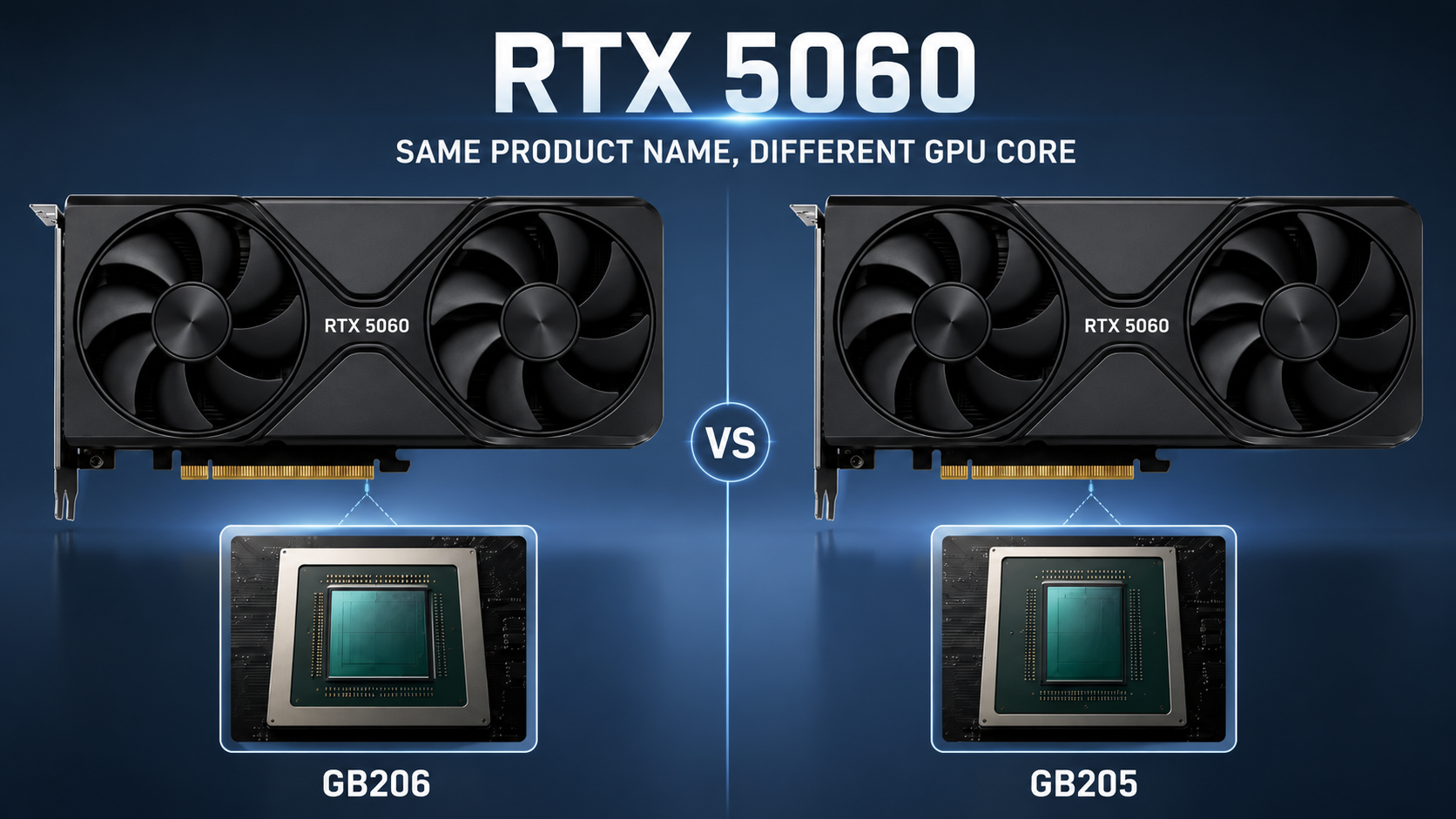
Although these changes do not alter the card’s advertised performance specifications, they introduce important differences in PCB design, power connectivity, and aftermarket cooler compatibility. Buyers planning a new gaming PC or GPU upgrade should verify these hardware revisions before making a purchase.
🔄 Some RTX 5060 Models Now Use the GB205 GPU #
Most GeForce RTX 5060 graphics cards currently available continue to use the GB206 GPU introduced alongside the original product launch.
However, several board partners have begun shipping newer variants built around a cut-down GB205 processor—the same silicon family used in the GeForce RTX 5070.
From a performance perspective, the transition has little impact. NVIDIA configures the GPU to deliver the same specifications expected from an RTX 5060, meaning gaming performance and official feature support remain effectively unchanged.
The hardware itself, however, differs in several important ways.
Because manufacturers rarely advertise the underlying GPU revision, identifying whether a card uses GB205 or GB206 may require checking detailed specifications or confirming the revision directly with the retailer.
⚙️ MSI Retains the 8-Pin Design #
MSI was among the first manufacturers to introduce GB205-based RTX 5060 models.
Despite adopting the newer GPU die, these cards retained the familiar:
- 8-pin PCIe power connector
- Redesigned PCB
- Full compatibility with existing power supplies
This decision makes upgrading straightforward for users with older PSUs that lack native 16-pin PCIe cables.
Given the RTX 5060’s relatively modest power requirements, an 8-pin connector provides ample electrical headroom.
Typical board power remains approximately:
- 145 W
- 150 W (depending on model)
An 8-pin PCIe connector, combined with power delivered through the motherboard slot, comfortably supports this level of consumption.
🔌 Yeston and Maxsun Introduce 16-Pin Connectors #
Some newer RTX 5060 models take a different approach.
Manufacturers including Yeston and Maxsun have released GB205-based cards equipped with a 16-pin power connector, creating a noticeable distinction from earlier RTX 5060 designs.
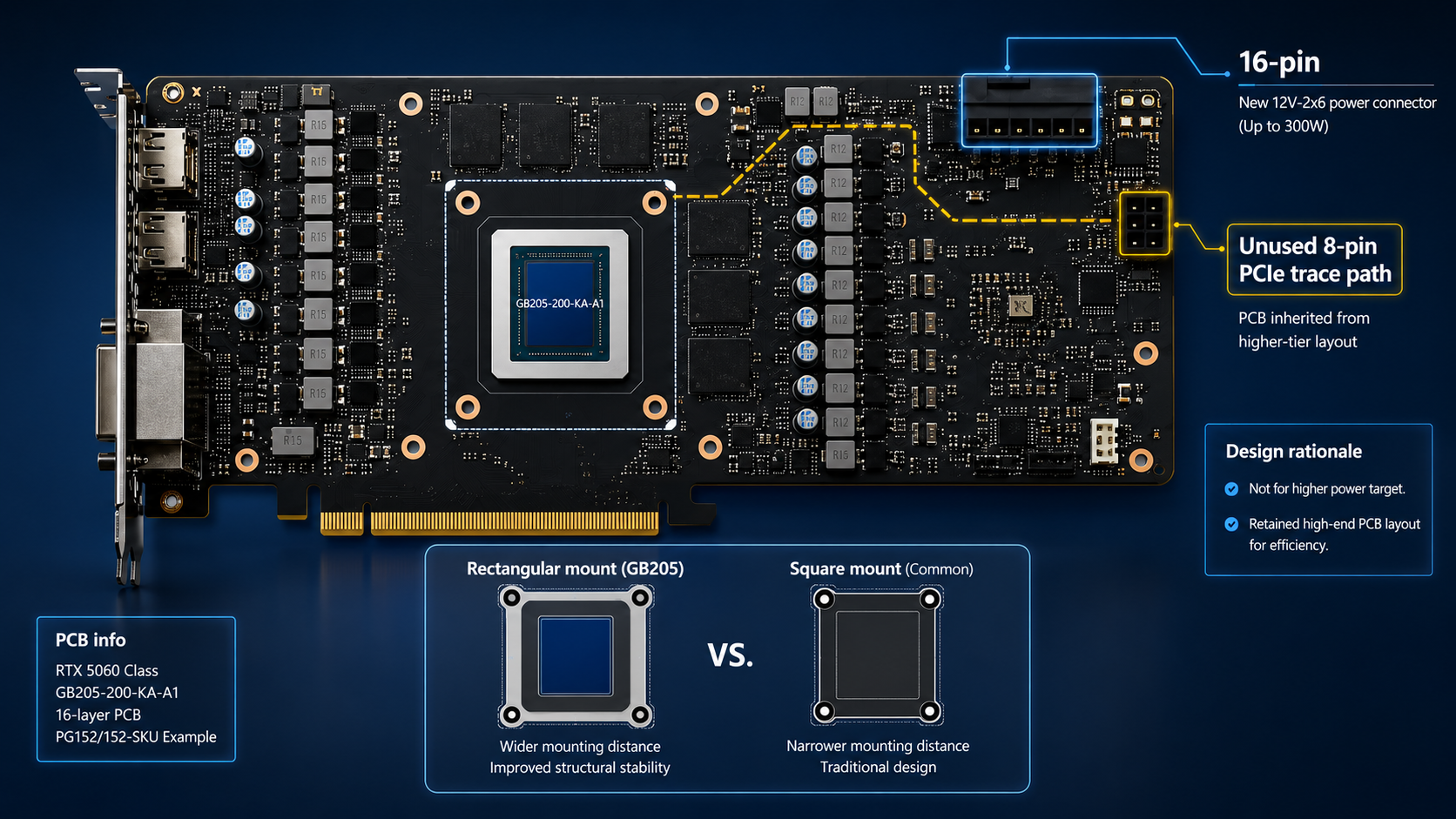
Examples include:
- Yeston RTX 5060 Gaea
- Maxsun RTX 5060 i-Craft Cyber Magical Girl Edition
Rather than developing entirely new PCB layouts, these manufacturers appear to have repurposed boards originally designed for higher-end RTX 5070 products.
Evidence supporting this includes:
- Existing traces for unused 8-pin connectors
- 16-pin connector placement inherited from RTX 5070 layouts
- Shared PCB architecture
This reuse simplifies manufacturing while reducing engineering costs.
🧩 PCB and Mechanical Differences #
Beyond the power connector, GB205-based RTX 5060 cards differ mechanically from their GB206 counterparts.
Rectangular GPU Package #
The newer cards use a rectangular GPU mounting footprint, whereas GB206-based RTX 5060 cards typically feature a square package.
This distinction matters primarily for users planning to install:
- Aftermarket GPU coolers
- Custom water blocks
- Specialized mounting hardware
Compatibility should be verified before purchasing third-party cooling solutions.
GPU Identification #
Teardown reports identify the processor as:
GB205-200-KA-A1
The GPU operates with one memory controller disabled, producing specifications identical to the standard RTX 5060:
- 8 GB GDDR7
- 128-bit memory interface
Consequently, memory bandwidth and VRAM capacity remain unchanged despite the different GPU die.
Memory Layout #
Another inherited characteristic of the RTX 5070 PCB design is memory placement.
All four GDDR7 memory packages are mounted on the same side of the PCB, while the corresponding memory footprints on the opposite side remain unpopulated.
Although this design difference has little effect on performance, it illustrates how manufacturers have adapted existing higher-tier board designs for the RTX 5060.
⚡ Should You Worry About the 16-Pin Connector? #
The appearance of a 16-pin connector may concern some buyers, particularly following well-publicized connector failures associated with high-power graphics cards.
Fortunately, those concerns are far less relevant for the RTX 5060.
Unlike flagship GPUs that can exceed 450 W of board power, the RTX 5060 typically operates around 150 W.
At this power level:
- Electrical load remains modest.
- Thermal stress on the connector is significantly lower.
- The risk of overheating under normal operating conditions is minimal when properly connected.
In practical terms, the connector itself should not be viewed as a reliability concern.
🛠️ Choosing Between 8-Pin and 16-Pin Models #
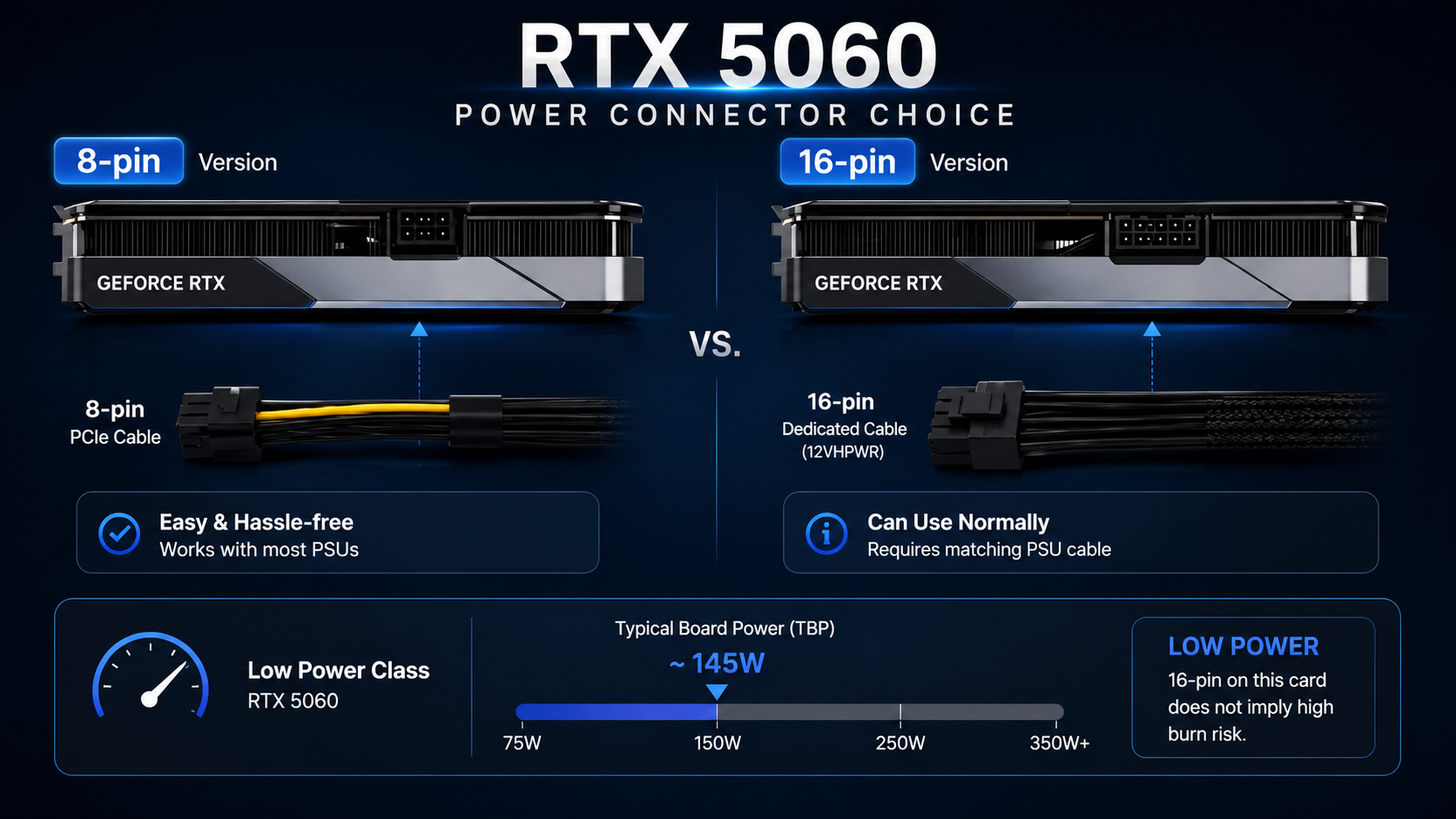
The choice between RTX 5060 variants primarily depends on your existing power supply.
Choose an 8-Pin Model If #
An 8-pin RTX 5060 is generally the more convenient option if:
- Your PSU provides only traditional PCIe power cables.
- You want to avoid adapters.
- You are upgrading an older gaming PC.
Compatibility is typically straightforward.
Choose a 16-Pin Model If #
A 16-pin version makes sense when:
- Your power supply includes native 12V-2x6 or 12VHPWR cables.
- You are building a new system with an ATX 3.x power supply.
- You prefer a cleaner cable configuration.
From a performance standpoint, there is no meaningful difference between connector types.
📊 GB205 vs. GB206 at a Glance #
| Feature | GB206-Based RTX 5060 | GB205-Based RTX 5060 |
|---|---|---|
| GPU Die | GB206 | Cut-down GB205 |
| Performance | Standard RTX 5060 | Standard RTX 5060 |
| Memory | 8 GB GDDR7 | 8 GB GDDR7 |
| Memory Bus | 128-bit | 128-bit |
| Typical Power Connector | 8-pin PCIe | 8-pin or 16-pin (varies by vendor) |
| PCB Origin | RTX 5060-specific | Often adapted from RTX 5070 designs |
| GPU Package | Square | Rectangular |
📖 Conclusion #
The arrival of GB205-based GeForce RTX 5060 models illustrates how board partners are leveraging common PCB designs across NVIDIA’s Blackwell product stack. While the underlying GPU silicon and power connector have changed on some models, these revisions do not affect the card’s official performance or feature set.
Instead, buyers should focus on practical compatibility considerations, including power supply connections, PCB layout, and cooler support.
Users with existing systems equipped only with 8-pin PCIe power cables may find traditional RTX 5060 models more convenient, while those building new PCs with ATX 3.x power supplies can choose either design without concern. Since both 8-pin and 16-pin variants are expected to remain available, selecting the appropriate model largely comes down to matching the graphics card with the rest of your system configuration.