Can AMD’s CDNA 5 Finally Challenge NVIDIA’s Server GPU Dominance?
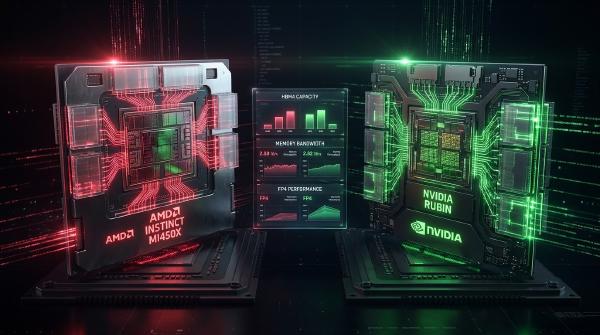
AMD has officially unveiled its next-generation CDNA 5 architecture for AI and data center workloads, introducing one of the most significant architectural overhauls since the CDNA family was launched. Rather than delivering an incremental update, CDNA 5 incorporates several design principles from AMD’s RDNA graphics architecture while introducing substantial changes across compute, cache, memory, packaging, and AI acceleration.
The result is a server GPU platform designed to improve performance, efficiency, and scalability for modern AI workloads. While NVIDIA continues to lead the AI accelerator market, CDNA 5 demonstrates that AMD is narrowing the technology gap and positioning itself as a stronger competitor in enterprise AI infrastructure.
🚀 CDNA 5 Brings AMD’s Biggest Architectural Evolution Yet #
Since its introduction, the CDNA architecture has remained distinct from AMD’s RDNA graphics architecture.
While RDNA focuses on gaming and graphics rendering, CDNA has been purpose-built for:
- High-performance computing (HPC)
- AI training
- Scientific simulation
- Large-scale data center workloads
With CDNA 5, AMD breaks down some of the historical separation between the two architectures by adopting several proven RDNA design concepts.
Compute Units Become Work Group Processors #
One of the most notable architectural changes is the replacement of traditional Compute Units (CUs) with Work Group Processors (WGPs).
Each WGP delivers approximately twice the computational throughput of a previous-generation CU while closely resembling the organization used throughout RDNA GPUs.
Each Accelerator Complex Die (XCD) now integrates:
- 32 Work Group Processors
- Improved parallel execution
- Higher overall compute density
This redesign enables more efficient scheduling while increasing throughput across AI and HPC workloads.
Wave32 Replaces Wave64 Execution #
CDNA 5 also abandons the long-standing Wave64 execution model in favor of Wave32.
Under Wave64, execution required groups of 64 threads before computation could begin. Wave32 cuts that requirement in half, allowing workloads to start processing with smaller thread groups.
Key benefits include:
- Lower scheduling overhead
- Better compute unit utilization
- Improved execution efficiency
- Stronger performance during mixed-precision and format-conversion workloads
The transition mirrors the execution model that has already proven successful within the RDNA architecture.
🏗️ Advanced Manufacturing Pushes Compute Density Higher #
AMD’s flagship MI455X accelerator is manufactured using TSMC’s N2 process node.
According to AMD, each accelerator contains approximately:
- 320 billion transistors
- More than 50% higher transistor count than NVIDIA’s B200 (208 billion)
This manufacturing advantage gives AMD one of the industry’s most advanced server GPU process technologies until NVIDIA’s next-generation Vera Rubin architecture enters production.
Higher transistor density enables AMD to integrate additional compute resources, AI engines, cache capacity, and memory interfaces without substantially increasing package size.
💾 Cache and Memory Architecture Receive a Major Redesign #
Beyond compute improvements, CDNA 5 significantly restructures its cache hierarchy and memory subsystem.
Infinity Cache Is Removed #
AMD has eliminated Infinity Cache from the CDNA architecture.
Instead, L2 cache has been relocated from the Accelerator Complex Dies to dedicated Fabric and Cache Dies (FCDs).
The redesigned cache system provides:
- 192 MB total L2 cache
- Up to 27 TB/s cache bandwidth
- Reduced cache hierarchy complexity
- Lower latency for AI workloads
Each Fabric and Cache Die serves four XCDs while managing a shared 96 MB L2 cache partition.
As with modern NVIDIA architectures, cache partitions remain local to their assigned compute complexes, reducing cross-chip communication overhead.
The FCDs themselves are manufactured using TSMC’s N3P process, optimized for cache density and low-latency access.
HBM4 Capacity Reaches 432 GB #
Memory capacity is another major area of advancement.
Each MI455X accelerator features:
- 12 HBM4 memory stacks
- 432 GB total memory capacity
- 23.3 TB/s peak memory bandwidth
Supporting twelve HBM stacks is made possible through TSMC’s CoWoS-L advanced packaging technology.
Unlike traditional silicon interposers, CoWoS-L uses redistribution layers (RDLs), enabling significantly larger package sizes capable of accommodating additional memory stacks.
🌐 Rack-Scale Unified Memory Targets Massive AI Models #
For today’s frontier AI models, even hundreds of gigabytes of local memory may not be sufficient.
CDNA 5 addresses this challenge by enabling memory pooling across every GPU within a server rack.
According to AMD, the architecture supports:
- Up to 31 TB of unified GPU memory
- 100 GB/s inter-GPU memory access
- Full 1:1 connectivity between GPUs
This shared-memory approach allows extremely large language models to access significantly larger working datasets without relying as heavily on CPU memory or external storage.
The design targets demanding workloads such as:
- Large language model (LLM) training
- Multi-trillion parameter AI models
- Scientific simulation
- Large-scale distributed inference
🤖 AI Acceleration Receives Dedicated Hardware Enhancements #
CDNA 5 introduces several hardware features specifically designed to accelerate modern AI workloads.
Tensor Data Mover #
Each Work Group Processor now integrates a Tensor Data Mover engine.
Instead of moving data through multiple intermediate stages, the engine transfers data directly from HBM memory into Local Data Share (LDS), reducing latency and improving tensor throughput.
New Microscaling Data Formats #
AMD expands hardware support for low-precision AI computing through new microscaling formats, including:
- MXFP4
- MXFP8
These formats reduce storage overhead by allowing multiple values to share scaling information.
MXFP4 further minimizes memory usage by supporting shared mantissa bits, reducing both:
- VRAM consumption
- Memory bandwidth requirements
These optimizations improve efficiency during AI training and inference where extremely low-precision arithmetic is increasingly common.
Hardware-Accelerated Tanh Operations #
CDNA 5 also introduces dedicated hardware acceleration for the hyperbolic tangent (tanh) activation function.
Previously, tanh calculations were executed in software, consuming valuable compute resources.
Native hardware execution now enables:
- Lower execution latency
- Reduced computational overhead
- Approximately double the throughput for tanh-heavy workloads
Given tanh’s widespread use across neural networks, this optimization directly benefits numerous machine learning applications.
🧩 ROCm Continues Closing the Software Gap #
For years, NVIDIA’s CUDA software ecosystem has been one of its strongest competitive advantages.
AMD has steadily invested in ROCm, expanding compatibility with modern AI frameworks while improving developer tooling and ecosystem maturity.
As AI software becomes increasingly framework-driven, many developers now operate at higher abstraction layers using libraries such as PyTorch and TensorFlow, reducing direct dependence on CUDA-specific programming.
Additionally, AI-assisted code generation and automated portability tools are helping developers migrate workloads between hardware platforms more easily than in previous years.
Although CUDA remains the industry’s most mature GPU computing ecosystem, the practical usability gap between CUDA and ROCm continues to narrow.
📊 Can AMD Finally Challenge NVIDIA? #
From a purely technical perspective, CDNA 5 represents AMD’s most competitive server GPU architecture to date.
Key strengths include:
- Comprehensive architectural redesign
- Advanced TSMC N2 manufacturing
- Massive HBM4 memory capacity
- High-bandwidth cache architecture
- Rack-scale unified memory
- AI-specific hardware acceleration
- Continued ROCm ecosystem improvements
These innovations position AMD to compete more aggressively in AI infrastructure and high-performance computing.
However, technology leadership alone does not determine market success.
AMD’s ability to capture meaningful server GPU market share will also depend on several external factors, including manufacturing capacity, software ecosystem adoption, enterprise qualification cycles, and the timing of NVIDIA’s next-generation product launches.
As NVIDIA prepares its future AI accelerators, CDNA 5 demonstrates that AMD is no longer competing solely on price. Instead, it is delivering architectural innovations that directly target the evolving requirements of large-scale AI training and inference, making the competition in the enterprise GPU market more balanced than it has been in years.