Musk’s SpaceX Roadmap: Mars, AI, and the Trillion-Dollar Future
As SpaceX prepares for what could become the largest Initial Public Offering (IPO) in U.S. history, investors are looking beyond the company’s current financial performance and focusing on something far more ambitious: Elon Musk’s long-term vision for humanity.
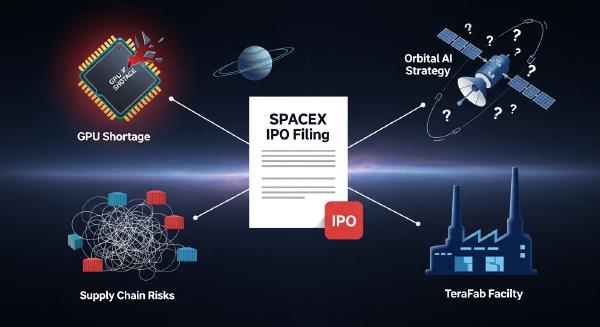
Despite reporting a net loss on $18.67 billion in revenue during fiscal year 2025, SpaceX has reportedly achieved a valuation approaching $1.77 trillion. Such a valuation reflects investor expectations that the company is building far more than a launch provider. Musk’s roadmap spans planetary expansion, artificial intelligence, semiconductor manufacturing, orbital infrastructure, and potentially a complete redefinition of human civilization’s future.
The company’s prospectus paints a picture of a future where space exploration and AI become deeply interconnected, creating an ecosystem designed to extend human activity beyond Earth while establishing new technological and economic frontiers.
🌎 Expanding Human Civilization Beyond Earth #
At the core of SpaceX’s mission lies a belief that humanity’s greatest vulnerability is its dependence on a single planet.
The company’s vision is heavily influenced by the Kardashev Scale, a framework proposed by Soviet astronomer Nikolai Kardashev in 1964 to classify civilizations according to the amount of energy they can harness.
Under this framework:
- Type I civilizations utilize the full energy potential of their home planet.
- Type II civilizations harness the energy output of their parent star.
- Type III civilizations exploit energy resources across an entire galaxy.
According to SpaceX’s long-term vision, humanity must eventually progress toward a Type II civilization by developing technologies capable of utilizing solar energy on a massive scale, both in space and across multiple worlds.
This philosophy is rooted in Musk’s long-standing argument that humanity faces existential risks if it remains confined to Earth. Potential threats include:
- Global conflicts
- Asteroid impacts
- Climate-related catastrophes
- Unforeseen natural disasters
- Other civilization-ending events
To mitigate these risks, SpaceX views the establishment of a self-sustaining multi-planetary civilization as a strategic necessity rather than a scientific curiosity.
🚀 Mars Colonization as the Ultimate Objective #
Among all potential destinations, Mars occupies a central role in Musk’s vision.
SpaceX intends to establish a self-sustaining Martian city capable of supporting approximately one million residents. This objective has become one of the company’s most publicized long-term milestones and represents the cornerstone of its planetary expansion strategy.
The initial phases of the program involve deploying Tesla’s Optimus humanoid robots aboard Starship missions. These robotic pioneers would be tasked with:
- Constructing habitat infrastructure
- Deploying solar power systems
- Establishing communications networks
- Preparing life-support systems
- Building protective structures for future human settlers
Over time, SpaceX envisions constructing large pressurized habitats beneath transparent domes. Ultimately, the company hopes to pursue terraforming initiatives that could gradually alter Mars’ environment to become more Earth-like.
To sustain such a colony, SpaceX anticipates operating between 1,000 and 2,000 Starship flights during each Earth-Mars transfer window, which occurs approximately every two years. Such a transportation network would require extensive launch, landing, and logistics infrastructure on both planets.
🌕 The Moon as a Strategic Transit Hub #
Before Mars can support large-scale human settlement, the Moon is expected to serve as an intermediate logistics and industrial platform.
SpaceX’s roadmap envisions utilizing lunar resources to reduce the cost of deep-space missions. Potential applications include:
- Converting lunar water ice into rocket fuel
- Using lunar regolith for construction materials
- Establishing manufacturing facilities on the lunar surface
- Supporting orbital refueling operations
A particularly ambitious concept involves the deployment of a Lunar Mass Driver, an electromagnetic launch system capable of sending cargo from the Moon into orbit without traditional rockets.
By manufacturing and exporting resources from the Moon, SpaceX hopes to create a self-reinforcing space economy that supports missions to Mars and beyond.
🛰️ Building a Space-Based Infrastructure Economy #
While Mars remains the long-term destination, SpaceX’s prospectus highlights numerous commercial opportunities that could emerge from large-scale space infrastructure.
Potential future businesses include:
- Ultra-fast point-to-point Earth transportation
- Space tourism
- Orbital manufacturing
- Microgravity research facilities
- Asteroid mining operations
- Deep-space logistics services
The success of these initiatives depends heavily on Starship, which serves as the foundational transportation platform for the entire ecosystem.
Standing approximately 124 meters tall, Starship is currently the largest rocket ever developed. SpaceX’s strategy relies on fully reusable upper-stage spacecraft and booster systems to dramatically reduce launch costs.
To support future demand, the company plans to expand manufacturing operations in Texas and Florida, ultimately aiming for annual production rates comparable to commercial aircraft manufacturing.
🤖 Why AI Has Become Central to SpaceX’s Future #
Although SpaceX is best known for rockets and space exploration, Musk increasingly views artificial intelligence as the largest economic opportunity of the coming decades.
To strengthen its position in the AI race, Musk has expanded collaboration between SpaceX and xAI, creating a broader ecosystem that combines:
- Computing infrastructure
- Data acquisition
- AI model development
- Semiconductor manufacturing
- Global communications networks
This strategy mirrors Musk’s successful approach at Tesla and SpaceX, where vertical integration reduced costs and accelerated innovation.
The underlying assumption is straightforward: companies that control critical AI infrastructure will possess a significant competitive advantage as demand for computing resources continues to surge.
☀️ The Vision for Space Data Centers #
One of the most controversial and ambitious components of Musk’s roadmap is the concept of space-based AI data centers.
Instead of constructing ever-larger facilities on Earth, SpaceX envisions launching AI computing platforms into orbit. These orbital facilities would leverage continuous access to solar energy and potentially avoid many of the energy constraints facing terrestrial data centers.
The long-term plan includes:
- AI server satellites operating in orbit
- Large-scale solar power generation
- Orbital computing clusters
- Integration with Starlink communications networks
Deployment could begin as early as 2028, eventually evolving into a vast constellation dedicated to AI workloads.
Musk believes that abundant solar energy in space may eventually provide a cost advantage over Earth-based facilities, especially as electricity demand from AI systems continues to rise dramatically.
🔋 Pursuing Terawatt-Scale AI Computing #
SpaceX’s AI ambitions extend far beyond conventional cloud infrastructure.
The company reportedly aims to deploy AI computing systems capable of consuming energy on a scale measured in terawatts. Such an objective would require an unprecedented expansion of computing infrastructure beyond Earth orbit.
Future plans envision:
- Manufacturing AI satellites in space
- Mining lunar resources
- Producing solar panels beyond Earth
- Expanding communications networks throughout cislunar space
As low-Earth orbit becomes increasingly crowded, SpaceX views the Moon as a critical industrial platform supporting deeper-space infrastructure development.
🏭 Building a Vertically Integrated Semiconductor Ecosystem #
A major challenge facing AI companies today is access to advanced semiconductor manufacturing capacity.
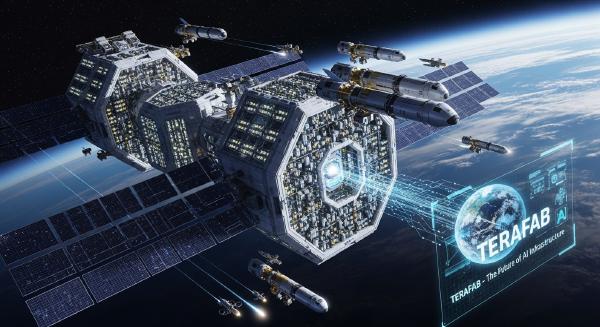
To address this constraint, Musk has proposed the Terafab initiative, a collaboration involving SpaceX and Tesla designed to support large-scale semiconductor production.
The project’s objective is to reduce dependence on external foundries and establish greater control over the supply chain required for future AI infrastructure.
The broader strategy reflects a recurring theme across Musk’s companies: controlling as much of the technology stack as possible, including:
- Data generation
- AI models
- Compute infrastructure
- Communications networks
- Semiconductor production
This vertically integrated approach seeks to create an ecosystem capable of supporting AI development at unprecedented scale.
📊 The Role of X and Grok in the AI Strategy #
SpaceX’s AI ambitions also extend into software and data.
Musk’s acquisition of Twitter—later rebranded as X—provided access to one of the world’s largest streams of real-time human-generated information. This data source became a foundational asset for xAI’s Grok model.
The strategy combines:
- Real-time social data from X
- AI model development through xAI
- Global connectivity via Starlink
- Future computing infrastructure in space
Together, these components form a comprehensive AI ecosystem designed to compete with established leaders in the field.
While Grok continues to face significant competition, Musk’s long-term objective is not simply to build another chatbot but to create a fully integrated AI platform spanning data, infrastructure, and deployment.
⚙️ Technical Challenges Remain Significant #
Despite the scale of Musk’s vision, substantial technical obstacles remain.
Space-based AI data centers, for example, face numerous engineering challenges, including:
- Thermal management in space
- Radiation protection
- Hardware maintenance
- Launch economics
- Power generation and storage
- Communications latency
Similarly, establishing a self-sustaining Martian civilization would require breakthroughs in life support, resource extraction, transportation, and manufacturing technologies.
Many of these challenges remain unresolved and will likely require decades of continued development.
🏛️ The Growing Influence of the Musk Ecosystem #
The broader Musk ecosystem now encompasses several major companies, including:
- SpaceX
- Tesla
- xAI
- X
- Neuralink
- The Boring Company
Collectively, these organizations operate across transportation, artificial intelligence, communications, robotics, neuroscience, and infrastructure development.
Observers have increasingly noted the strategic connections between these ventures. Technologies developed by one company often reinforce the capabilities of another, creating a network effect that strengthens the broader ecosystem.
Examples frequently discussed include:
- Neuralink supporting long-duration human spaceflight
- The Boring Company contributing underground infrastructure technologies
- Tesla robotics assisting extraterrestrial construction
- Starlink enabling global and off-world communications
Whether these integrations ultimately materialize remains uncertain, but they illustrate the increasingly interconnected nature of Musk’s long-term vision.
⚖️ Opportunity and Concentrated Power #
The potential success of a massive SpaceX IPO raises broader questions beyond technology and finance.
SpaceX already occupies a dominant position in several strategic sectors, including commercial launch services and satellite communications. Future expansion into AI infrastructure, semiconductors, and space-based computing could further increase the company’s influence.
Supporters view this concentration of resources as a catalyst for rapid innovation and technological progress. Critics argue that the combination of immense wealth, critical infrastructure, and concentrated control presents significant governance and competitive concerns.
Regardless of perspective, few would dispute the scale of the ambition.
🎯 Conclusion #
SpaceX’s roadmap represents one of the most expansive technological visions ever proposed by a private company. The plan extends far beyond rockets and satellites, encompassing Mars colonization, lunar industrialization, AI infrastructure, semiconductor manufacturing, and the creation of a multi-planetary civilization.
Many elements remain speculative and face formidable technical, economic, and regulatory challenges. Yet the roadmap reveals a consistent underlying objective: expanding the boundaries of human civilization while building the infrastructure required for an AI-driven future.
Whether these ambitions ultimately become reality or remain aspirational, they continue to shape discussions around the future of technology, space exploration, and humanity’s long-term trajectory beyond Earth.