NVIDIA and AGI: Compute, AI Agents, and the Token Economy
Jensen Huang’s latest argument about artificial general intelligence (AGI) is less interesting as a debate over terminology than as a statement about where AI systems are already heading.
His central thesis is straightforward: for a meaningful class of economically valuable tasks, AI capabilities have reached a level that can reasonably be described as AGI. More importantly, the industry is moving beyond models that merely answer prompts toward autonomous AI agents capable of planning, executing, evaluating, and improving workflows.
That distinction has enormous implications for NVIDIA.
NVIDIA already controls one of the world’s most important AI compute platforms. If increasingly capable AI agents can be deployed across software engineering, chip design, verification, research, operations, and other knowledge-intensive workflows, compute becomes more than infrastructure. It becomes a production asset that can continuously generate additional economic output.
This creates a potentially powerful feedback loop:
More compute → more AI agents → more useful work → more revenue → more compute → faster technological development.
The long-term question is therefore not simply whether NVIDIA has “achieved AGI.” The more consequential question is whether increasingly autonomous AI systems can turn NVIDIA’s compute advantage into a self-reinforcing engineering and economic moat.
🔮 AGI Has Been Achieved? The Definition Matters Less #
In technology discussions, AGI is generally used to describe an AI system capable of performing a broad range of economically valuable cognitive tasks at approximately human or superhuman levels.
The problem is that there is no universally accepted definition or benchmark for AGI.
Different organizations use different thresholds involving generality, autonomy, reasoning ability, adaptability, economic usefulness, or performance across unfamiliar tasks. Consequently, declaring that AGI has arrived often produces more semantic debate than technical insight.
Huang’s position is essentially that this debate is becoming less useful.
During NVIDIA’s earnings discussion, he argued that for many tasks, it is reasonable to say that AGI has already been achieved. He has expressed a similar position previously, emphasizing that the industry lacks a sufficiently precise definition of intelligence itself to establish a universally accepted AGI finish line.
The important signal is therefore not the label.
It is the capability curve.
From Pattern Matching to Autonomous Work #
Traditional LLM deployments are largely reactive:
- A user provides an instruction.
- The model generates an answer.
- The user evaluates the result.
- The user provides another instruction if necessary.
Agentic systems change this architecture.
An AI agent can instead:
- Interpret a high-level objective.
- Decompose the objective into subtasks.
- Select and invoke tools.
- Execute multiple steps autonomously.
- Inspect intermediate results.
- Detect failures.
- Revise its approach.
- Store or reuse useful information.
- Continue until the objective is completed.
This transition from answer generation to autonomous task execution is one of the most important developments in modern AI systems.
It also changes how AI productivity should be measured.
A model that produces a better paragraph is useful.
An agent that autonomously completes an entire software-development workflow is economically transformative.
ARC-AGI and Generalization #
The ARC-AGI benchmark family is designed to evaluate abstract reasoning and generalization rather than conventional memorization.
Its underlying challenge is important: an AI system must infer the rules governing unfamiliar tasks from very limited examples rather than simply retrieve patterns encountered during training.
That makes ARC-style evaluations particularly relevant to discussions about general intelligence.
The reported performance attributed to NVIDIA’s Avo architecture is therefore significant if independently reproduced and validated. A perfect result across the specified ARC-AGI-3 evaluation would indicate that the system can solve a broad collection of novel tasks under stringent conditions.
However, benchmark performance should not be treated as synonymous with AGI.
A benchmark measures a defined capability distribution. AGI implies much broader competence, including robust reasoning, long-horizon planning, adaptation, tool use, real-world interaction, and economically useful execution across heterogeneous domains.
The stronger interpretation is that increasingly capable AI systems are demonstrating components traditionally associated with general intelligence.
That is already consequential.
⚙️ AI Agents and the Emergence of Recursive Improvement #
The next step beyond autonomous execution is self-improvement.
Recursive self-improvement (RSI) refers to a system improving aspects of its own capabilities, tools, processes, or successor systems and then using those improvements to produce further improvements.
The distinction is important.
A model does not need to rewrite its own neural-network weights to participate in a broader self-improvement loop.
An AI system could contribute to recursive improvement by:
- generating better software tools;
- optimizing inference pipelines;
- discovering bugs in existing systems;
- producing synthetic training data;
- designing experiments;
- improving verification workflows;
- optimizing hardware architectures;
- evaluating alternative algorithms;
- generating and testing code;
- proposing new engineering architectures.
When these activities are connected to automated evaluation and deployment pipelines, AI becomes part of the engineering process that creates the next generation of AI infrastructure.
This creates a potentially powerful bootstrap loop:
AI improves engineering → improved engineering produces better AI systems → better AI systems accelerate engineering.
The limiting factor then shifts from purely human engineering capacity toward available compute, data, experimentation bandwidth, and physical manufacturing capacity.
🧪 AI Designing AI Infrastructure #
One of the strongest examples is AI-assisted semiconductor engineering.
NVIDIA’s collaboration with Cadence around the ChipStack AI Super Agent illustrates what this direction looks like in practice.
The system combines AI models with semiconductor engineering tools to automate portions of the chip-design and verification workflow. AI systems can orchestrate tasks involving RTL development, simulation, formal verification, debugging, and related engineering operations.
A representative workflow can look like:
High-level engineering objective
          ↓
AI planning and task decomposition
          ↓
RTL/code generation
          ↓
Simulation
          ↓
Formal verification
          ↓
Failure analysis
          ↓
Code or design revision
          ↓
Re-verification
          ↓
Validated result
The importance of this architecture is not that an AI agent can generate RTL.
Engineers have been using automation and code generation for years.
The more significant development is the integration of reasoning, tool invocation, verification, feedback, and iteration into a relatively autonomous engineering loop.
According to the reported metrics, some verification feedback cycles that traditionally required weeks can be reduced to less than a day, representing an order-of-magnitude improvement in iteration speed.
At NVIDIA’s scale, where chip verification involves enormous numbers of engineers, tests, and compute hours, even partial automation can translate into substantial engineering leverage.
Why Verification Is a Critical Bottleneck #
Modern semiconductor development is constrained not only by the ability to create designs but also by the ability to verify them.
A simplified development loop is:
Architecture
    ↓
RTL implementation
    ↓
Simulation
    ↓
Formal verification
    ↓
Bug discovery
    ↓
RTL modification
    ↓
Regression testing
    ↓
Tape-out
As designs become more complex, verification workloads grow rapidly.
If AI agents can compress this feedback loop, they effectively increase the number of architectural experiments engineers can perform within the same calendar period.
That matters because semiconductor performance is heavily influenced by iteration speed.
A faster engineering loop can produce:
- more architecture candidates;
- more aggressive optimization;
- faster bug discovery;
- broader verification coverage;
- shorter development cycles;
- more efficient use of engineering resources.
In other words, AI can increase the productivity of the people who design the hardware that runs AI.
That is a much deeper feedback loop than simple AI-assisted coding.
💰 $1 Billion a Day: Compute Is Becoming a Production Asset #
The AGI discussion becomes even more interesting when viewed alongside NVIDIA’s financial performance.
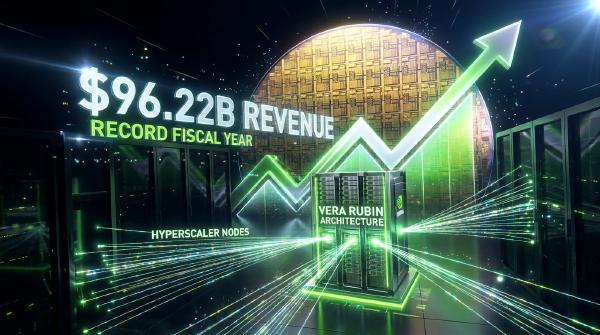
According to the figures in the earnings discussion, NVIDIA’s fiscal Q2 2027 revenue reached approximately $96.2 billion, while Data Center revenue reached approximately $89.0 billion.
Other reported figures included:
- Revenue: $96.2 billion
- Data Center revenue: $89.0 billion
- Net income: $59.7 billion
- Gross margin: approximately 75%
- Adjusted EPS: $2.22
- Q3 revenue guidance: approximately $108 billion
At $96.2 billion over a 91-day quarter, average revenue works out to approximately $1.06 billion per day.
The precise daily figure is less important than the economic trajectory.
AI infrastructure has evolved from an experimental capital expense into one of the largest sources of incremental computing demand in the global economy.
The $10-to-$100 Compute Thesis #
A useful way to understand the AI infrastructure boom is to consider compute as a production input.
Suppose a workload requires a certain amount of GPU capacity to generate tokens, execute software agents, perform scientific simulations, or train a model.
If the economic output generated by that compute is substantially greater than its infrastructure and operating cost, additional compute becomes economically rational.
The simplified relationship is:
Compute
   ↓
More inference/training capacity
   ↓
More AI-generated work
   ↓
More useful economic output
   ↓
More revenue
   ↓
Additional investment in compute
This is fundamentally different from the economics of a conventional software feature.
A software application typically creates value through human users interacting with the product.
An AI agent can create value continuously.
It can write code overnight, process documents, analyze data, run experiments, monitor systems, perform customer operations, or execute other digital workflows with relatively little incremental human supervision.
That makes tokens an increasingly useful economic abstraction.
🪙 Tokens as a New Unit of Digital Productivity #
A token is fundamentally a unit of model input or output.
In isolation, a token has little economic meaning.
But when tokens are connected to useful actions, they become associated with measurable productivity.
Consider a software-engineering agent:
Tokens
  ↓
Code generation
  ↓
Compilation
  ↓
Testing
  ↓
Bug fixing
  ↓
Production deployment
  ↓
Business value
The tokens themselves are not the value.
The value comes from the work those tokens enable.
The same principle applies to financial analysis, scientific research, customer operations, industrial automation, robotics, and semiconductor engineering.
This leads to two increasingly important infrastructure metrics:
Tokens per dollar
and
Tokens per watt
The first measures economic efficiency.
The second measures physical efficiency.
A system that can generate twice as much useful work for the same electricity consumption has effectively doubled the productivity of its energy budget.
This is why architectural efficiency matters almost as much as peak compute.
⚡ Vera Rubin and the Economics of AI Infrastructure #
NVIDIA’s Vera Rubin platform illustrates this broader transition.
The goal of each new GPU generation is not merely to increase FLOPS.
The more meaningful question is:
How much economically useful AI work can a data center generate from a fixed amount of power, space, and capital?
This changes the optimization target.
Instead of looking only at:
Peak FLOPS
Memory bandwidth
GPU count
operators increasingly care about:
Tokens / second
Tokens / dollar
Tokens / joule
Revenue / megawatt
Revenue / rack
Revenue / data center
According to the figures presented in the original discussion, Vera Rubin could increase the revenue opportunity associated with each gigawatt of data-center capacity from roughly $18 billion with Hopper to approximately $40 billion.
Whether individual projections ultimately materialize is less important than the underlying economic mechanism.
Every generation of hardware attempts to extract more useful computation from the same physical constraints.
That creates a direct connection between semiconductor architecture and macroeconomic productivity.
🤖 40,000 Humans and Millions of AI Agents #
Huang’s most provocative prediction concerns workforce scale.
He suggested that NVIDIA could eventually operate with roughly 40,000 human employees while directing hundreds of thousands—or potentially millions—of AI agents.
The implied ratios are extraordinary:
40,000 humans
      ↓
400,000 AI agents
or potentially:
40,000 humans
      ↓
4,000,000 AI agents
That corresponds to approximately 10:1 or 100:1 AI-agent-to-human ratios.
This should not be interpreted literally as a prediction that every human employee will directly supervise exactly 10 or 100 independent software entities.
The deeper concept is digital labor leverage.
A human engineer may eventually operate a portfolio of specialized agents:
Engineer
 ├── Architecture Agent
 ├── Coding Agent
 ├── Verification Agent
 ├── Simulation Agent
 ├── Debugging Agent
 ├── Documentation Agent
 └── Optimization Agent
Each agent can execute thousands of relatively inexpensive computational steps while the human focuses on objectives, constraints, architectural decisions, and final validation.
The human therefore becomes less of an individual task executor and more of an orchestrator of machine labor.
The Human Bottleneck Moves Up the Stack #
As AI agents become more capable, the bottleneck does not necessarily disappear.
It moves.
The limiting factors may increasingly become:
- problem selection;
- system architecture;
- compute availability;
- energy supply;
- semiconductor manufacturing;
- networking;
- memory capacity;
- data quality;
- verification;
- physical deployment;
- capital allocation.
This is why NVIDIA’s position in the compute stack is strategically important.
The company does not merely sell software agents.
It supplies much of the infrastructure required to run them.
🏭 From AI Factory to Cyber Factory #
The emerging AI data center can be viewed as a new kind of factory.
A traditional factory consumes:
Raw materials
      ↓
Machines
      ↓
Human labor
      ↓
Manufacturing
      ↓
Products
An AI factory increasingly looks like:
Electricity + Compute + Data
            ↓
       AI inference
            ↓
        AI agents
            ↓
      Digital work
            ↓
    Economic output
The physical inputs remain substantial.
Servers must be manufactured. Power must be generated. Data centers must be constructed. Networks and cooling systems must operate continuously.
But the output can be almost entirely digital.
That is why AI infrastructure can behave like a cyber factory: a physical facility whose primary production output is intelligence, decisions, software, simulations, and other forms of digital labor.
The more efficiently that factory converts electricity and compute into economically valuable tokens, the more productive the infrastructure becomes.
📈 The Compute Feedback Loop and NVIDIA’s Moat #
NVIDIA’s strongest potential advantage is not simply its current GPU market share.
It is the possibility of a reinforcing ecosystem in which compute accelerates the development of the very systems that require more compute.
The feedback loop could look like this:
More NVIDIA compute
        ↓
More capable AI agents
        ↓
Faster software and chip development
        ↓
Better NVIDIA architectures
        ↓
More efficient AI infrastructure
        ↓
Lower cost per useful token
        ↓
More AI deployment
        ↓
Higher compute demand
        ↓
More NVIDIA compute
This is a classic positive-feedback system.
The critical question is whether NVIDIA can capture enough of each layer to prevent competitors from breaking the loop.
Its advantage spans multiple layers:
- GPU architecture;
- high-speed interconnects;
- networking;
- CUDA and the software ecosystem;
- AI libraries;
- developer tooling;
- data-center platforms;
- inference optimization;
- partnerships across the semiconductor ecosystem.
If AI itself increasingly contributes to improving these layers, the moat could become stronger.
🌐 Physical Supply Chains Remain the Hard Constraint #
There is an important limitation to the AGI-and-compute thesis: digital intelligence still depends on physical infrastructure.
AI agents can be replicated almost instantly at the software level.
GPUs cannot.
Data centers cannot.
Electricity generation cannot.
Advanced semiconductor fabs cannot.
High-bandwidth networking infrastructure cannot.
This creates an unusual asymmetry:
Digital labor can scale extremely quickly, while physical compute capacity scales much more slowly.
Consequently, even if AI systems become capable of performing enormous amounts of useful work, physical constraints can determine how quickly that capability reaches the economy.
Those constraints include:
Semiconductor manufacturing
        ↓
Advanced packaging
        ↓
HBM and memory
        ↓
Networking
        ↓
Data-center construction
        ↓
Power generation
        ↓
Grid infrastructure
        ↓
Cooling
        ↓
Operational deployment
This is also why supply-chain control can become strategically important during an AI infrastructure expansion.
The scarcity may shift away from algorithms and toward the physical resources required to execute them.
💵 AI Compute and the Coming Capital Cycle #
If AI compute generates sufficiently high economic returns, capital will continue flowing into the infrastructure required to expand it.
This creates another feedback loop:
AI productivity
      ↓
Higher expected returns
      ↓
More capital investment
      ↓
More data centers
      ↓
More compute
      ↓
More AI productivity
Large-scale expansion can also influence credit markets, energy investment, construction, semiconductor capacity, and infrastructure financing.
The broader implication is that AI infrastructure is no longer merely a technology-sector story.
It increasingly intersects with:
- power generation;
- industrial policy;
- semiconductor manufacturing;
- data-center construction;
- debt markets;
- interest rates;
- capital expenditure;
- labor economics.
As AI compute scales into multi-trillion-dollar infrastructure markets, its economic effects become increasingly difficult to isolate from the broader economy.
🔬 The Real Question Is Not “Did NVIDIA Achieve AGI?” #
The provocative headline is that NVIDIA has achieved AGI.
The more useful technical question is different:
How much economically useful autonomous work can NVIDIA’s compute infrastructure produce?
That question can actually be measured.
Useful metrics include:
- tokens per dollar;
- tokens per watt;
- useful tasks completed per GPU-hour;
- autonomous task completion rate;
- human intervention rate;
- cost per completed workflow;
- engineering cycle-time reduction;
- inference revenue per megawatt;
- compute utilization;
- agent reliability.
These metrics connect AI capability directly to economics.
A system does not need to satisfy every philosophical definition of AGI to transform the labor market.
If an AI agent can reliably perform a task that previously required one hour of human engineering, and thousands of such agents can run continuously, the economic impact is real regardless of whether researchers agree on the AGI label.
🚀 Token Is Power #
The August 2026 NVIDIA earnings discussion represents an important moment in the evolution of the AI industry because it connects three ideas that were previously treated as separate:
Compute, intelligence, and economic output.
Compute enables models.
Models enable agents.
Agents perform work.
Work generates economic value.
Economic value finances more compute.
The resulting loop could become one of the most powerful technological feedback systems ever created.
The next phase of AI therefore may not be defined by a single moment when someone officially declares AGI.
It may instead be defined by the point at which autonomous AI labor becomes cheaper, faster, and more scalable than human labor across an expanding range of economically valuable tasks.
That is the significance of the 40,000-human, 400,000-to-4-million-agent scenario.
The fundamental unit of production begins shifting from human hours toward compute hours and useful tokens.
In that world, compute is productive capacity, tokens are measurable digital output, and AI agents become scalable units of intellectual labor.
The strategic contest is consequently no longer just about building the smartest model.
It is about controlling the infrastructure that turns intelligence into work.
And in that contest, the companies that can most efficiently convert watts into tokens, tokens into work, and work into revenue may possess an advantage far more consequential than a conventional semiconductor lead.