AMD Ryzen 7 9850X3D at CES: Is the 9950X3D2 Still Coming?
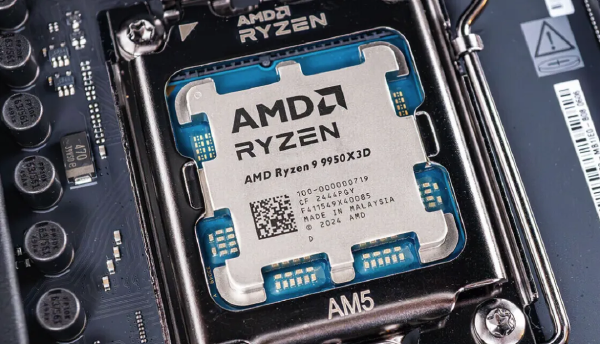
AMD’s Ryzen X3D processors have become a major part of its desktop gaming strategy, combining high-performance CPU cores with additional L3 cache to improve performance in cache-sensitive games. At CES 2026, the company introduced the Ryzen 7 9850X3D, a refreshed Zen 5 gaming processor with eight cores, 16 threads, and a reported boost clock of up to 5.6 GHz.
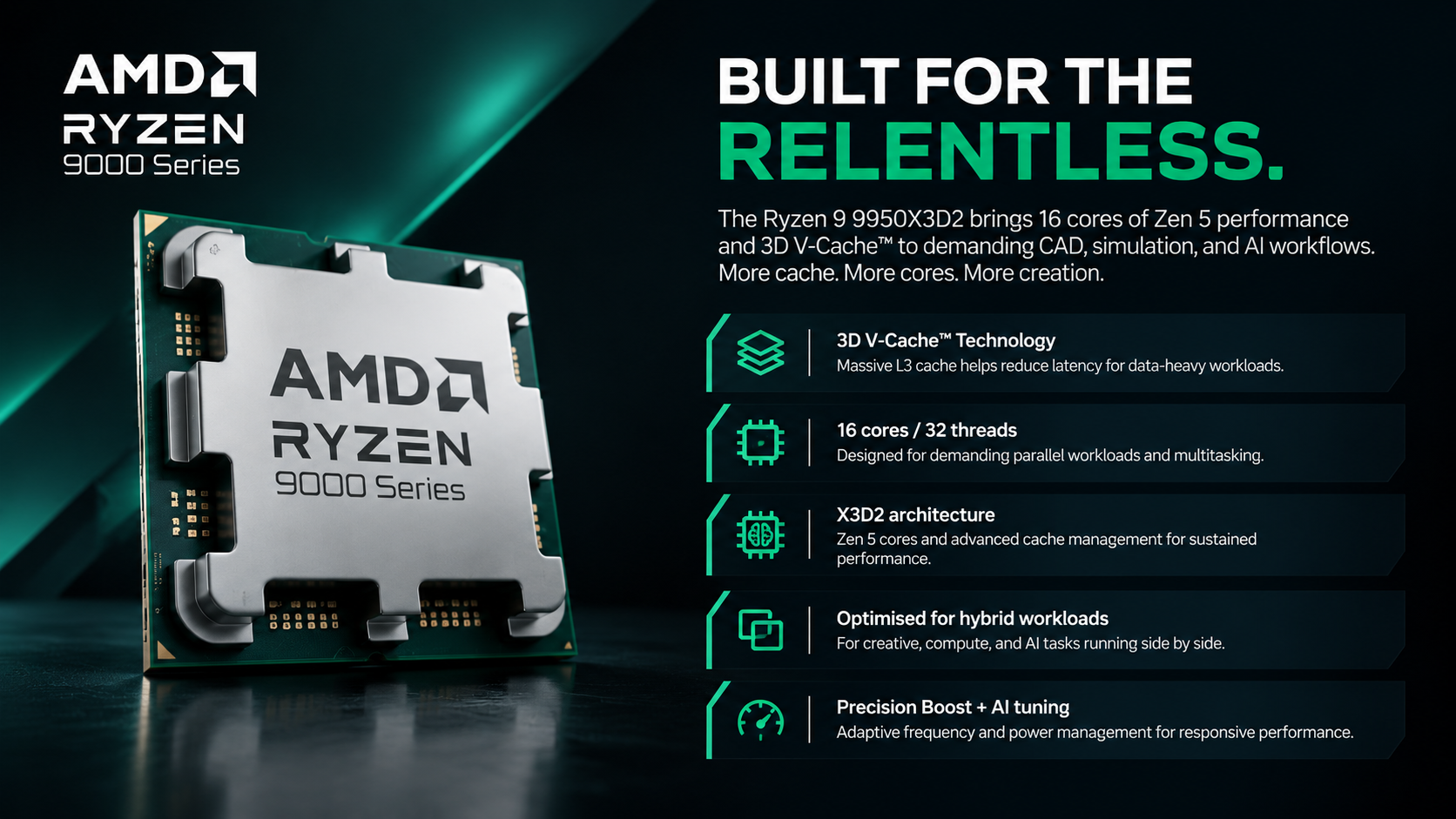
However, attention has also focused on a rumored processor that AMD did not officially announce: the Ryzen 9 9950X3D2. Speculation suggests that this potential flagship could feature 3D V-Cache on both compute chiplets, increasing the amount of cache available across its 16-core design.
The distinction is important: while the 9850X3D is a publicly announced product, the specifications, launch timing, and even the final product name of the rumored 9950X3D2 should not be treated as confirmed without an official AMD announcement.
🎮 Ryzen 7 9850X3D: A Higher-Clocked Gaming Refresh #
The Ryzen 7 9850X3D follows the familiar formula of AMD’s X3D gaming processors. Its eight-core, 16-thread configuration and 96 MB of L3 cache target games that benefit from low-latency access to frequently used data.
The reported maximum boost clock of 5.6 GHz represents a modest increase over the Ryzen 7 9800X3D. Higher clock speeds can improve performance in workloads that are limited by CPU frequency, although actual gaming gains depend on the title, resolution, graphics settings, and system configuration.
The key specifications reported for the processor are:
- Architecture: AMD Zen 5
- CPU cores and threads: 8 cores / 16 threads
- Total L3 cache: 96 MB
- Maximum boost clock: Up to 5.6 GHz
A clock-speed increase does not automatically translate into the same percentage increase in game performance. Real-world benchmarks are needed to establish how much faster the newer model is across different games.
For additional context on AMD’s cache-focused desktop CPUs, see AMD Ryzen 7 9800X3D: Gaming Performance and Architecture.
🕵️ What Is the Evidence for a Ryzen 9 9950X3D2? #
The rumored Ryzen 9 9950X3D2 has attracted interest because a dual-cache design could address a limitation of conventional multi-chiplet X3D processors: additional stacked cache is not necessarily present on every compute chiplet.
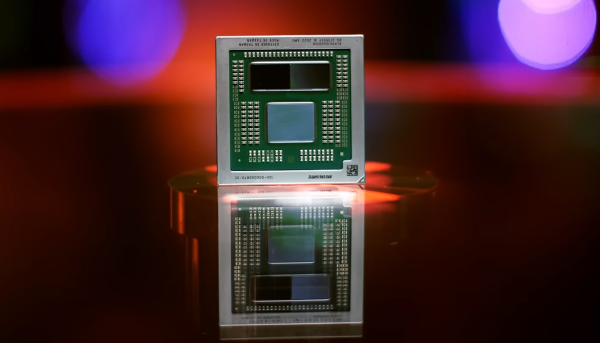
Several types of industry speculation have been cited as possible evidence of a future model, including promotional imagery, motherboard-vendor comments, and references allegedly made by system builders. Such clues can help generate hypotheses, but they do not establish that a product has been finalized or scheduled for release.
The claims should be evaluated separately:
- Promotional imagery: An image resembling a dual-chiplet processor may invite speculation, but visual similarities alone cannot verify a product’s identity or specifications.
- Motherboard-vendor comments: Broad references to future Ryzen processors can indicate continued product development without confirming a specific model.
- System-integrator listings: A listing naming an unannounced CPU can be noteworthy, but it may reflect preliminary information, a placeholder, or an error until corroborated by the manufacturer.
Taken together, these reports may justify watching for further announcements, but they do not prove that the 9950X3D2 is delayed rather than canceled. AMD has not publicly confirmed the rumored processor or provided a release date in the information described here.
🔬 How Would Dual 3D V-Cache Work? #
The defining feature implied by the “3D2” rumor is cache placement. AMD’s Ryzen 9 9950X3D combines two eight-core compute chiplets (CCDs), with additional 3D V-Cache on one CCD rather than both. A hypothetical dual-cache version would extend the stacked-cache configuration to the second CCD as well.
| Feature | Ryzen 9 9950X3D | Ryzen 9 9950X3D2 (rumored) |
|---|---|---|
| Architecture | Zen 5 | Expected Zen 5, unconfirmed |
| Cores / threads | 16 / 32 | 16 / 32, projected |
| Cache configuration | One V-Cache CCD, one standard CCD | V-Cache on both CCDs, rumored |
| Total L3 cache | 128 MB | Up to 192 MB, speculative |
| Maximum boost clock | Up to 5.7 GHz | Unknown |
| TDP | 170 W | Unknown |
The rumored 192 MB figure is a projection based on the proposed cache arrangement, not an official specification. Likewise, any predicted clock speed or power rating should be treated as uncertain until AMD publishes verified product details.
If AMD were to build such a processor, the potential benefit would be broader access to large cache capacity across its cores. However, operating-system scheduling, game-engine behavior, inter-chiplet communication, and workload characteristics would still affect performance.
🌡️ Why a Dual-Cache Design Could Be Difficult #
Adding more cache is not simply a matter of stacking another chiplet component. Advanced packaging introduces engineering and commercial trade-offs that could influence whether a dual-V-Cache desktop processor reaches the market.
Thermal and clock-speed trade-offs #
Stacked cache changes the thermal and physical characteristics of a processor package. AMD would need to manage heat transfer, voltage, power consumption, and sustained clock speeds while maintaining reliability.
A larger cache could improve performance in some workloads, but any gains could be reduced if thermal constraints required lower operating frequencies.
Packaging cost and manufacturing complexity #
A dual-stack design could require additional silicon, more complex packaging, and tighter manufacturing controls. Those factors could increase production costs and limit the number of processors that meet the required quality and performance targets.
For a premium desktop product, AMD would need to balance those costs against the performance advantage buyers could actually measure.
Software and scheduling behavior #
A dual-cache CPU would not guarantee that every application benefits equally. Games and other workloads differ in their cache sensitivity, thread distribution, and interaction with the operating system.
To realize the design’s potential, software scheduling and workload placement would need to make effective use of the cache resources available on both CCDs.
📈 What Could It Mean for Enthusiasts? #
If a dual-V-Cache Ryzen 9 processor eventually appears, its appeal would likely center on users who want both a high core count and extensive cache capacity.
Potential beneficiaries could include:
- Simulation and strategy games: Workloads that repeatedly access large sets of game-state data may benefit from additional cache.
- High-refresh-rate gaming: CPU-limited scenarios may see gains when a faster supply of game data helps keep the GPU busy.
- Mixed gaming and productivity systems: A 16-core configuration could offer substantial multithreaded capacity alongside cache-sensitive gaming performance.
These are plausible use cases, not guaranteed performance improvements. Additional cache does not automatically make a processor faster in rendering, encoding, or other workloads dominated by computation or memory bandwidth.
🧭 Product Strategy: A Flagship or a Niche Experiment? #
A dual-V-Cache processor could serve as a premium showcase for AMD’s packaging technology. Such a product might demonstrate how far the company can extend its cache-based gaming strategy without changing the underlying core architecture.
However, it is too early to conclude that AMD is intentionally holding back the 9950X3D2 to protect the 9850X3D’s launch. Product timing can depend on engineering readiness, market demand, manufacturing capacity, pricing, and competition.
Until AMD confirms the product, claims about a deliberate delay or a specific launch window remain speculation.
🏁 Conclusion #
The Ryzen 7 9850X3D represents a straightforward extension of AMD’s Zen 5 gaming lineup, emphasizing higher boost clocks while retaining the familiar eight-core design and 3D V-Cache.
The rumored Ryzen 9 9950X3D2 is a more ambitious proposition: a potential 16-core processor with additional cache on both compute chiplets. Such a design could benefit selected cache-sensitive workloads, but its specifications, release status, and commercial viability remain unconfirmed.
For now, the 9850X3D is the more concrete product to evaluate, while the 9950X3D2 remains a rumor worth watching. Official announcements and independent benchmarks will be needed to determine whether the dual-cache concept becomes a shipping desktop CPU—and whether its real-world gains justify the likely premium.