ASUS Launches First Intel Arc Graphics Card for AI Inference
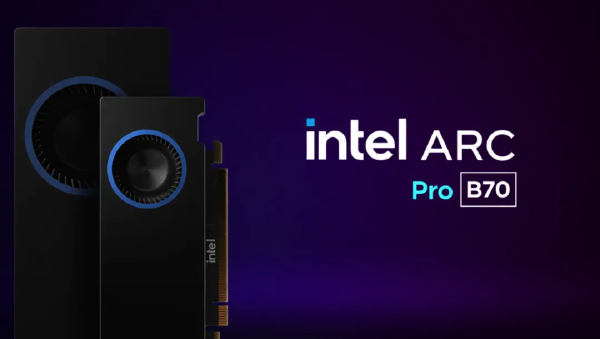
ASUS has listed the UGen Intel Arc Pro B70 32GB GDDR6 on its official website, marking the company’s first discrete graphics card carrying the Intel Arc brand. Rather than targeting conventional gaming PCs, ASUS is positioning the card within its UGen AI accelerator lineup for local AI inference and professional workstation workloads.
Based on Intel’s Xe2 architecture, the card combines 32 Xe-cores, 256 XMX AI engines, and 32GB of error-correcting code (ECC) GDDR6 memory. ASUS advertises peak INT8 performance of up to 367 TOPS and support for systems equipped with as many as four cards.
The launch expands ASUS’s workstation GPU options with an Intel-based accelerator designed for developers, AI practitioners, and businesses seeking to run models locally.
🧠 1. Intel Xe2 Architecture and Key Specifications #
The UGen Arc Pro B70 uses Intel’s Xe2-HPG architecture, part of the Battlemage GPU generation. Its hardware combines general GPU resources with specialized XMX matrix engines for accelerating AI workloads.
Core specifications #
| Feature | Specification |
|---|---|
| GPU architecture | Intel Xe2-HPG |
| Xe-cores | 32 |
| XMX AI engines | 256 |
| Dedicated memory | 32GB GDDR6 with ECC |
| Memory interface | 256-bit |
| Memory bandwidth | 608GB/s |
| Peak AI performance | 367 TOPS, INT8 |
| Maximum graphics clock | 2,800MHz |
| Interface | PCIe 5.0 x16 |
| Total board power | 310W, according to ASUS’s technical specifications |
| Power connector | 12V-2x6 |
| Recommended system PSU | 750W |
| Form factor | Dual-slot |
| Cooling | Blower-style |
| Display outputs | 3 × DisplayPort 2.1 and 1 × HDMI 2.1b |
| Operating systems | Windows 11 and Linux |
Source: ASUS UGen Arc Pro B70 official specifications and Intel Arc Pro B70 datasheet.
367 TOPS for AI workloads #
The card’s peak performance of 367 TOPS refers to INT8 operations using Intel’s XMX matrix engines. It is a theoretical throughput specification, not a direct prediction of inference speed across different AI models.
Actual performance depends on factors such as model architecture, quantization, batch size, software optimization, and memory utilization.
The card’s 32GB of ECC memory is particularly relevant to professional AI workloads. Capacity determines how much model data and inference state can reside in graphics memory, while ECC adds protection against certain memory errors during operation.
With 608GB/s of memory bandwidth, the card also provides substantial data-transfer capacity for workloads that repeatedly access model weights and other inference data.
ASUS lists the board’s total power at 310W, above Intel’s 230W reference-card specification for the Arc Pro B70. The higher board-power rating is specific to ASUS’s implementation and does not, by itself, establish a proportional performance advantage.
🖥️ 2. Dual-Slot Blower Design for Multi-GPU Workstations #
ASUS uses a dual-slot design with a blower-style cooling system rather than the open-air, multi-fan coolers common on gaming graphics cards.
The design is intended to support dense workstation configurations, where several accelerators may need to operate in close proximity. A blower directs much of the heated air toward the rear of the system, helping reduce heat recirculation between closely spaced cards.
The card provides three DisplayPort 2.1 outputs and one HDMI 2.1b output. It supports up to four displays, with resolution and refresh-rate capabilities depending on the connection and display configuration.
Although the product can drive displays, its primary positioning is AI inference and professional computing rather than consumer gaming.
Four cards provide 128GB of aggregate VRAM #
ASUS supports configurations with up to four UGen Arc Pro B70 cards in a compatible system. Four cards provide a combined 128GB of physical graphics memory.
The company says this capacity can accommodate AI models with up to 120 billion parameters. However, the four memory pools do not automatically become one unified 128GB GPU.
Running a large model across multiple cards requires compatible software and an appropriate model-parallel or multi-GPU execution strategy. The actual model size that can be loaded also depends on quantization, runtime memory overhead, context length, and the memory reserved for the key-value cache.
Consequently, the 120-billion-parameter figure should be treated as a supported use-case claim rather than a guarantee that every model of that size will run efficiently.
🤖 3. Software Support for Local AI #
A key part of the UGen Arc Pro B70’s positioning is its support for a broad range of AI software rather than a single proprietary inference environment.
ASUS lists compatibility with the following frameworks and tools:
| Software | Role |
|---|---|
| vLLM (XPU) | Large language model serving and inference |
| llama.cpp (SYCL/Vulkan) | Local language-model inference |
| Ollama | Local model management and inference |
| PyTorch with IPEX | Deep-learning development and acceleration |
| OpenVINO | AI inference optimization and deployment |
| oneAPI | Heterogeneous computing and accelerator programming |
| Vulkan | Cross-platform graphics and compute API |
The available software stack gives developers several potential deployment paths, including local language-model inference, AI application development, and workstation-based experimentation.
Nevertheless, software compatibility does not imply identical performance across frameworks. Model coverage, supported operations, driver versions, and multi-GPU functionality can vary, so developers should verify the requirements of their intended workloads before deploying a production system.
For background on the hardware trade-offs behind GPUs and dedicated AI accelerators, see KAD8’s overview of AI hardware architectures.
🏭 4. ASUS Enters the Arc GPU Market Through Its UGen Lineup #
ASUS’s decision to introduce its first Arc-branded discrete graphics card through the UGen AI accelerator lineup signals a focus on professional AI computing rather than the traditional consumer gaming GPU market.
The company has previously shipped Intel graphics hardware, including the passively cooled DG1-based product, but the UGen Arc Pro B70 is its first discrete card marketed under the Intel Arc brand.
The product also reflects a broader change in how graphics hardware is being positioned. Dedicated GPUs are increasingly marketed around local inference, model memory capacity, and multi-accelerator deployment, alongside traditional graphics and rendering performance.
For ASUS, the B70 adds an Intel-based option to its workstation and AI accelerator offerings. Its 32GB of ECC memory and four-card scalability are central to that positioning.
📅 5. Availability and Pricing #
ASUS has listed the UGen Arc Pro B70 32GB on its official website, but it has not announced a confirmed retail price or release date in the supplied information.
The card’s eventual value will depend on its market pricing, real-world inference performance, software maturity, and power consumption. Independent testing will also be important for evaluating how effectively it scales across multiple cards and how it compares with competing workstation GPUs.
For now, the launch establishes ASUS’s entry into Intel Arc-branded discrete graphics with a product built specifically for local AI inference and professional workloads rather than mainstream gaming.