Intel D-Series GPU Rumored to Feature 512GB of LPDDR5X Memory
Intel’s D-Series AI accelerator could receive partner-developed variants featuring up to 512GB of memory, according to an unconfirmed report. If accurate, the configuration would exceed Intel’s officially disclosed maximum partner capacity of 480GB, raising questions about memory density, PCB layout, and the accelerator’s existing hardware design.
According to VideoCardz, citing leaker Haze on X, select hardware partners are reportedly preparing D-Series accelerator cards with 512GB of memory. Intel has not confirmed the configuration, and no specific manufacturers or detailed implementation plans have been identified. The reported capacity should therefore be treated as a rumor rather than an established product specification.
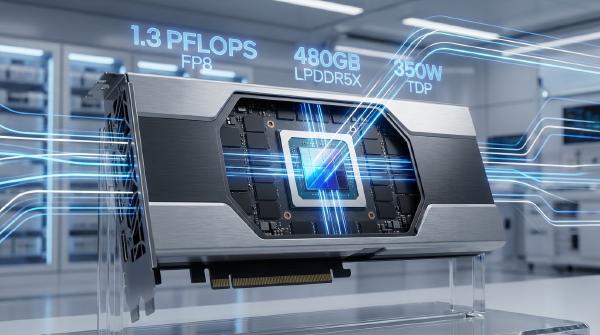
Originally codenamed Crescent Island, Intel’s D-Series is built on the Xe3P architecture and targets continuous, memory-intensive AI inference workloads. Unlike consumer graphics cards, the accelerator prioritizes inference compute, memory capacity, and bandwidth for data center deployments rather than gaming or conventional 3D rendering.
🔍 Intel D-Series Specifications and Memory Configurations #
Intel’s disclosed specifications position the D-Series as a specialized AI inference accelerator designed to balance memory capacity, bandwidth, and power efficiency.
| Specification | Disclosed Details |
|---|---|
| Architecture | Xe3P |
| Codename | Crescent Island |
| Memory type | LPDDR5X |
| First-party memory capacity | 160GB |
| Maximum announced partner capacity | 480GB |
| Memory bandwidth | Up to 1.5TB/s |
| FP8 compute performance | Up to 1.3 PFLOPS |
| Thermal design power (TDP) | 350W |
| Form factor | Standard PCIe card |
| Cooling | Air cooling |
| Primary workload | AI inference |
Intel’s first-party D-Series accelerator features 160GB of LPDDR5X memory. Hardware partners and original design manufacturers (ODMs) can develop alternative configurations, with 480GB representing the maximum capacity disclosed in the available specifications.
The rumored 512GB variant would add 32GB over that limit, an increase of approximately 6.7%. Although this is a relatively modest percentage increase, the feasibility depends on the supported memory architecture and the physical implementation of the accelerator.
Customer sampling for the D-Series has reportedly begun, but Intel has not announced definitive retail pricing or a confirmed full-market availability date.
The accelerator also omits display outputs and conventional consumer graphics features, reflecting its focus on data center inference rather than gaming or desktop graphics workloads.
For a deeper look at the accelerator’s architecture, memory subsystem, and AI inference capabilities, see KAD8’s technical analysis of Intel Crescent Island and the Xe3P GPU architecture.
🧩 Why a 512GB Configuration Raises Hardware Design Questions #
The central technical question is whether a 512GB memory configuration can be implemented within the board layout described in existing Crescent Island leaks.
Previously reported board details indicate that the accelerator uses 20 LPDDR5X memory package positions distributed across both sides of the PCB:
- Front side: 12 memory package positions.
- Back side: 8 memory package positions.
- Total: 20 memory package positions.
If this layout and the reported package configurations are accurate, the disclosed capacities can be explained through straightforward arithmetic.
How the 160GB and 480GB Configurations Add Up #
With 20 memory package positions, the total capacity depends on the amount of memory supported by each package.
| Capacity per package | Package count | Total memory |
|---|---|---|
| 8GB | 20 | 160GB |
| 24GB | 20 | 480GB |
The 160GB reference configuration corresponds to 20 packages providing 8GB each. Similarly, 20 packages with 24GB each would provide 480GB, matching Intel’s disclosed maximum partner capacity.
A uniform 512GB configuration across the same 20 positions would require an average of 25.6GB per package. This does not align with the 8GB and 24GB package capacities used in the examples above.
However, these calculations do not establish the full range of supported memory-device configurations. The publicly described package arrangement and capacities may not capture every implementation available to Intel’s partners.
Potential Approaches to Reaching 512GB #
If the rumor proves accurate, a partner-developed 512GB accelerator could require a different memory implementation from the configurations described in existing reports.
Potential approaches include:
- Higher-density memory packages: Using packages with capacities above the previously reported 24GB configuration, provided compatible components and platform support are available.
- Mixed-capacity configurations: Combining packages with different capacities to reach the target total, subject to memory-controller, channel-organization, and firmware constraints.
- Revised PCB design: Changing the number or arrangement of memory packages if the accelerator’s electrical design, memory controller, and platform support permit such modifications.
Each approach presents different engineering trade-offs. Higher-density packages could preserve the existing package count, while mixed-capacity arrangements might introduce additional validation and memory-mapping requirements. A revised board could offer more flexibility but would potentially increase design complexity and qualification costs.
These remain hypothetical explanations. No public evidence establishes which implementation, if any, Intel or its partners are developing for a 512GB variant.
⚙️ What More Memory Could Mean for AI Inference #
A larger memory pool can help AI inference deployments accommodate larger models, additional model weights, and more inference data within a single accelerator.
For large language models, memory capacity can determine whether a model fits on one device or must be distributed across multiple accelerators. Keeping more of the working set in local memory can also reduce the need for model partitioning and associated inter-device communication.
A 512GB D-Series configuration could therefore appeal to workloads with substantial memory requirements, particularly where consolidating inference capacity onto fewer accelerators simplifies deployment.
However, memory capacity is only one factor in overall accelerator performance.
Memory Capacity Versus Bandwidth #
Intel’s disclosed D-Series specifications include up to 1.5TB/s of memory bandwidth and up to 1.3 PFLOPS of FP8 compute performance. The rumored increase in memory capacity does not establish that either figure would change.
Capacity determines how much data can reside in memory, while bandwidth determines how quickly that data can be transferred. An accelerator with more memory may accommodate a larger model without delivering proportionally higher token throughput or lower inference latency.
Actual performance would depend on factors such as:
- Memory bandwidth and access patterns.
- Compute utilization and supported numerical formats.
- Model architecture, parameter count, and quantization.
- Batch size, sequence length, and key-value cache requirements.
- Software optimization and inference runtime efficiency.
- Interconnect bandwidth when workloads span multiple accelerators.
Power consumption, thermal behavior, system compatibility, pricing, and software support would also influence the practical value of a higher-capacity model.
For additional background on Intel’s accelerator design, see PUDN’s coverage of the Xe3P architecture and Crescent Island GPU.
📰 Intel Has Yet to Confirm the 512GB Variant #
The reported 512GB D-Series accelerator remains unverified. Intel has disclosed partner configurations of up to 480GB, but no public confirmation establishes that a 512GB model is under development or scheduled for release.
The difference between the rumored capacity and the previously reported 20-package memory layout warrants further scrutiny. Without confirmed package densities, memory-organization details, or revised board specifications, the implementation cannot be determined reliably.
Additional disclosures from Intel or its hardware partners will be needed to establish whether the 512GB configuration is technically supported and commercially viable.
Until then, Intel’s disclosed 160GB first-party accelerator and partner configurations of up to 480GB remain the appropriate reference points for evaluating the D-Series lineup. The rumored 512GB model is a potentially significant development for memory-intensive AI inference, but its specifications and availability remain unconfirmed.