Googlebook Drops Arm for Intel AI PCs Ahead of 2026 Launch
Google’s upcoming premium laptop platform, the Googlebook, is officially moving away from Arm-based hardware in favor of Intel processors. The announcement marks a significant strategic shift for Google’s broader computing ecosystem and positions the new device family as a high-performance AI PC platform rather than a traditional Chromebook successor.
Industry expectations had previously pointed toward Arm adoption due to Google’s deep ecosystem investment in Android and ChromeOS. However, Intel recently confirmed that it will supply CPUs for the Googlebook lineup, strongly indicating that the devices will utilize the upcoming Core Ultra 300 series based on the Panther Lake architecture.
The first wave of Googlebook systems is expected to arrive in the second half of 2026 through major OEM partners including Acer, ASUS, Dell, HP, and Lenovo.
💻 Googlebook Targets the Premium Laptop Market #
The Googlebook represents a new product category positioned above traditional Chromebooks.
Unlike ChromeOS-first budget laptops, Googlebook systems are expected to focus on:
- Premium productivity experiences
- On-device AI acceleration
- Full Android ecosystem integration
- Advanced local computing capabilities
- High-performance mobile workflows
When Google first introduced the category, the company disclosed very little technical information beyond confirming that the devices would rely on the Android Tech Stack. This immediately triggered widespread speculation about the underlying hardware architecture.
Given Google’s extensive history with Arm across smartphones, tablets, and Chromebooks, the industry largely assumed that the Googlebook would also adopt Arm processors.
Intel’s announcement completely changed that narrative.
🚨 Intel Partnership Shifts the Industry Narrative #
Intel recently confirmed through official channels that it will supply CPUs for the Googlebook lineup and that the two companies are already collaborating on product development.
At present, no other chip vendor has publicly been associated with the project.
This decision surprised much of the industry because Arm previously appeared to be the logical choice for several reasons:
- Android has over a decade of Arm optimization
- ChromeOS ecosystems are heavily Arm-oriented
- Arm platforms traditionally deliver strong mobile power efficiency
- Existing Android application compatibility is highly mature on Arm
From a conventional product planning perspective, Arm would likely have reduced:
- Software adaptation complexity
- Development timelines
- Platform validation costs
Instead, Google chose x86.
This immediately shifts attention toward one key question: how effectively can Google merge the Android ecosystem with high-performance x86 AI PCs?
🔮 Panther Lake and On-Device AI Become the Core Strategy #
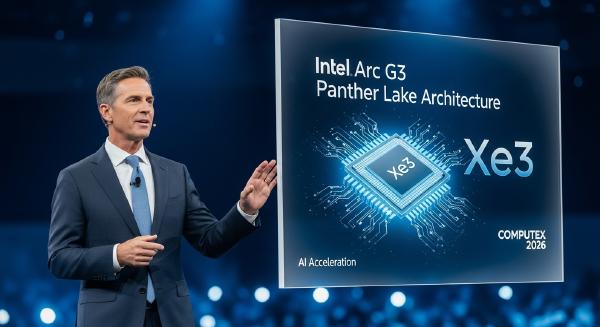
Based on currently available information, the Googlebook will likely utilize Intel’s Core Ultra 300 series built on the Panther Lake architecture.
The most important factor behind this decision appears to be AI performance.
Massive NPU Upgrade #
Panther Lake reportedly delivers:
- Up to 50 TOPS of NPU performance
This is nearly three times higher than the roughly 17 TOPS available on Intel’s lower-end Wildcat Lake Core 300 platforms.
That level of AI acceleration aligns directly with Google’s broader strategy surrounding:
- Gemini AI
- On-device inference
- Local AI assistants
- AI-enhanced productivity
- Edge AI computing
Rather than depending heavily on cloud inference, Googlebook systems appear designed to execute many AI workloads locally.
This offers several advantages:
- Lower latency
- Improved privacy
- Reduced cloud dependency
- Better offline AI capabilities
- Faster real-time AI interactions
⚙️ Android Tech Stack Successfully Adapted to x86 #
One of the largest technical challenges surrounding the Googlebook project involved Android compatibility on x86 architecture.
Google and Intel reportedly completed adaptation work for the underlying Android Tech Stack, enabling native Android application compatibility on the x86 platform.
This is strategically significant.
Why This Matters #
Historically, Android-on-x86 has faced several issues:
- Inconsistent app compatibility
- Software translation overhead
- Optimization gaps
- Power management limitations
If Google successfully resolves these problems at the platform level, the Googlebook could become the first genuinely premium Android-first laptop ecosystem built around x86 hardware.
For users, this means access to:
- Native Android applications
- Full productivity workflows
- Advanced AI features
- Traditional PC-level multitasking
- Improved local performance
The result could bridge a longstanding gap between:
- Mobile-first ecosystems
- High-performance laptop computing
🚀 Moving Beyond Traditional Chromebooks #
The Googlebook initiative also signals Google’s ambition to move beyond the limitations of conventional Chromebook products.
Traditional Chromebooks have largely competed on:
- Low cost
- Lightweight web workloads
- Education markets
- Simplicity
The Googlebook instead targets:
- Premium consumer laptops
- AI-centric workflows
- Productivity users
- Content creators
- Mobile professionals
By leveraging Intel’s high-performance AI PC architecture, Google gains access to a much broader computing envelope than typical Arm Chromebook platforms currently provide.
This may allow Google to compete more directly with:
- Windows AI PCs
- Apple Silicon MacBooks
- Premium ultraportables
🏭 Major OEMs Already Committed #
Several major global PC vendors have already confirmed participation in the Googlebook ecosystem.
Confirmed Manufacturing Partners #
- Acer
- ASUS
- Dell
- HP
- Lenovo
Importantly, Google itself will not manufacture first-party Googlebook hardware.
Instead, the company is positioning the platform similarly to Android smartphones, where Google provides the software ecosystem while hardware partners handle manufacturing and retail distribution.
This approach allows rapid scaling across multiple price tiers and industrial designs.
📈 Pricing May Become a Critical Challenge #
While the platform strategy is ambitious, pricing remains one of the largest uncertainties surrounding Googlebook adoption.
Memory Costs Continue Rising #
Since the beginning of 2026, global memory prices have continued increasing, creating cost pressure across the PC industry.
This is particularly relevant for AI PCs because on-device AI workloads generally require:
- Larger memory capacities
- Higher memory bandwidth
- Faster storage subsystems
Premium Googlebook configurations focused on local AI acceleration will likely require significantly more RAM than traditional Chromebooks.
As a result, final retail pricing may exceed the price range consumers traditionally associate with Google ecosystem laptops.
Whether consumers are willing to pay premium AI PC pricing for a Googlebook device remains an open question.
🔍 Why Google Chose Intel Over Arm #
The broader strategic reason behind Google’s decision appears increasingly clear: AI performance now outweighs architectural tradition.
For years, Arm dominated Google’s mobile ecosystem because of its efficiency advantages. However, the rise of local AI workloads is fundamentally changing laptop design priorities.
Modern AI PCs require:
- High-performance NPUs
- Strong integrated graphics
- Large memory bandwidth
- Mature desktop-class multitasking
- Broad software flexibility
Intel’s Panther Lake platform offers a more aggressive AI-centric hardware roadmap tailored to these demands.
This reflects a wider industry transition where AI acceleration is becoming a primary purchasing factor rather than a secondary feature.
🌐 A Major Shift for the Android and x86 Ecosystems #
The Googlebook project may ultimately become one of the most important ecosystem experiments in modern PC computing.
If successful, it could establish:
- Android as a premium laptop platform
- x86 as a viable Android AI PC architecture
- A new category between Chromebooks and Windows laptops
- Broader AI-first computing experiences
More importantly, it demonstrates how rapidly the AI PC movement is reshaping long-standing assumptions about operating systems, architectures, and device categories.
The traditional boundaries separating:
- Mobile devices
- Chromebooks
- Windows laptops
- AI PCs
are beginning to blur.
🏁 Conclusion #
Google’s decision to abandon Arm for Intel in the Googlebook platform marks a significant strategic pivot driven primarily by on-device AI ambitions.
By leveraging Intel’s Panther Lake Core Ultra 300 series processors, Google appears focused on creating a premium AI-first laptop ecosystem capable of combining:
- Native Android experiences
- x86 productivity performance
- Advanced local AI acceleration
- Premium mobile computing
The success of the Googlebook initiative will ultimately depend on several critical factors:
- Android compatibility quality on x86
- Real-world AI performance
- Battery efficiency
- Device pricing
- OEM execution
Regardless of market outcome, the collaboration between Google and Intel represents one of the clearest examples yet of how AI is redefining the future direction of PC platform architecture.