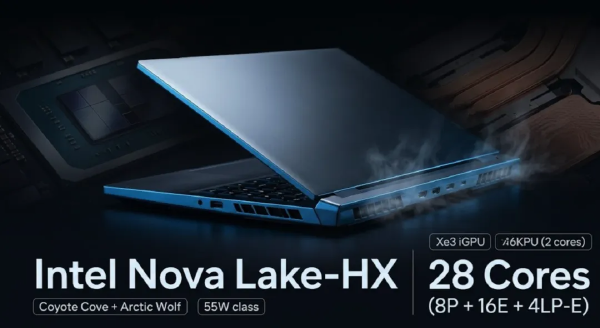
Intel Nova Lake Edge CPU Leak Reveals All E-Core Design
Intel’s upcoming Nova Lake processor family continues to generate significant attention ahead of Computex 2026, and a newly leaked edge-focused SKU has become one of the most discussed entries in the lineup.
Unlike conventional hybrid Intel processors that combine performance cores (P-cores) and efficiency cores (E-cores), this leaked Nova Lake Edge variant reportedly eliminates P-cores entirely. Instead, it adopts a pure E-core architecture featuring 8 Arctic Wolf efficiency cores paired with a 12-core Xe3P integrated GPU.
The design appears heavily optimized for edge computing, embedded AI, industrial deployments, and low-power workstation environments where thermal efficiency, parallel throughput, and long-term stability are more important than peak single-threaded performance.
🧩 Leaked Nova Lake Edge Specifications #
According to leaks originating from hardware outlet Wccftech and Chinese leaker Golden Pig Upgrade Pack, the edge-focused Nova Lake SKU differs substantially from previously leaked desktop models within the Core Ultra 4 family.
Consumer Desktop Nova Lake #
Earlier leaks suggested mainstream desktop variants would feature:
- 4 Coyote Cove P-cores
- 12 E-cores
- 12 Xe3P integrated GPU cores
These models are expected to compete directly against AMD Ryzen APUs by combining strong integrated graphics performance with hybrid CPU architecture.
Nova Lake Edge Variant #
The newly leaked edge-oriented SKU reportedly includes:
- 8 Arctic Wolf E-cores
- No P-cores
- 12 Xe3P integrated GPU cores
- BGA-only packaging
This makes it one of Intel’s most unconventional x86 designs in recent years.
⚙️ Why Intel Is Dropping P-Cores #
At first glance, removing all P-cores may seem counterintuitive. However, for edge computing workloads, the design choice makes strategic sense.
Edge deployments typically prioritize:
- Power efficiency
- Thermal stability
- Continuous 24/7 operation
- Compact system integration
- Parallel processing capability
- Lower cooling requirements
Typical edge workloads include:
- Industrial machine vision
- Smart surveillance analytics
- Local AI inference
- Robotics control systems
- Video transcoding
- Sensor aggregation
- Retail automation
- Smart city infrastructure
These environments rarely depend on extreme single-core burst performance.
🔮 Arctic Wolf E-Cores Target Efficiency-First Computing #
The leaked processor uses Intel’s next-generation Arctic Wolf efficiency cores.
According to early reports, the IPC performance of Arctic Wolf E-cores approaches the level previously associated with 12th-generation Intel Core P-cores. At the same time, power consumption is reportedly dramatically lower, making them well-suited for sustained embedded workloads.
Potential advantages include:
- Lower TDP envelopes
- Reduced cooling requirements
- Improved deployment density
- Better performance-per-watt
- Higher sustained utilization under thermal constraints
For industrial deployments running continuously for years, efficiency and thermal consistency often matter more than maximum clock speeds.
🎮 Xe3P Integrated Graphics Takes Center Stage #
While the CPU side shifts toward an all-E-core architecture, the integrated GPU remains surprisingly aggressive.
The leaked Nova Lake Edge SKU retains:
12 Xe3P GPU coresThis suggests Intel is positioning the chip as a heterogeneous compute platform rather than a traditional CPU-first processor.
The Xe3P architecture is expected to deliver strong acceleration for:
- Video encoding and decoding
- AI inference workloads
- Computer vision pipelines
- Lightweight GPU compute
- Media analytics
- Edge rendering workloads
Earlier Xe3 graphics implementations in Panther Lake reportedly demonstrated substantial improvements in integrated graphics efficiency and compute throughput, and Xe3P is expected to extend those gains further.
🏭 Built Specifically for Edge Deployments #
Leaked documentation indicates that the Nova Lake Edge series will exclusively use BGA soldered packaging.
This approach improves:
- Shock resistance
- Mechanical stability
- Thermal consistency
- Embedded integration reliability
The absence of socketed versions strongly suggests Intel is targeting:
- Industrial systems
- Embedded controllers
- Compact AI appliances
- Smart edge gateways
- Fanless computing platforms
- Ruggedized hardware deployments
This also aligns with long-lifecycle embedded market requirements where hardware stability is prioritized over user upgradeability.
🖥️ Future Xeon Variants May Reuse the Design #
One particularly interesting aspect of the leak is the suggestion that this same configuration may later appear in entry-level Xeon products.
Possible deployment targets include:
- Compact local servers
- AI inference nodes
- Low-power enterprise appliances
- Edge microservers
- Small-form-factor workstations
Intel appears increasingly interested in segmenting its architectures based on workload specialization rather than maintaining a one-size-fits-all CPU design philosophy.
📈 Nova Lake Product Family Expands Aggressively #
The broader Nova Lake roadmap appears significantly more diversified than previous Intel client generations.
Leaked variants currently include:
| Segment | Configuration |
|---|---|
| Flagship Desktop | Up to 52 total cores |
| High-Cache Models | Up to 288MB cache |
| Gaming Variants | 3D cache packaging |
| Edge Models | Pure E-core architecture |
| Mainstream Desktop | Hybrid P-core + E-core design |
Some flagship models are rumored to feature:
- Up to 28 cores per compute tile
- Dual compute tile configurations
- Massive bLLC cache implementations
- Advanced AI acceleration features
Intel appears to be aggressively modularizing the Nova Lake platform across multiple market verticals.
🔋 The Industry Shift Toward Specialized Compute #
The leaked Nova Lake Edge SKU reflects a broader industry trend toward workload-specific processor design.
Instead of maximizing raw single-threaded performance universally, vendors are increasingly optimizing chips around:
- AI acceleration
- Media processing
- Edge analytics
- Power efficiency
- Thermal density
- Parallel throughput
This mirrors trends seen across:
- ARM edge processors
- NVIDIA embedded platforms
- AMD APUs
- AI accelerators
- Smart NIC architectures
Intel’s pure E-core Nova Lake variant may represent one of the clearest signals yet that heterogeneous and efficiency-focused computing is becoming central to future x86 platform strategy.
🚀 What to Expect at Computex 2026 #
With Computex 2026 only days away, Intel is widely expected to provide the first official public preview of the Nova Lake family.
Potential announcements may include:
- Core Ultra 4 branding confirmation
- Xe3P graphics details
- AI acceleration features
- Platform segmentation
- Power efficiency targets
- Launch timelines
- Edge ecosystem partnerships
Additional specifications will likely emerge rapidly once official disclosures begin.
📌 Final Thoughts #
The leaked Nova Lake Edge processor represents a notable departure from traditional Intel CPU design.
By combining:
- 8 Arctic Wolf E-cores
- 12 Xe3P GPU cores
- No P-cores
- Embedded-focused BGA packaging
Intel appears to be building a processor specifically tailored for edge AI, industrial systems, and low-power parallel computing.
Rather than chasing peak desktop benchmark numbers, this design prioritizes:
- sustained efficiency
- deployment stability
- integrated acceleration
- thermal scalability
- parallel compute density
If the leaks prove accurate, Nova Lake could become one of Intel’s most strategically important architectural transitions in years, particularly as edge computing and localized AI inference continue expanding across enterprise and industrial markets.