Intel Nova Lake-HX May Adopt Core Ultra 4000 Naming
Intel’s upcoming Nova Lake-HX high-performance mobile processors may use a different naming scheme from other mobile chips in the same generation, potentially creating a dual-track product hierarchy.
According to leaker Jaykihn, Nova Lake-HX processors could adopt the four-digit Core Ultra 4000 naming convention associated with Nova Lake-S desktop processors. Meanwhile, H-series and suffix-less mainstream mobile processors are reportedly expected to retain three-digit model numbers.
The information has been reported by outlets including VideoCardz and TechPowerUp, but Intel has not officially confirmed the product names or the proposed naming structure.
If implemented, the approach would mean that processors from the same Nova Lake generation could appear under substantially different numbering systems: high-performance HX models in the 4000 range and mainstream mobile products potentially remaining in the 400 range. Although the distinction is only one digit in the numerical representation, it could make Intel’s product hierarchy more difficult to interpret.
🧩 Nova Lake-HX Naming Strategy #
The potential decision to align Nova Lake-HX with desktop-style naming has a clear product-positioning rationale.
HX processors have traditionally targeted high-performance laptops, particularly gaming notebooks and mobile workstations. These systems generally use larger chassis, higher power budgets, and discrete GPUs, while HX silicon has often been closely related to Intel’s desktop-oriented processor designs.
If Nova Lake-HX enters the Core Ultra 4000 family, Intel would effectively be emphasizing the processor’s performance class and silicon lineage rather than treating the desktop and mobile platforms as completely separate naming categories.
Nova Lake-S Naming Precedent #
The rumored HX naming scheme also corresponds with previously leaked Nova Lake-S desktop SKU information.
That leaked material included four-digit models such as:
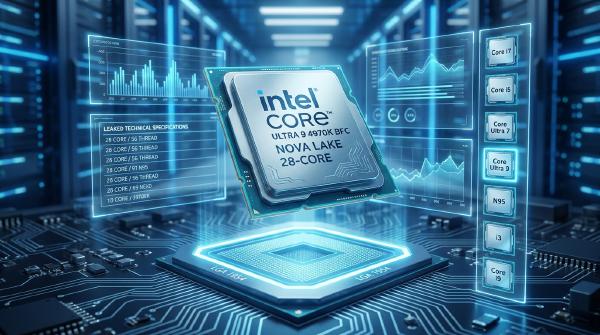
- Core Ultra 9 4970K BFC
- Core Ultra 9 4950K
- Core Ultra 7 4870K BFC
The flagship Core Ultra 9 4970K BFC was reportedly associated with 28 cores, a 125W power tier, and 32 execution units of integrated graphics.
However, these specifications remain unconfirmed. The model names themselves, the listed specifications, and the meaning of the BFC suffix have not been officially explained by Intel.
⚙️ Dual-Track Mobile CPU Numbering #
Under the reported strategy, Nova Lake could introduce two numbering conventions within a single generation.
High-performance Nova Lake-HX processors would potentially use four-digit Core Ultra 4000-series identifiers, while H-series and suffix-less mainstream mobile processors would continue using three-digit identifiers.
This would create a structure in which model numbers alone would provide less straightforward information about a processor’s generation and market position.
For example, a consumer comparing two Nova Lake-based laptops might encounter processors whose numerical ranges differ substantially despite belonging to the same architectural generation. The suffix and platform classification would therefore become increasingly important when determining product positioning.
Why HX Could Be Treated Differently #
The distinction is not entirely arbitrary. HX processors occupy a different performance segment from conventional H-series mobile CPUs and are designed for substantially higher power envelopes.
They also compete more directly with desktop-class performance in gaming laptops and mobile workstations. Aligning their names with Nova Lake-S could therefore reinforce the idea that HX represents the high-performance branch of Intel’s client processor portfolio.
🔍 Naming Details Remain Uncertain #
Several important aspects of the reported naming strategy remain unresolved.
First, no specific Nova Lake-HX model names have been publicly confirmed. While the Core Ultra 4000 designation has been associated with Nova Lake-S and reportedly with HX products, it is not yet established that mainstream H-series or suffix-less processors will officially use a Core Ultra 400 naming range.
In particular, the reported information does not necessarily establish the exact numbering scheme for every mobile product. Some of that interpretation appears to be based on reporting and inference rather than an explicit statement from the source.
Second, Intel can modify product names relatively late in the development cycle. Even if the current internal naming structure follows the reported pattern, the final retail branding could still change before launch.
🛒 Potential Impact on Consumers #
A dual-track naming system could increase the identification cost for buyers.
Intel’s processor names already require consumers to distinguish between product tiers, generations, and suffixes such as HX and H. If processors from the same generation also use different numerical ranges, buyers may need to pay closer attention to the complete model identifier rather than relying on the number itself.
This becomes particularly relevant for laptop purchases, where manufacturers can pair processors from different power classes with substantially different cooling systems, GPUs, memory configurations, and chassis designs.
Since the introduction of the Core Ultra branding, Intel has already made several changes to its client CPU naming strategy. Adding separate three-digit and four-digit schemes within the Nova Lake generation could make product comparisons even less intuitive.
📅 Intel Has Yet to Confirm Nova Lake Naming #
Intel has not officially disclosed the final naming structure for the Nova Lake family.
Reports have indicated that Nova Lake-S qualification samples have appeared in HWiNFO, while the broader Nova Lake lineup is rumored to launch in early 2027. That timeline leaves Intel sufficient room to revise its product segmentation and naming conventions before commercial release.
For now, the Core Ultra 4000 Nova Lake-HX designation should therefore be treated as an unconfirmed naming report rather than an official Intel product specification. The final retail names for HX, H-series, and mainstream Nova Lake processors will ultimately determine whether Intel adopts the reported dual-track strategy.