Meta Vistara: Reusing DDR4 Memory with CXL at Hyperscale
For years, data center optimization has focused primarily on compute, storage, and networking. Yet one increasingly critical bottleneck has emerged across hyperscale infrastructure: memory capacity.
According to Meta’s internal analysis, nearly 43.7% of servers in its fleet are constrained by memory capacity rather than compute resources. In many cases, CPUs, storage systems, and network fabrics remain underutilized while applications are prevented from scaling due to insufficient memory.
To address this challenge, Meta developed Vistara, a full-stack hardware and software platform that combines Compute Express Link (CXL) technology, custom silicon, and Linux memory tiering to reuse retired DDR4 memory modules as expandable memory pools for modern servers.
The project demonstrates that memory expansion is not simply a hardware problem. Achieving production-scale deployment requires coordinated optimization across silicon, firmware, operating systems, workload scheduling, and resource management.
🧩 Why Memory Has Become the Primary Data Center Bottleneck #
Modern workloads increasingly exhibit large memory footprints while consuming relatively modest compute resources.
Examples include:
- Recommendation systems
- Distributed caching platforms
- Large-scale analytics
- AI inference services
- Parameter server architectures
These applications typically contain a mix of frequently accessed (“hot”) and infrequently accessed (“cold”) data. While only a subset of the data requires high-speed access, the entire dataset must remain addressable.
As datasets continue to grow, organizations face three interconnected challenges.
Memory Capacity Limits Compute Utilization #
Meta reports that 43.7% of servers become memory-constrained before exhausting CPU, storage, or networking resources.
In large-scale AI systems, models often exceed the memory capacity of a single server, forcing engineers to shard workloads across multiple machines. This introduces:
- Additional network traffic
- Higher latency
- Increased synchronization overhead
- Reduced hardware efficiency
The result is higher infrastructure costs and lower overall utilization.
DRAM Dominates Server Carbon Footprints #
One of the most surprising findings from Meta’s analysis concerns sustainability.
Across a server’s lifecycle, DRAM contributes approximately 69% of total embodied carbon emissions, exceeding the impact of CPUs, motherboards, and storage devices combined.
This is largely due to the energy-intensive manufacturing process required to produce modern memory chips.
Memory Outlives the Servers It Serves #
Enterprise servers are typically retired after three to five years.
Memory modules, however, often remain operational for seven to ten years.
This mismatch creates significant waste. Large quantities of DDR4 memory are discarded despite remaining fully functional.
The challenge is that directly installing older DDR4 modules into modern systems would introduce substantial performance penalties due to lower bandwidth and higher latency.
This is precisely the problem Vistara aims to solve.
🔗 Why CXL Adoption Has Been Slower Than Expected #
At first glance, Compute Express Link appears to be the ideal solution.
CXL enables memory devices to be attached externally through high-speed PCIe links, allowing servers to access memory beyond directly attached DIMMs.
However, despite years of industry investment, large-scale production deployments have remained relatively rare.
Several obstacles have slowed adoption.
Performance Concerns #
Early academic studies and prototype systems suggested that CXL-attached memory could deliver:
- Up to 10× lower bandwidth
- More than 60% higher latency
- Significant software overhead
This created a perception that CXL memory was unsuitable for performance-sensitive workloads.
Commercial Products Missed the Reuse Opportunity #
Many commercially available CXL memory products pair new DRAM with proprietary controllers.
While functional, these solutions do not address one of the most compelling economic opportunities:
- Reusing existing DDR4 inventory
For hyperscalers operating millions of servers, the ability to redeploy retired memory is often more valuable than purchasing entirely new memory appliances.
Software Ecosystems Were Immature #
Operating systems historically treated memory as a largely uniform resource.
CXL introduces heterogeneous memory tiers with significantly different characteristics.
The software stack must determine:
- Which data belongs in fast local memory
- Which data can be placed in slower memory
- When pages should migrate between tiers
- How to avoid excessive migration overhead
Without intelligent memory management, the benefits of CXL are difficult to realize.
⚙️ Vistara Hardware Architecture #
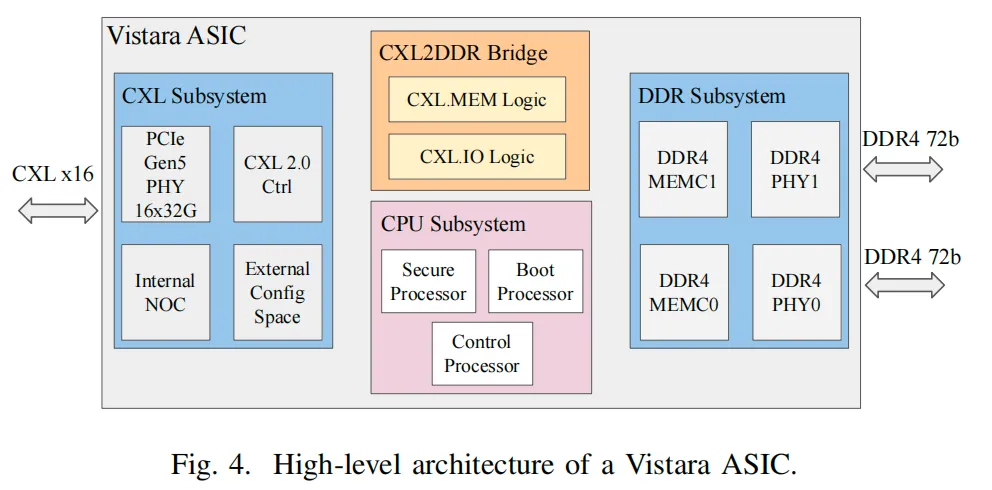
Meta’s solution begins with a custom-designed CXL memory expansion ASIC.
The objective is straightforward:
Bridge legacy DDR4 memory into modern servers while minimizing cost, power consumption, and performance overhead.
Vistara ASIC Specifications #
The Vistara chip is a CXL Type-3 memory expansion device compliant with CXL 2.0 and CXL 1.1 standards.
Key specifications include:
| Component | Specification |
|---|---|
| Host Interface | PCIe 5.0 x16 (deployed as x8) |
| Memory Channels | 2× 72-bit DDR4 |
| Maximum Capacity | 256GB per chip |
| Additional Latency | ~50ns idle |
| Power Consumption | 9W |
| Reliability | Reed-Solomon ECC + 4-bit self-healing |
| Management Processors | 3× RISC-V cores |
The embedded RISC-V processors manage:
- Secure boot
- Firmware updates
- Device initialization
- Health monitoring
- Remote management
MemServer Configuration #
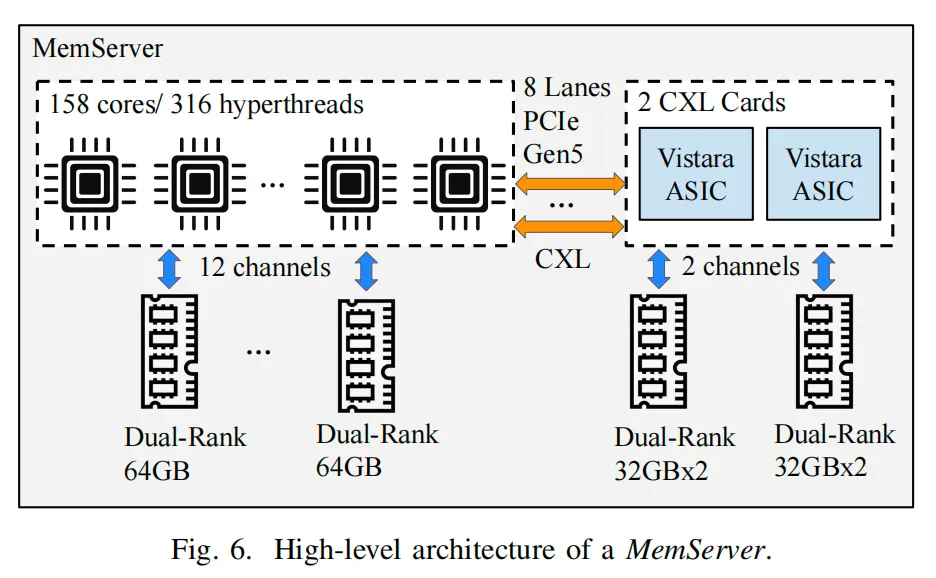
A typical Vistara-enabled memory server includes:
- AMD Zen 5 Turin processor
- 158 CPU cores
- 12-channel DDR5-6400 memory
- 768GB local DDR5
- Two Vistara devices
- Eight recycled 32GB DDR4 DIMMs
This configuration delivers:
- 768GB local DDR5
- 256GB CXL-attached DDR4
- 1TB total memory capacity
Remarkably, the entire CXL subsystem consumes only about 50W.
📊 Performance Characteristics #
The most important question is whether reused DDR4 memory can deliver acceptable performance.
Bandwidth Comparison #
A significant gap remains between local and expanded memory.
| Memory Type | Peak Bandwidth |
|---|---|
| DDR5 Local Memory | 497GB/s |
| CXL DDR4 Memory | 48GB/s |
Local memory offers roughly ten times the bandwidth.
Latency Comparison #
Latency differences are more moderate.
| Scenario | Local DDR5 | CXL DDR4 |
|---|---|---|
| Low Utilization | 169ns | 269ns |
| 60% Load | 234ns | 372ns |
The additional latency originates from:
- CXL transport overhead
- Vistara processing path
- Lower DDR4 operating speeds
However, Meta discovered something important during production testing.
Contrary to earlier prototype findings, Vistara exhibited highly predictable latency characteristics under load. Tail latency remained stable and closely tracked local memory behavior.
Meta attributes previous latency anomalies to limitations in FPGA-based prototypes rather than inherent flaws in CXL itself.
🐧 Linux Memory Tiering Software Stack #
Hardware alone is insufficient.
The true innovation behind Vistara lies in the software platform responsible for managing heterogeneous memory transparently.
NUMA-Based Memory Separation #
The Linux kernel recognizes CXL memory as a dedicated NUMA node.
Several safeguards are implemented:
- Kernel-critical structures remain on local DDR5
- CXL memory is designated as movable memory
- Memory characteristics are exposed through ACPI HMAT tables
- NUMA balancing remains fully operational
This enables the operating system to make intelligent placement decisions without requiring application changes.
Transparent Page Placement #
Meta’s primary scheduling mechanism is Transparent Page Placement (TPP).
Its behavior is intentionally simple:
- New allocations are placed in local DDR5.
- The kernel monitors access frequency.
- Cold pages migrate to CXL memory.
- Frequently accessed pages are promoted back to DDR5.
Production measurements revealed that TPP introduces less than 0.5% CPU overhead, making it effectively invisible to applications.
Notably, Meta found that simple LRU-based access tracking was sufficient. Complex machine learning-based page classification systems provided little additional value.
🏢 Multi-Tenant Memory Fairness #
One challenge emerged during containerized deployments.
Without controls, a single workload could consume nearly all local memory, forcing neighboring applications onto slower CXL memory.
To prevent this “noisy neighbor” problem, Meta introduced memory fairness controls.
Using Linux cgroups and memory quotas, the system enforces balanced access to high-performance memory resources.
Benefits include:
- Consistent latency across tenants
- Improved workload isolation
- Elimination of memory starvation
- Reduced performance variability
In testing, P99 latency nearly halved for co-located workloads, while throughput degradation during traffic spikes dropped dramatically.
🚀 Production Results Across Major Workloads #
Meta evaluated Vistara across several large-scale production environments.
Distributed Caching #
Caching workloads exhibit strong hot/cold data separation, making them ideal candidates for memory tiering.
Results included:
- 33% more total memory capacity
- 33% higher query throughput
- Longer cache retention periods
- Reduced SSD write amplification
Big Data Analytics #
For Spark and distributed analytics workloads:
- 25% more executors per server
- 33% fewer out-of-memory failures
- Improved overall cluster efficiency
Development Infrastructure #
Build systems and development virtual machines benefited from:
- 33% higher VM density
- 15% fewer servers required
- Less than 10% performance impact
AI Recommendation Systems #
Recommendation models experienced some of the most significant gains.
For models ranging from 5TB to 20TB:
- 25% fewer servers required
- 4%–12% higher inference throughput
- Reduced network traffic between shards
These gains stem largely from consolidating model data into fewer machines.
📌 Key Lessons from the Deployment #
Meta’s experience highlights several important realities about memory expansion.
Memory Reuse Requires an Ecosystem #
Reusing DDR4 at scale requires:
- Validation pipelines
- Refurbishment workflows
- Inventory tracking
- Reliability testing
The hardware itself is only one piece of the solution.
Bandwidth Is Rarely the Limiting Factor #
Production telemetry showed that most workloads consume only a small fraction of available CXL bandwidth.
As a result, PCIe 5.0 x8 connectivity proved more than adequate for current deployments.
Fairness Is Essential #
Memory tiering must account for multi-tenant environments.
Without resource controls, memory expansion can create unpredictable performance outcomes.
Hot Data Ratio Determines Success #
Perhaps the most important finding is that application behavior matters more than raw hardware specifications.
Meta observed that workloads experience minimal performance degradation when hot data accounts for less than approximately 75% of total memory demand.
Beyond that threshold, performance declines rapidly.
This provides a practical guideline for future deployment planning.
🔍 Conclusion #
Meta’s Vistara project demonstrates that CXL memory expansion can move beyond experimental deployments and deliver measurable benefits at hyperscale.
By combining custom CXL hardware, Linux memory tiering, intelligent page migration, and large-scale DDR4 reuse, Meta has shown that memory capacity constraints can be addressed without proportionally increasing server counts or purchasing vast amounts of new DRAM.
The results also challenge a long-standing assumption within the industry: that CXL-attached memory is inherently too slow for production environments. Instead, the findings suggest that when workloads exhibit clear hot/cold data separation, memory capacity often matters far more than raw memory bandwidth.
For AI infrastructure, distributed systems, and hyperscale data centers facing rapidly growing memory requirements, Vistara provides a compelling blueprint for extending memory resources while reducing both cost and environmental impact.
Vistara: Making CXL Real—Full Path from ASIC Design and OS Support to Hyperscale Deployment