Marvell’s $115B Lumentum Deal: Why Optical Interconnects Matter
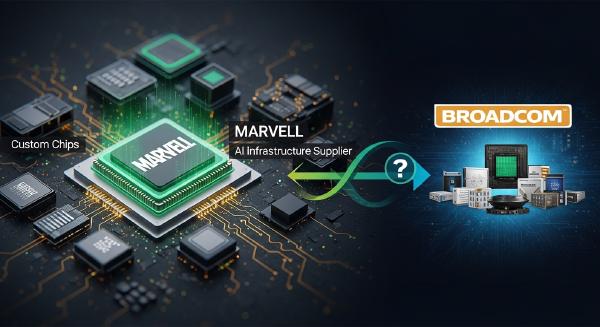
On November 2, Marvell announced an all-stock agreement to acquire Lumentum in a transaction valued at approximately $115 billion. Under the proposed terms, each Lumentum share will be exchanged for 4.5 Marvell shares, representing a premium of approximately 23.9% over Lumentum’s share price before acquisition rumors surfaced on October 28.
The transaction remains subject to shareholder and regulatory approvals, with both companies expecting completion in the first half of 2028.
The deal raises an interesting strategic question: Why would a company already operating across high-speed connectivity chips, optical DSPs, and custom silicon want to acquire a major optical component supplier?
The answer goes beyond expanding its product portfolio.
AI data centers are changing the economics and engineering requirements of optical interconnects. As bandwidth requirements increase, electrical chips, optical engines, light sources, and packaging technologies need to be designed together. Access to high-performance optical components and the ability to manufacture them at scale are becoming increasingly important.
Marvell is effectively betting on greater vertical integration across the electrical and optical domains.
Its objective is not simply to sell more chips or optical components. It is to gain control over more of the technologies required to build complete optoelectronic interconnect solutions.
🔍 Optical Interconnect Economics Are Being Reallocated #
To understand the acquisition, start with the architecture of a high-speed optical transceiver.
An optical module converts electrical signals into optical signals for transmission over fiber, then converts incoming optical signals back into electrical signals.
In conventional high-speed pluggable modules, the DSP performs digital signal processing, equalization, and signal compensation. Lasers, modulators, photodetectors, and other optical components handle light generation, modulation, transmission, and reception.
Both sides are necessary, but they involve different engineering disciplines and manufacturing requirements.
The Electrical Side: DSPs and Signal Processing #
As transmission speeds increase, electrical signal integrity becomes harder to maintain.
Higher data rates introduce greater sensitivity to insertion loss, crosstalk, reflections, and other channel impairments. Maintaining acceptable bit error rates requires increasingly sophisticated signal processing and compensation.
This has made optical DSPs an important part of the high-speed interconnect supply chain, benefiting vendors such as Broadcom and Marvell.
However, not every architecture relies on a conventional DSP-based module.
Linear-drive pluggable optics (LPO), for example, reduce or eliminate the DSP inside the optical module and shift more signal-processing responsibilities toward the host ASIC. This can lower module power consumption, latency, and cost, although it also places tighter requirements on the electrical channel and host-side signal integrity.
The result is a changing division of responsibilities between the host system and optical module.
The Optical Side: Materials, Devices, and Manufacturing #
Optical components compete on a different set of technical variables.
Indium phosphide (InP) materials, epitaxial growth, laser design, photonic device fabrication, optical coupling, and manufacturing yields all influence final product performance.
These are not problems that can be solved simply by improving a DSP.
A laser may perform well in laboratory testing, but commercial deployment requires consistent device characteristics, acceptable production yields, reliable packaging, and sufficient manufacturing capacity.
This distinction becomes particularly important as AI infrastructure demand accelerates.
Hyperscale customers do not purchase isolated laboratory breakthroughs. They need products that meet specifications, maintain consistent quality, and arrive in sufficient quantities to support system deployments.
Manufacturing execution is therefore part of the technology itself.
Why Lumentum Matters to Marvell #
Optical module competitiveness also depends on the ability to integrate optical design, packaging, testing, yield management, and high-volume delivery.
The economic value of the supply chain cannot be divided neatly into electrical chips versus optical components. Bargaining power increasingly depends on how difficult a supplier’s capabilities are to replace.
This is where Lumentum becomes strategically relevant to Marvell.
If the acquisition closes, Marvell will have an opportunity to combine its existing DSP, silicon photonics, and connectivity businesses with Lumentum’s light-source technology, optical component expertise, manufacturing experience, and supply capabilities.
Activities that previously required coordination across separate companies could be developed under a more unified product and engineering organization.
That does not guarantee lower costs or better performance. Integration still needs to be demonstrated through actual products, production yields, and customer deployments.
But the strategic opportunity is clear: Marvell can move beyond supplying individual connectivity chips and participate more directly in designing complete optoelectronic solutions.
🤝 NVIDIA Has Strategic Relationships With Both Companies #
Another important part of this transaction is NVIDIA’s involvement with both Marvell and Lumentum.
In March 2026, NVIDIA announced a $2 billion investment in Lumentum, alongside a multi-year strategic agreement supporting optical technology research and development, manufacturing capacity expansion, and U.S. production capabilities.
During the same month, NVIDIA also announced a $2 billion investment in Marvell. The companies identified cooperation opportunities involving NVLink Fusion, custom compute silicon, and advanced optical interconnect technologies.
These investments point toward a shared infrastructure requirement: AI systems need increasingly capable interconnects, backed by sufficient manufacturing capacity.
Interconnects Are Becoming a System-Level Bottleneck #
As AI clusters expand across more servers, racks, and accelerator systems, data movement becomes a major factor in overall computing efficiency.
A GPU or accelerator can deliver substantial processing performance, but that performance is difficult to realize when communication between computing units becomes a bottleneck.
Several variables must be considered together:
- Bandwidth: How much data can move between computing units.
- Latency: How quickly information can travel between endpoints.
- Power consumption: How much energy the interconnect requires.
- Signal integrity: Whether data can be transmitted reliably at high speeds.
- Reliability: Whether the network can operate continuously at scale.
- Manufacturing capacity: Whether suppliers can deliver enough components to support deployment.
For NVIDIA, investing in optical technology development and supplier capacity helps secure the infrastructure required for future AI systems.
Its optical ecosystem also extends beyond Marvell and Lumentum. Coherent is another important optical technology supplier with strategic investment and cooperation ties to NVIDIA.
Marvell’s Position in the NVIDIA Ecosystem #
Marvell operates across multiple customer relationships and technology ecosystems.
It participates in NVIDIA-related infrastructure initiatives while continuing to supply connectivity chips, custom silicon, and networking products to other data center customers.
Acquiring Lumentum could expand its ability to participate in customers’ system architecture decisions earlier in the development process.
This matters because customers increasingly evaluate computing, networking, optical connectivity, and packaging as interconnected design problems.
Suppliers capable of supporting several of these areas can take on more engineering responsibility and potentially secure a larger share of the overall system value.
The commercial opportunity is not limited to selling additional components. It is about becoming a more influential participant in the customer’s architecture.
⚡ Moving Light Closer to Chips Creates New Engineering Challenges #
Traditional electrical interconnects face physical limitations.
As signals travel through circuit boards, connectors, and copper traces, they encounter insertion loss, reflections, crosstalk, and other signal-integrity problems.
The higher the transmission speed and the longer the electrical path, the more compensation is generally required. That compensation consumes additional power and increases design complexity.
One way to address these limitations is to move electrical-to-optical conversion closer to the computing or switching silicon.
This is driving development across several architectural approaches:
- Co-Packaged Optics (CPO)
- Near-Packaged Optics (NPO)
- On-Board Optics (OBO)
- Silicon photonics
- Optical I/O chiplets
- External laser architectures
These approaches differ in implementation, but they share a common objective: shorten high-speed electrical connections and use optical transmission where it offers better bandwidth and power characteristics.
CPO Changes the Manufacturing and Maintenance Model #
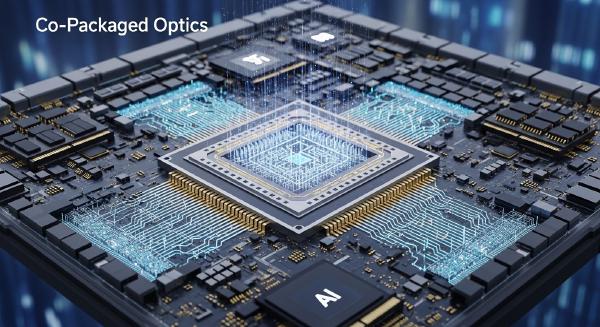
CPO places optical engines close to the switch ASIC or compute chip, reducing the distance that high-speed electrical signals must travel.
This can improve signal integrity and reduce electrical I/O power consumption.
However, closer integration also concentrates manufacturing and operational challenges.
Optical components must operate within demanding thermal environments. Fiber connections need to support high density without compromising reliability. Packaging must maintain precise alignment, and testing becomes more complicated once electrical and optical components are integrated into the same assembly.
Repairability is another concern.
A conventional pluggable optical module can be removed and replaced independently. A failed optical engine integrated into a switch package may require a much more complicated repair process.
The system-level power savings must therefore be evaluated against the costs of optical sources, cooling, advanced packaging, testing, and maintenance.
Why Pluggable Optics Will Remain Relevant #
Despite the progress of CPO, conventional pluggable optical modules are unlikely to disappear immediately.
They offer several operational advantages:
- Straightforward deployment and replacement.
- Established manufacturing and supply chains.
- Greater flexibility when upgrading network configurations.
- Independent testing and maintenance.
- Familiar service procedures for data center operators.
Different applications also have different bandwidth, reach, cost, and reliability requirements.
Pluggable optics, LPO, NPO, and CPO will therefore coexist across different parts of the infrastructure.
For suppliers, this creates a broader set of engineering requirements. Optical sources, electrical chips, packaging, thermal management, and testing must increasingly be considered together.
Marvell’s proposed acquisition of Lumentum directly addresses this requirement.
By controlling more of the technology stack, Marvell could become involved in customer architecture decisions before individual component specifications are finalized.
For additional technical background, see LPO vs. CPO vs. NPO: The Future of AI Optical Interconnects.
🧠 Will Optical Engines Follow the HBM Integration Model? #
High Bandwidth Memory (HBM) offers a useful reference for understanding how value can shift when components become more tightly integrated.
HBM and compute chips increasingly depend on advanced packaging to deliver the memory bandwidth, capacity, and power efficiency required by modern accelerators.
This changes the relationship between memory suppliers, compute chip designers, and packaging manufacturers.
Instead of developing products independently and integrating them near the end of the process, these companies need to coordinate much earlier.
Memory bandwidth, package dimensions, thermal characteristics, power delivery, and manufacturing capacity all influence the final system architecture.
Optical interconnects are beginning to follow a similar development pattern.
Optical Sources and Compute Chips Need Earlier Co-Design #
Future optical engines will need to be optimized alongside electrical chips, packaging structures, and thermal systems.
The location of the light source, optical coupling method, electrical interface, and packaging architecture can all influence overall performance.
This means suppliers may need to participate in product development much earlier than they did in conventional pluggable transceiver designs.
The resulting value shift does not necessarily mean independent optical suppliers will lose bargaining power.
HBM demonstrates the opposite possibility.
Companies that control scarce technology, maintain reliable manufacturing capacity, and deliver products that customers cannot easily replace can strengthen their market positions even as their products become more deeply integrated into customer systems.
The same principle applies to optical components.
The key question is whether suppliers can maintain differentiated capabilities as optical product architectures evolve.
What This Means for Optical Module Manufacturers #
For domestic high-speed optical module manufacturers, existing engineering capabilities remain valuable.
Optical design, packaging, testing, yield management, and high-volume delivery provide the foundation for competing in the next generation of data center infrastructure.
However, these capabilities may no longer be sufficient on their own.
The next challenge is extending existing expertise into customer-specific optical engines and integrated optoelectronic systems.
Several developments deserve attention.
First, earlier chip-and-light-engine co-design will require optical suppliers to become involved in customer development programs before product specifications are finalized.
Second, high-performance light sources could become a supply-chain bottleneck. Companies with differentiated device technology and proven manufacturing capacity may gain greater negotiating power.
Third, packaging and thermal integration will become increasingly important as optical components move closer to compute and networking silicon.
Finally, suppliers will need to demonstrate that their technologies can scale beyond engineering samples into stable, high-volume production.
The ability to ship large quantities of existing optical modules remains important. But future competitiveness will also depend on whether companies can transfer their accumulated engineering experience into next-generation optical architectures.
For a closer look at Lumentum’s position in this market, see Why Lumentum Became a Critical AI Optical Interconnect Supplier.
📊 Marvell Is Betting on the Integration of Light and Silicon #
Marvell’s proposed $115 billion acquisition of Lumentum reflects a broader shift in AI infrastructure.
The competitive boundary is expanding beyond processors, networking ASICs, and optical DSPs. Light sources, silicon photonics, advanced packaging, and optical integration are becoming increasingly important parts of system architecture.
Marvell wants to bring electrical chips, optical sources, and optoelectronic integration technologies into a more unified product organization.
The potential benefits include:
- Better coordination between electrical and optical design.
- Earlier participation in customer system architecture development.
- Greater control over critical optical component supply.
- Opportunities to optimize performance and power at the system level.
- A broader portfolio of products for next-generation AI infrastructure.
However, acquiring the technology is only the first part of the challenge.
The real test will come from product integration and manufacturing execution.
Can Marvell combine its electrical connectivity expertise with Lumentum’s optical capabilities to reduce customer system costs? Can the combined organization improve bandwidth density and power efficiency? Can it maintain reliable production yields and deliver enough components to support large-scale AI deployments?
These questions will determine whether the acquisition creates lasting competitive advantages.
The economics of optical interconnects are being reallocated, not simply transferred from electrical chip suppliers to optical component manufacturers.
As AI infrastructure evolves, bargaining power will increasingly favor companies that can combine differentiated technology, system-level engineering, and dependable manufacturing capacity.
In the next generation of data centers, controlling how data moves may become just as important as controlling how data is processed.