CXMT LPDDR6 Mass Production: A New Milestone for Mobile DRAM
ChangXin Memory Technologies (CXMT) announced on August 29, 2026, that its self-developed LPDDR6 mobile DRAM has entered mass production, marking a significant step in the company’s transition toward next-generation memory technology.
According to the announcement, CXMT’s LPDDR6 will make its global commercial debut in Xiaomi’s upcoming flagship foldable smartphone, the Xiaomi 18 Fold, scheduled for launch in September 2026.
The development is notable because mobile DRAM has traditionally been dominated by a small group of global suppliers, particularly Samsung, SK hynix, and Micron. Reaching mass production on a new generation of low-power memory gives CXMT an opportunity to compete at the leading edge of mobile DRAM rather than focusing exclusively on mature generations.
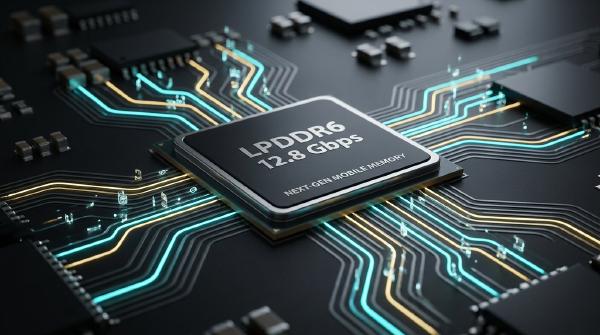
CXMT’s H1 2026 financial disclosure had already outlined progress toward LPDDR6 industrialization. The company says the new memory reaches a peak transfer rate of 12,800 Mbps, supports up to 16 GB per chip, and has undergone customer sampling, validation, and hardware/software compatibility testing before entering volume production.
The milestone is particularly relevant to the rise of on-device AI, where memory bandwidth, capacity, latency, and power efficiency increasingly influence the performance of local AI workloads.
🔮 LPDDR6 Brings a New Mobile Memory Architecture #
LPDDR6 is designed as the next generation of low-power DRAM for mobile and other power-constrained computing platforms.
Compared with mainstream LPDDR5X, the new generation introduces architectural and signaling changes intended to increase data throughput while improving power and thermal efficiency.
CXMT reports a peak transfer rate of:
12,800 Mbps
This represents a substantial increase in memory bandwidth compared with widely deployed LPDDR5X configurations.
For mobile SoCs, the significance extends beyond benchmark memory throughput. Modern application processors increasingly rely on system memory for CPU workloads, GPU rendering, image processing, neural-network inference, and increasingly sophisticated multitasking.
Higher memory bandwidth can reduce contention between these workloads and allow compute engines to spend less time waiting for data.
Memory Capacity #
CXMT’s LPDDR6 supports a maximum single-chip density of 16 GB according to the company’s disclosed specifications.
Higher-density mobile DRAM is particularly useful for flagship devices because it allows manufacturers to increase system memory capacity without requiring an excessive number of discrete memory packages.
This becomes increasingly important as smartphones move toward larger local AI models and more demanding multimodal applications.
Power and Thermal Efficiency #
Mobile memory is subject to an unusually restrictive power envelope.
Unlike a desktop graphics card or server accelerator, smartphone DRAM operates inside a compact device where sustained power consumption directly affects:
- Battery life
- Surface temperature
- Sustained performance
- Thermal throttling
- Mechanical design
- Overall system efficiency
CXMT states that LPDDR6 improves energy efficiency and thermal behavior compared with previous-generation memory.
Actual improvements will ultimately depend on the implementation, memory frequency, voltage configuration, workload, controller design, and device-level power management.
🔧 From Development to Commercial Mass Production #
The transition from a functional memory prototype to mass production is considerably more difficult than demonstrating a working chip.
Before commercial deployment, a mobile DRAM product must satisfy requirements across several layers:
- Manufacturing yield
- Electrical stability
- Power consumption
- Thermal behavior
- Memory-controller compatibility
- Package integration
- Operating-system support
- Firmware validation
- Device-level reliability
- High-volume production consistency
CXMT says it completed multiple rounds of customer sampling, verification, and software/hardware adaptation before beginning mass production.
This process is critical because mobile memory is tightly coupled to the SoC and platform firmware.
A theoretically faster memory device has limited practical value if the host processor, memory controller, package, board design, or software stack cannot reliably operate at the required data rate.
📱 Xiaomi Provides the First Commercial Platform #
The first major commercial platform for CXMT’s LPDDR6 is Xiaomi’s upcoming Xiaomi 18 Fold flagship foldable smartphone.
This creates a particularly interesting hardware combination because Xiaomi is also pairing the memory with its proprietary Xuanjie O3 SoC.
According to Xiaomi founder Lei Jun, Xuanjie O3 is a 3nm, all-big-core SoC and the first system-on-chip to fully support CXMT’s LPDDR6.
The resulting platform creates a tightly integrated domestic hardware stack:
CXMT LPDDR6 → Xuanjie O3 SoC → Xiaomi flagship device
Rather than introducing new memory technology as an isolated component, the platform combines the memory controller, processor, firmware, and terminal product around the same technology transition.
⚡ Why LPDDR6 Matters for On-Device AI #
The importance of faster mobile DRAM extends well beyond conventional application performance.
Smartphones increasingly execute AI workloads locally rather than sending every task to a remote cloud service.
These workloads include:
- Generative AI
- Large language model inference
- Image generation
- Computational photography
- Speech recognition
- Real-time translation
- Multimodal processing
- Personal AI assistants
Many of these workloads are constrained not only by raw compute throughput but also by memory bandwidth and capacity.
Neural-network inference frequently involves moving large quantities of weights and intermediate activations between memory and compute engines.
When the processor can calculate faster than memory can supply data, the system becomes memory-bound.
Higher-bandwidth LPDDR6 can therefore increase the amount of data available to CPU, GPU, and NPU resources and potentially improve sustained AI throughput.
However, memory bandwidth alone does not determine AI performance.
Actual gains depend on the complete platform, including:
- NPU architecture
- GPU compute capability
- CPU performance
- Memory latency
- Cache hierarchy
- Memory-controller efficiency
- AI software optimization
- Model quantization
- Thermal limits
LPDDR6 should therefore be viewed as an important enabling technology rather than a standalone guarantee of faster AI inference.
🏭 A Shift in China’s Mobile DRAM Supply Chain #
The broader significance of CXMT’s LPDDR6 production lies in the transition from supplying established memory generations to participating in the commercialization of a new generation.
Historically, the earliest commercial deployments of new LPDDR generations have largely involved the major international DRAM manufacturers.
Domestic device and SoC manufacturers then typically integrate those components into their platforms.
CXMT’s LPDDR6 strategy changes that relationship.
The company is attempting to establish an integrated domestic ecosystem in which:
Memory technology
→ SoC compatibility
→ Device integration
→ Commercial deployment
can progress together.
The Xiaomi relationship is particularly important in this context because the memory supplier and smartphone manufacturer can coordinate validation and platform integration rather than treating LPDDR6 as a generic component purchased after the fact.
🔗 The Importance of SoC-Memory Co-Design #
Modern mobile processors are increasingly designed around the characteristics of their memory subsystem.
The memory controller determines supported data rates, channel configurations, timing behavior, power states, and other parameters. The SoC’s cache architecture also determines how frequently the processor must access external DRAM.
As a result, maximizing the value of LPDDR6 requires close coordination between the memory manufacturer and SoC designer.
The Xuanjie O3 platform provides an example of this approach.
If the processor, memory controller, DRAM, firmware, and operating system are validated together, manufacturers can optimize the entire data path instead of relying solely on improvements in DRAM specifications.
This becomes even more important for AI workloads because different models produce very different memory-access patterns.
📈 CXMT’s Broader DRAM Strategy #
LPDDR6 is also part of a larger progression for CXMT.
The company has already expanded its presence in domestic mobile-memory supply chains through products based on previous generations such as LPDDR4 and LPDDR5/LPDDR5X.
Moving to LPDDR6 allows CXMT to demonstrate capabilities across the full development cycle of a new DRAM generation:
- Architecture development
- Process integration
- Product engineering
- Customer sampling
- Platform validation
- Mass production
- Commercial deployment
Successfully executing this cycle at scale is important because leading-edge memory competitiveness depends on much more than peak data rate.
Yield, cost, reliability, power efficiency, packaging, manufacturing capacity, and customer qualification all determine whether a memory product can become commercially significant.
🌐 Implications for the Global Mobile Memory Market #
The commercial introduction of CXMT LPDDR6 adds another supplier to the leading edge of mobile DRAM development.
For the global memory market, the significance is not simply the appearance of another LPDDR6 product. The larger issue is whether CXMT can scale production, maintain competitive yields, expand customer adoption, and sustain technological progress across subsequent generations.
Several factors will determine the long-term impact:
Manufacturing Scale #
Mass production must progress beyond initial flagship-device deployments.
Yield and Cost #
Competitive manufacturing economics are essential for broader adoption.
Platform Compatibility #
More SoCs and device platforms must support LPDDR6.
Reliability #
Flagship smartphones require memory capable of sustained operation across demanding thermal and power conditions.
Customer Expansion #
The technology will become more strategically significant if it moves beyond a limited number of domestic flagship platforms.
Next-Generation Development #
Maintaining a competitive development cadence will matter as international suppliers introduce their own future DRAM technologies.
📊 What the 12,800 Mbps Specification Really Means #
The 12,800 Mbps figure represents a per-pin data-transfer rate rather than the total memory bandwidth of an entire smartphone.
Actual system bandwidth depends on the memory interface width and channel configuration.
Conceptually:
Memory bandwidth = data rate × interface width ÷ 8
Therefore, a higher LPDDR6 transfer rate provides the foundation for greater bandwidth, but the final system-level bandwidth depends on how the SoC implements the memory interface.
This distinction matters when comparing smartphones.
Two devices using the same LPDDR6 memory generation can still produce different real-world performance because their memory controllers, bus widths, software, thermal envelopes, and workload characteristics differ.
🚀 From Memory Supplier to Leading-Edge Competitor #
CXMT’s LPDDR6 mass production marks an important transition for China’s mobile DRAM ecosystem.
The immediate milestone is straightforward: a domestically developed LPDDR6 product has reached volume production and is being integrated into a flagship commercial device.
The more important question is what happens afterward.
If CXMT can increase production yields, expand capacity, qualify additional customers, and continue developing successive DRAM generations, LPDDR6 could become more than a single product milestone. It could serve as a foundation for a broader expansion into premium mobile memory.
The rise of on-device AI further strengthens the strategic importance of this transition.
As smartphones increasingly execute AI models locally, memory is becoming a critical component of system architecture rather than a passive storage resource. Bandwidth, capacity, latency, and energy efficiency increasingly determine how effectively processors can use their CPU, GPU, and NPU resources.
CXMT’s LPDDR6 therefore represents more than a faster memory chip. It is a test of whether a domestic semiconductor ecosystem can coordinate advanced DRAM manufacturing, SoC design, platform validation, and flagship device integration at the leading edge of the mobile market.
The technology’s ultimate impact will be determined not by the launch announcement alone, but by how rapidly it scales from an initial flagship deployment into a broader commercial ecosystem.