AMD Extends AM5 Support to 2029 and Launches New X3D Processors
Ahead of Computex 2026, AMD delivered one of the most consumer-friendly announcements in recent desktop PC history: the AM5 socket platform will now be supported through at least 2029.
The decision significantly extends the lifespan of AMD’s current desktop ecosystem and confirms that future Ryzen processors based on Zen 7 will continue to use the same socket introduced alongside Zen 4 in 2022.
For PC builders and enthusiasts, the message is clear: upgrading to future AMD CPUs will not require replacing motherboards for many years to come.
🔄 AM5 Support Officially Extended Through 2029 #
When AMD launched the AM5 platform in 2022, the company committed to supporting the socket through at least 2027. At Computex 2026, AMD not only fulfilled that promise but extended the platform’s lifespan by an additional two years.
According to AMD’s current roadmap, AM5 will support:
- Zen 4 (2022)
- Zen 5
- Zen 6
- Zen 7
This gives the platform a projected lifespan of at least seven years.
Why AMD Is Extending AM5 #
Several market factors likely influenced this decision.
Rising Platform Upgrade Costs #
Upgrading to a new socket often requires replacing multiple components simultaneously:
- Motherboard
- Memory
- CPU cooler (in some cases)
- Potentially storage devices
With DDR5 memory prices remaining elevated and SSD prices rising significantly in recent years, consumers have become increasingly sensitive to platform transition costs.
Existing Standards Remain Sufficient #
Current technologies still provide ample headroom for future hardware:
- PCIe 5.0 remains far from saturated by most GPUs
- PCIe 5.0 SSDs already exceed the needs of typical workloads
- DDR6 remains years away from widespread adoption
- PCIe 6.0 ecosystem maturity is still limited
As a result, introducing a new desktop platform today would provide relatively little practical benefit for most users.
🏆 AM4 Remains the Blueprint for Platform Longevity #
AMD’s confidence in long-term platform support is rooted in its success with AM4.
Introduced in 2016, AM4 became one of the longest-lived desktop platforms in PC history.
Over its lifespan, AM4 supported:
- Bristol Ridge APUs
- Zen 1
- Zen+
- Zen 2
- Zen 3
Even a decade after its debut, AMD continues releasing new products for the platform.
This long-term compatibility helped establish AMD’s reputation among enthusiasts and significantly reduced upgrade costs for existing users.
AM5 appears set to continue that tradition.
🎮 Ryzen 7 5800X3D 10th Anniversary Edition Celebrates AM4 #
To commemorate ten years of the AM4 platform, AMD announced the Ryzen 7 5800X3D 10th Anniversary Edition.
Originally launched in 2022, the 5800X3D became one of the most influential gaming processors of its generation thanks to its pioneering implementation of 3D V-Cache technology.
Specifications #
The Anniversary Edition retains the same core specifications as the original model:
| Specification | Ryzen 7 5800X3D |
|---|---|
| Architecture | Zen 3 |
| Cores / Threads | 8 / 16 |
| Base Clock | 3.4 GHz |
| Boost Clock | 4.5 GHz |
| L3 Cache | 96 MB |
| TDP | 105W |
| Overclocking | Not Supported |
First-Generation 3D V-Cache Design #
Unlike later X3D processors, the original 5800X3D placed the stacked cache directly above the CPU cores.
This design introduced thermal limitations because:
- SRAM cache is voltage-sensitive
- Maximum operating voltage is limited to approximately 1.35V
- Heat dissipation becomes more challenging
These constraints prevented traditional overclocking support.
Later products such as the 7800X3D and 9800X3D moved the cache beneath the compute die, improving thermal characteristics and enabling additional tuning capabilities.
Gaming Performance Remains Competitive #
Even by modern standards, the 5800X3D remains a highly capable gaming processor.
AMD reports performance gains of:
- 115% over Ryzen 7 2700X
- 47% over Ryzen 7 3700X
- 16% over Ryzen 7 5800X
For many gaming workloads, it continues to compete surprisingly well against significantly newer processors.
Pricing and Availability #
The Ryzen 7 5800X3D 10th Anniversary Edition includes AMD’s new Carbice Ice Pad thermal solution and will launch on June 25.
| Product | MSRP |
|---|---|
| Original 5800X3D (2022) | $449 |
| 5800X3D 10th Anniversary Edition | $349 |
For existing AM4 users with compatible 400-series or 500-series motherboards, it remains one of the most cost-effective gaming upgrades available.
⚡ Ryzen 7 7700X3D Lowers the Barrier to Entry for AM5 Gaming #
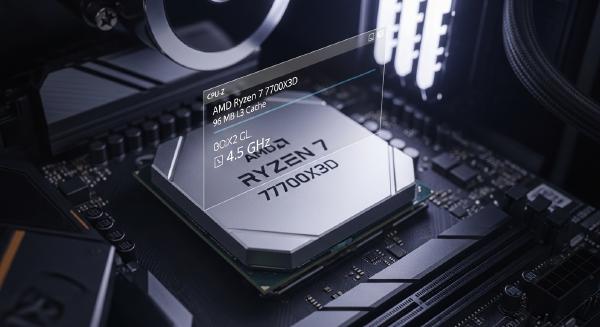
AMD also introduced a new AM5 gaming processor: the Ryzen 7 7700X3D.
Positioned below the popular 7800X3D, the new chip aims to make 3D V-Cache technology accessible to a broader audience.
Ryzen 7 7700X3D Specifications #
| Specification | Ryzen 7 7700X3D |
|---|---|
| Architecture | Zen 4 |
| Cores / Threads | 8 / 16 |
| Base Clock | 4.0 GHz |
| Boost Clock | 4.5 GHz |
| L2 Cache | 8 MB |
| L3 Cache | 96 MB |
| Total Cache | 104 MB |
| TDP | 120W |
Comparison with the 7800X3D #
The primary differences between the two processors are clock speeds.
Compared with the 7800X3D:
- Base frequency is reduced by 200 MHz
- Boost frequency is reduced by 500 MHz
However, AMD retains the full 96 MB 3D V-Cache configuration.
Because gaming workloads often benefit more from cache capacity than raw clock speed, real-world gaming performance is expected to remain highly competitive.
Cooler Operation #
Although both processors share a 120W TDP rating, the lower frequencies may result in:
- Reduced thermal output
- Lower operating temperatures
- Easier cooling requirements
This could make the 7700X3D particularly attractive for compact gaming systems.
Pricing #
AMD has positioned the processor aggressively.
| Product | MSRP |
|---|---|
| Ryzen 7 7700X3D | $329 |
Availability is scheduled for July 16.
At launch, it becomes the most affordable new 8-core X3D processor available on the AM5 platform.
🖥️ Industry-Wide Shift Toward Platform Longevity #
Interestingly, AMD is not alone in extending platform lifecycles.
Intel has also indicated a growing commitment to longer socket support windows, highlighting:
- Continued relevance for existing LGA 1700 systems
- Multi-generation plans for future desktop sockets
This represents a notable shift from the frequent socket transitions that historically characterized the desktop CPU market.
The benefits for consumers are significant:
- Lower upgrade costs
- Longer hardware investment cycles
- Reduced electronic waste
- Greater motherboard value retention
📊 AMD Desktop Platform Roadmap #
| Platform | Launch Year | Supported Architectures | Status |
|---|---|---|---|
| AM4 | 2016 | Bristol Ridge, Zen 1, Zen+, Zen 2, Zen 3 | Still Active |
| AM5 | 2022 | Zen 4, Zen 5, Zen 6, Zen 7 | Supported Through 2029 |
🏁 Conclusion #
AMD’s decision to extend AM5 support through 2029 reinforces one of the company’s strongest competitive advantages: platform longevity. By ensuring compatibility across four Ryzen generations—from Zen 4 through Zen 7—AMD enables users to upgrade processors without repeatedly replacing motherboards and memory.
Alongside this announcement, the launch of the Ryzen 7 5800X3D 10th Anniversary Edition and the Ryzen 7 7700X3D strengthens both the AM4 and AM5 ecosystems. Existing AM4 users gain another opportunity to maximize the value of their systems, while AM5 adopters receive a more affordable entry point into AMD’s highly successful 3D V-Cache lineup.
As component prices continue to rise and platform transitions become increasingly expensive, AMD’s commitment to long-term socket support may prove just as important as raw processor performance in shaping future upgrade decisions.