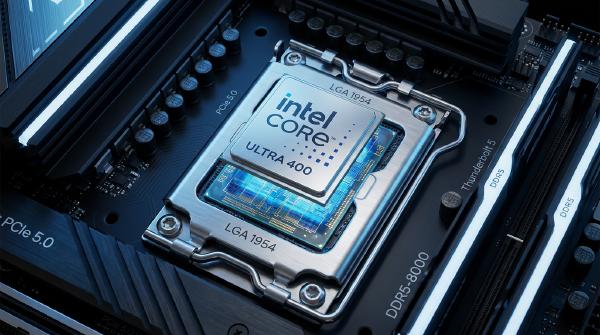
Intel Nova Lake-S Leak: 28-Core CPU Leads in PassMark Single-Thread
Early benchmark records for Intel’s next-generation Nova Lake-S desktop processors have appeared in the PassMark PerformanceTest 11.1 database, offering a first look at the performance potential of the upcoming Core Ultra 400 family.
The most interesting result comes from a 28-core engineering sample that achieved approximately 5,210 points in PassMark’s single-threaded test, narrowly surpassing the existing Core Ultra 9 285K and AMD Ryzen 9 9950X3D flagships.
Even more intriguing is the sample’s calculated performance per gigahertz. Based on its reported 4.8 GHz boost frequency, the result translates to approximately 1,085 points per GHz—a substantial improvement over the frequency-normalized figures of current desktop processors.
However, the picture changes in multi-threaded workloads. The same 28-core sample scored approximately 61,500 points in CPU Mark, trailing both the Core Ultra 9 285K and Ryzen 9 9950X3D.
These results come from pre-production engineering hardware rather than retail processors. They provide an early indication of Nova Lake’s architectural direction, but firmware, clock behavior, power limits, and software optimization remain subject to change.
📊 Nova Lake-S Engineering Samples Appear in PassMark #
The newly discovered records were first reported by VideoCardz after a reader identified unidentified Intel processors through PassMark PerformanceTest 11.1’s Manage Baselines feature.
The processors appear under the generic name “Intel 0000,” with benchmark submissions dating back to September 2026. Unlike the public CPU rankings, the database’s individual submission records can expose results from processors that have not yet received official retail names.
Two configurations stand out:
- 28-core Nova Lake-S: Multiple benchmark submissions, with the highest single-thread result reaching 5,210 points. One entry reports a boost frequency of 4.8 GHz.
- 8-core Nova Lake-S: Several submissions with widely varying results. The strongest single-thread result reaches 5,085 points, slightly exceeding the Core Ultra 9 285K baseline.
The 28-core configuration is particularly important because it is expected to be among the first Nova Lake-S desktop processors to reach the market.
Single-thread results challenge current flagships #
The best-performing 28-core sample recorded approximately 5,210 points in PassMark’s single-threaded CPU test.
For comparison, the individual baseline results selected in the report were:
| Processor | PassMark single-thread score |
|---|---|
| Intel Nova Lake-S 28-core ES | 5,210 |
| Intel Core Ultra 9 285K | 5,059 |
| AMD Ryzen 9 9950X3D | 4,805 |
| Intel Core i9-14900KF | 4,635 |
The Nova Lake sample leads the Core Ultra 9 285K by approximately 3%, the Ryzen 9 9950X3D by around 8%, and the Core i9-14900KF by approximately 12%.
These are encouraging early results, especially considering that the processor remains an engineering sample. However, the margins are not so large that they establish a definitive performance hierarchy for the final products.
The results also depend on the specific PassMark submissions selected for comparison rather than a controlled review of finalized retail processors.
Even the 8-core sample performs competitively #
The smaller Nova Lake-S configuration also produced an interesting result.
Its strongest 8-core submission reached approximately 5,085 points in the single-threaded test, narrowly exceeding the Core Ultra 9 285K’s 5,059-point result.
However, the other 8-core submissions displayed much greater variation. Their overall CPU Mark scores ranged from roughly 9,000 to 19,200 points.
Such a wide spread suggests that the samples were tested under different development conditions, firmware configurations, or power settings. The precise cause is unknown, so these records should not be treated as representative of the eventual 8-core retail product.
⚡ Performance per GHz: A Potential Architectural Improvement #
The most interesting aspect of the Nova Lake benchmark is not simply its absolute single-threaded score. It is the result after dividing the score by the processor’s reported or specified boost frequency.
This produces a rough metric of PassMark points per GHz.
Using the available figures:
| Processor | Single-thread score | Frequency used | Approx. points/GHz |
|---|---|---|---|
| Nova Lake-S 28-core ES | 5,210 | 4.80 GHz | 1,085 |
| Core Ultra 9 285K | 5,059 | 5.38 GHz | 940 |
| Ryzen 9 9950X3D | 4,805 | 5.70 GHz | 843 |
On this calculation, the Nova Lake sample delivers approximately 15% more PassMark points per GHz than the Core Ultra 9 285K and roughly 29% more than the Ryzen 9 9950X3D.
That is a substantial difference, although it should not be interpreted as a measured 15% or 29% improvement in IPC.
Why points per GHz is not the same as IPC #
IPC, or instructions per clock, describes how many instructions a processor executes per clock cycle under a particular workload. It is a useful architectural metric, but it requires controlled testing to measure accurately.
PassMark points per GHz are not a direct IPC measurement.
There are several reasons:
- Different frequency references: The Nova Lake sample uses a reported benchmark boost frequency, while the comparison processors use recorded or manufacturer-specified boost figures.
- Different operating conditions: Actual clock speeds during benchmark execution can vary with temperature, power limits, and workload behavior.
- Benchmark characteristics: PassMark measures application-level performance, which is influenced by more than instruction throughput alone.
- Engineering sample maturity: The Nova Lake processor may not yet have finalized frequency behavior, firmware, or power management.
The Ryzen 9 9950X3D comparison is particularly sensitive to the frequency baseline because its nominal maximum boost clock is used rather than a verified clock recorded during the same test.
Consequently, the normalized figures are best viewed as an early performance-efficiency indicator, not a precise architectural comparison.
Nevertheless, if retail Nova Lake processors retain much of this apparent advantage, the results could point to meaningful improvements in Intel’s next-generation CPU core design.
🔬 Multi-Threaded Performance Tells a Different Story #
While Nova Lake’s single-threaded results look promising, the multi-threaded numbers are considerably less impressive.
The 28-core engineering sample achieved approximately 61,509 points in PassMark CPU Mark. That places it ahead of the Core i9-14900KF, but behind the Core Ultra 9 285K and Ryzen 9 9950X3D.
| Processor | PassMark CPU Mark |
|---|---|
| Intel Core Ultra 9 285K | 67,274 |
| AMD Ryzen 9 9950X3D | 72,065 |
| Intel Nova Lake-S 28-core ES | 61,509 |
| Intel Core i9-14900KF | 58,074 |
Based on these selected results, the Nova Lake sample trails the Core Ultra 9 285K by approximately 9% and the Ryzen 9 9950X3D by around 15%. It remains roughly 6% ahead of the Core i9-14900KF.
This gap is notable because the Nova Lake sample reportedly contains 28 cores. Its comparatively modest multi-threaded result suggests that the processor is not yet operating at the performance level expected from its core configuration.
Possible explanations for the multi-core gap #
There are several plausible explanations, although the available PassMark records do not establish a definitive cause.
1. Limited all-core boost frequencies
An engineering sample may operate at lower sustained frequencies than a finalized retail processor. Under multi-threaded workloads, power and thermal limits can significantly affect performance.
A processor that achieves a strong single-core boost but cannot sustain high frequencies across all cores may produce exactly this kind of performance imbalance.
2. Immature firmware and microcode
Early desktop processors depend on BIOS implementations, microcode, and platform-level power management to coordinate frequency behavior across different core types.
Incomplete tuning could affect scheduling, voltage control, and sustained performance.
3. Software and benchmark optimization
Nova Lake combines different types of CPU cores, making operating-system scheduling and workload distribution important. Software that does not fully account for the architecture may fail to extract its maximum available throughput.
4. Inconsistent engineering configurations
The wide variation among the 8-core PassMark submissions reinforces the possibility that these processors were tested under different firmware and system configurations.
At this stage, it would be premature to attribute the multi-threaded gap to a fundamental weakness in Nova Lake’s architecture.
Retail benchmarks will be necessary to determine whether the discrepancy disappears after Intel completes its firmware and frequency optimization.
🧩 Nova Lake-S Lineup Leaks: Seven Models and Three BFC Variants #
Alongside the benchmark results, separate leaks have outlined a possible initial Nova Lake-S desktop lineup.
The reported list includes seven processors spanning the Core Ultra 5, Core Ultra 7, and Core Ultra 9 segments. Three models carry a BFC suffix, which appears to identify processors equipped with a significantly enlarged last-level cache.
This is particularly interesting because Intel has been developing a big last-level cache technology, commonly described in leaks as bLLC. The approach is widely viewed as Intel’s potential response to AMD’s 3D V-Cache processors.
Core Ultra 9 4970K BFC: The rumored flagship #
The leaked Core Ultra 9 4970K BFC is associated with the following specifications:
| Specification | Rumored configuration |
|---|---|
| Model | Core Ultra 9 4970K BFC |
| CPU architecture | Nova Lake |
| Performance cores | 8 P-cores |
| Efficiency cores | 16 E-cores |
| Low-power efficiency cores | 4 LP-E cores |
| Total cores | 28 |
| Reported bLLC capacity | Up to 144MB |
| Native L3 cache | Reported separately in some leaks |
| TDP | 125W |
| Integrated graphics | 32 execution units |
An important terminology distinction is necessary here: the reported 144MB figure refers to bLLC, not necessarily 144MB of conventional native L3 cache. Some leaked cache tables list the bLLC capacity separately from the processor’s native L3 cache.
Neither the cache configuration nor the BFC product designation has been confirmed by Intel.
What does BFC mean? #
The BFC suffix appears on three of the seven leaked desktop models and is associated with the large-cache configuration.
The designation’s official meaning remains unknown. Earlier reports described the underlying technology as bLLC, or big last-level cache.
The strategic purpose is easier to understand than the branding. Increasing the amount of cache available to the CPU can reduce how often it needs to retrieve data from system memory.
This can be especially valuable in gaming, where frame-time consistency and access to frequently reused data can benefit from larger caches.
AMD’s Ryzen X3D processors have demonstrated the potential of this approach through 3D V-Cache. Intel’s reported bLLC technology suggests that it wants a comparable option in its desktop CPU lineup.
However, larger cache capacity does not automatically guarantee higher gaming performance. Cache latency, memory behavior, processor frequency, game-engine characteristics, and implementation details all influence the final result.
Seven rumored Nova Lake-S desktop models #
The leaked lineup includes the following model identifiers:
| Rumored processor | Core configuration | Cache designation | Reported TDP |
|---|---|---|---|
| Core Ultra 9 4970K BFC | 8P + 16E + 4LP-E | BFC / bLLC | 125W |
| Core Ultra 9 4950K | 8P + 16E + 4LP-E | Standard | 125W |
| Core Ultra 9 4900 BFC | 6P + 12E + 4LP-E | BFC / bLLC | 65W |
| Core Ultra 7 4870K BFC | 8P + 12E + 4LP-E | BFC / bLLC | 125W |
| Core Ultra 7 4850K | 8P + 12E + 4LP-E | Standard | 125W |
| Core Ultra 5 4650K | 6P + 12E + 4LP-E | Standard | 125W |
| Core Ultra 5 4650KF | 6P + 12E + 4LP-E | Standard | 125W |
These configurations are based on leaked product tables rather than Intel specifications. Different reports have presented inconsistent core-count details, particularly where low-power E-cores were omitted from individual entries.
The table should therefore be treated as a reported product lineup, not a finalized retail catalog.
🎮 Can BFC Become Intel’s Answer to AMD 3D V-Cache? #
The large-cache variants could be among the most strategically important products in the Nova Lake-S family.
AMD’s X3D processors have established a strong reputation among gaming enthusiasts, partly because additional cache can reduce memory access overhead in games that are sensitive to latency and data availability.
Intel’s proposed bLLC approach could offer a competing way to increase the amount of cache available to the processor.
If the technology works as intended, the benefits could include:
- Reduced dependence on system memory for frequently accessed data.
- Better performance in cache-sensitive game engines.
- More consistent frame delivery in selected workloads.
- Potential improvements in certain productivity and simulation applications.
The three rumored BFC models also suggest that Intel may not reserve the technology exclusively for its most expensive flagship. A range extending across Core Ultra 7 and Core Ultra 9 products could give users more flexibility when selecting a gaming-oriented processor.
However, the actual gaming advantage remains unknown. The leaked PassMark records do not measure the effects of bLLC, and synthetic CPU benchmarks cannot establish how the cache-enhanced models will compare with AMD’s X3D lineup.
Independent gaming benchmarks will be essential to determine whether Intel can challenge AMD in this segment.
📅 Nova Lake-S Launch Timeline: Early 2027 Is the Current Target #
Current industry reports point toward an early-2027 rollout for Nova Lake-S desktop processors.
The initial 28-core models are reportedly scheduled for a release window spanning late January through March 2027. Other configurations, including 16-core and 8-core models, are expected to follow later.
A separate high-core-count configuration with up to 52 cores has also appeared in industry rumors, potentially targeting a later launch window.
These dates are based on leaked partner schedules and industry reporting, not an official Intel launch announcement.
The staggered rollout would allow Intel to introduce its flagship desktop processors first before expanding the lineup across more price and performance segments.
It also means that the first retail Nova Lake-S products may not represent the full capabilities of the generation.
🔍 What the PassMark Leak Actually Tells Us #
The newly surfaced results offer several useful clues, but their significance needs to be kept in perspective.
Single-thread performance looks promising. The 28-core sample’s 5,210-point result puts it slightly ahead of current flagship desktop processors in this particular benchmark.
Frequency-normalized performance is intriguing. The approximate 1,085 points per GHz result suggests a potentially meaningful improvement, although it is not a controlled IPC measurement.
Multi-threaded performance remains uncertain. The 61,509-point CPU Mark result trails both the Core Ultra 9 285K and Ryzen 9 9950X3D, leaving considerable room for improvement.
The BFC cache strategy could be important. Three rumored large-cache variants suggest Intel is preparing a more direct response to AMD’s gaming-focused X3D processors.
The release schedule is still speculative. Early-2027 timing is supported by industry leaks, but Intel has not confirmed retail dates, pricing, or final configurations.
The most important next step is to evaluate qualification samples and eventually retail processors under controlled conditions.
🏁 Conclusion: Nova Lake’s Single-Thread Potential Looks Promising #
Intel’s Nova Lake-S engineering samples have produced an encouraging first set of PassMark results. The leading 28-core sample achieved 5,210 points in single-threaded testing, narrowly surpassing the Core Ultra 9 285K and Ryzen 9 9950X3D.
The frequency-normalized calculation is even more interesting, suggesting that Nova Lake may deliver stronger single-threaded performance per clock than current desktop flagships.
However, the multi-threaded results are less impressive. The same sample trails both the Core Ultra 9 285K and Ryzen 9 9950X3D in overall CPU Mark performance, while the smaller 8-core samples show significant variation.
The rumored BFC models add another dimension to the story. With up to 144MB of reported bLLC capacity, Intel may be preparing a cache-focused desktop lineup intended to challenge AMD’s 3D V-Cache products.
For now, the results are best interpreted as an early indication of Nova Lake’s potential rather than a final performance verdict. Engineering samples, inconsistent clock measurements, unfinished firmware, and uncertain retail specifications all limit what can be concluded.
If Intel can preserve the single-thread advantage while improving sustained multi-core performance and delivering a competitive large-cache implementation, Nova Lake could become a significant challenge to AMD’s current desktop CPU lineup in 2027.