Intel Xeon 6+ 18A CPUs: Specs, Performance and Pricing
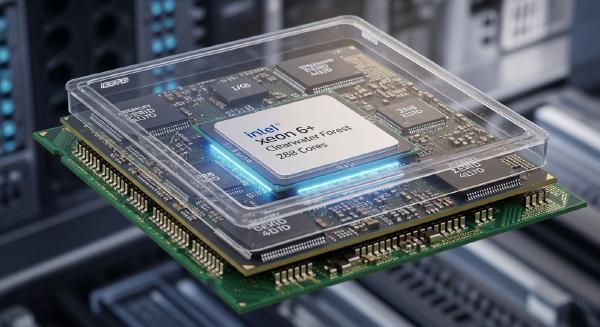
Intel’s Xeon 6+ family, codenamed Clearwater Forest, marks the first generation of server processors built on the Intel 18A process node. After more than a quarter on the market, the platform is expanding beyond hyperscale cloud deployments into the broader server market.
The lineup takes a different approach from conventional multi-SKU server processors. All four Xeon 6+ models use an all-E-core architecture and share the same core platform capabilities, while Intel differentiates them primarily through core count, frequency, power limits, cache capacity, and pricing.
The four models are the Xeon 6960E+, 6970E+, 6980E+, and 6990E+, covering configurations from 144 to 288 cores.
Across the family, customers receive dual-socket support, 12-channel DDR5 memory with MRDIMM support, 96 PCIe lanes, and Intel Application Energy Telemetry (AET). As a result, SKU selection is less about gaining or losing platform features and more about matching compute density and resource allocation to the workload.
🚀 Xeon 6990E+ Targets Maximum Throughput #
At the top of the stack, the Xeon 6990E+ is designed for workloads where aggregate parallel throughput matters more than per-core resource allocation.
The flagship configuration provides:
- 288 E-cores
- 576MB L3 cache
- 450W default TDP
- 2.8GHz all-core boost frequency
- $14,995 recommended customer price (RCP)
For highly parallel workloads capable of scaling across hundreds of cores, the 6990E+ offers the highest aggregate compute capacity in the lineup.
Intel SST-PP Adds Power Flexibility #
The Xeon 6990E+ and 6980E+ also support Intel Speed Select Technology - Performance Profile (SST-PP), allowing customers to select between different TDP and performance profiles.
For the 6990E+, the lower-power configuration reduces the all-core boost frequency from 2.8GHz to 2.4GHz, a reduction of approximately 14%. At the same time, the TDP falls from 450W to 330W, cutting power consumption by 120W, or roughly 27%.
This gives data-center operators another deployment variable. Systems optimized for maximum throughput can use the higher power profile, while installations constrained by rack power, cooling capacity, or operating costs can select the lower tier.
On a simple per-core calculation, the 6990E+ consumes approximately 1.15W per core in its 330W configuration. The 6980E+ reaches roughly 1.14W per core in its corresponding low-TDP mode.
This illustrates an important characteristic of high-core-count server processors: although total socket power increases with core count, the power allocated to each individual core can decline.
⚖️ More Cores Do Not Always Mean Better Performance #
The highest-core-count Xeon 6+ model is not necessarily the best choice for every workload.
The entry-level Xeon 6960E+ provides 144 E-cores, a 330W TDP, a 2.4GHz base frequency, up to 3.0GHz all-core boost, and 432MB of L3 cache. Its RCP is $4,608.
Notably, its 330W power level matches the low-TDP configuration of the 288-core 6990E+, yet the 6960E+ can reach a higher all-core boost frequency.
The reason becomes clearer when looking at the platform’s fixed memory and I/O resources.
Memory Bandwidth Per Core #
All Xeon 6+ models use the same 12-channel memory configuration. Consequently, reducing the number of cores increases the amount of memory bandwidth available to each individual core.
With a 12-channel DDR5-8000 MRDIMM configuration, theoretical per-core memory bandwidth works out to approximately:
| Model | Cores | Approx. Bandwidth per Core |
|---|---|---|
| Xeon 6990E+ | 288 | 2.67 GB/s |
| Xeon 6960E+ | 144 | 5.34 GB/s |
The 144-core model therefore provides roughly twice the memory bandwidth per core of the 288-core configuration under the same memory-channel assumptions.
This distinction matters for workloads that cannot efficiently scale across hundreds of threads or that depend heavily on memory access per active core.
L3 Cache Density #
Cache allocation follows a similar pattern.
The 6990E+ provides 576MB of L3 cache across 288 cores, equivalent to 2MB per core. Lower-core-count models provide greater cache capacity per individual core, with the 6970E+ reaching approximately 2.5MB per core and the 6960E+ reaching up to 3MB per core.
For workloads that are sensitive to cache locality, memory latency, or per-thread resource availability, a lower-core-count SKU can therefore offer a better balance than simply maximizing total core count.
💰 Xeon 6+ Pricing Follows Core Scale #
Intel’s recommended customer pricing establishes a clear progression across the four models:
| Model | Core Count | Approx. RCP |
|---|---|---|
| Xeon 6960E+ | 144 | $4,608 |
| Xeon 6970E+ | 192 | $7,700 |
| Xeon 6980E+ | — | $9,900 |
| Xeon 6990E+ | 288 | $14,995 |
As core counts increase, absolute pricing rises substantially. However, the additional cores do not translate into a proportional improvement in price-per-core efficiency.
The flagship 6990E+ has a significantly higher cost per core than the entry-level 6960E+, with the difference reaching roughly 63% based on the listed RCP figures.
RCP Is Not the Same as Procurement Cost #
Server processor RCP or MSRP figures should not be interpreted as the final price paid by enterprise customers. Actual procurement costs can vary significantly depending on volume, contracts, system configurations, and vendor discounts.
Nevertheless, the pricing gradient reveals Intel’s product positioning: the 6990E+ is designed to maximize socket-level compute density rather than provide the lowest possible cost per core.
🧠 Choosing the Right Xeon 6+ SKU #
The core design philosophy behind Xeon 6+ is different from a traditional feature-segmented product stack.
Instead of reserving major platform capabilities for higher-priced models, Intel provides a largely consistent platform across the family and changes the balance between compute capacity, frequency, cache density, memory bandwidth per core, and power consumption.
That makes workload characteristics more important than simply selecting the model with the highest core count.
Compute-Bound Workloads #
Highly parallel workloads that can efficiently utilize hundreds of threads are the natural target for the 6990E+ and other high-core-count configurations.
Examples include workloads where aggregate throughput scales predictably with additional CPU cores and where memory bandwidth per individual core is less restrictive.
Memory- and Cache-Sensitive Workloads #
Applications with limited parallelism or high per-thread memory and cache requirements may benefit from lower-core-count models.
Because the number of memory channels remains fixed across the family, fewer cores mean more memory bandwidth per active core. Higher L3 cache density can provide another advantage for workloads that depend heavily on cache locality.
Power-Constrained Deployments #
Data centers with strict power or thermal limits can also benefit from the available power profiles on supported models.
The 6990E+ demonstrates the trade-off particularly clearly: reducing its TDP from 450W to 330W sacrifices some all-core frequency but substantially lowers socket power.
📊 Xeon 6+ Is About Resource Balance #
The Xeon 6+ lineup is best understood as a unified platform with different compute scales rather than a conventional hierarchy in which expensive SKUs simply unlock more features.
All four models share major platform capabilities, including dual-socket support, 12-channel DDR5 memory, 96 PCIe lanes, and Intel Application Energy Telemetry. The key differences instead lie in the balance between core count, frequency, cache capacity, memory bandwidth per core, power consumption, and cost.
For server buyers, the optimal SKU therefore depends on the actual workload bottleneck.
If the workload scales efficiently across hundreds of threads, the 288-core Xeon 6990E+ provides the highest aggregate throughput. If the workload is constrained by per-core memory bandwidth, cache capacity, frequency, or power efficiency, a lower-core-count model may deliver a better overall result.
The central lesson of Clearwater Forest is straightforward: maximum core count is not automatically maximum workload performance or value. The best Xeon 6+ configuration is the one that most closely matches the compute, memory, and power characteristics of the workload.