Intel 14A and Coral Rapids: Can Xeon Catch AMD EPYC?
Intel is signaling a renewed effort to rebuild its competitiveness in both client computing and data center processors. During its Q3 2026 earnings call, CEO Lip-Bu Tan outlined the company’s next-generation CPU roadmap, highlighting Nova Lake for client systems, Diamond Rapids for servers, and Coral Rapids as a major milestone in its transition to the Intel 14A manufacturing process.
The announcements reveal two parallel priorities: closing product portfolio gaps in the PC market and strengthening Intel’s position in the rapidly expanding server CPU market.
On the client side, Nova Lake is progressing ahead of schedule, with Intel expecting its design wins at launch to reach twice the level achieved by Panther Lake. The product family is intended to address Intel’s high-end desktop gap while extending its next-generation client portfolio.
On the server side, Diamond Rapids is sampling to customers and targeting a 2027 ramp on Intel 18A-P. Its successor, Coral Rapids, is scheduled for 2028 and will transition to Intel 14A.
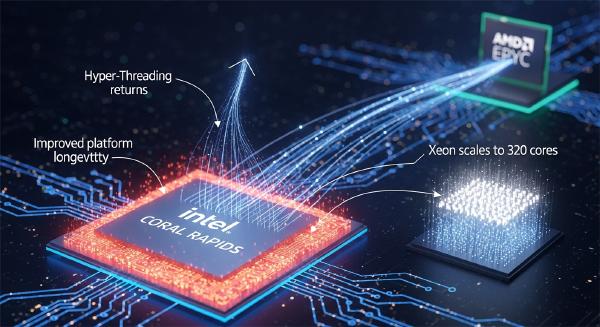
More importantly, Tan explicitly stated that Intel expects Coral Rapids to be competitive with AMD EPYC, while subsequent generations are intended to regain performance leadership.
These statements represent Intel’s product objectives rather than independently verified performance outcomes. Nevertheless, they provide an important indication of how Intel plans to compete across the next several processor generations.
🚀 Nova Lake: Intel’s Next-Generation Client CPU Strategy #
Nova Lake is one of the most important products in Intel’s upcoming client CPU roadmap.
During the Q3 2026 earnings call, Lip-Bu Tan described Nova Lake as Intel’s strongest client product portfolio in a considerable period, emphasizing its potential to address multiple segments of the PC market.
One of the most important objectives is filling Intel’s existing gap in the high-end desktop (HEDT and enthusiast desktop) market.
1. First Client Product on Intel 18A-P #
Nova Lake is positioned as the first Intel client processor family built on the company’s enhanced Intel 18A-P process technology.
This is significant because Intel 18A-P represents an evolution of the 18A manufacturing platform, providing an updated process foundation for future high-performance client products.
Compared with the previous generations, Nova Lake is expected to benefit from improvements in manufacturing technology, power efficiency, and transistor performance.
However, the actual performance benefits will depend on the final processor architecture, product configuration, operating frequencies, power limits, and manufacturing characteristics.
2. Design Wins Expected to Double Panther Lake #
One of the more notable disclosures from the earnings call concerns Nova Lake’s expected design wins.
According to Tan, Nova Lake is tracking ahead of schedule, with design wins expected to be approximately twice those of Panther Lake at launch.
This is an important signal of Intel’s confidence in the product portfolio and its potential appeal to PC manufacturers.
However, design wins should not be confused with actual shipments or market share.
A design win indicates that an OEM has selected or committed to a processor platform for a product configuration. Actual commercial results will still depend on manufacturing capacity, product availability, pricing, and consumer demand.
If Intel successfully converts these design wins into shipping products, Nova Lake could help expand its presence in premium desktop systems and other client segments.
3. Filling Intel’s High-End Desktop Gap #
Intel’s current client portfolio has faced increasing competition in performance-oriented desktop systems.
Nova Lake is intended to address this gap by expanding Intel’s product coverage at the higher end of the market.
Its broader positioning is important because desktop processors compete across several dimensions:
- Single-threaded performance.
- Multi-threaded processing capacity.
- Gaming performance.
- Power consumption and thermal characteristics.
- Memory and platform capabilities.
- Total platform cost.
Winning back high-end desktop customers requires improvements across more than one benchmark category.
Intel plans to reveal additional Nova Lake details at CES in January 2027.
The event should provide a clearer picture of product configurations, architectural changes, platform features, and expected availability.
For additional architectural context, see Intel’s Nova Lake and Diamond Rapids architecture overview on PUDN, which discusses the two processor families and their respective client and server positioning.
4. AI PCs and the Long-Term Client Opportunity #
Intel also sees opportunities beyond traditional PC replacement cycles.
As AI workloads increasingly move toward local execution, client processors will need to support more demanding workloads involving:
- Local large language model inference.
- AI-assisted productivity applications.
- Real-time content generation.
- On-device personal assistants.
- Hybrid CPU, GPU, and NPU execution.
This creates opportunities for processors that combine general-purpose computing with dedicated AI acceleration.
However, Intel’s ability to convert AI interest into additional PC demand will depend on whether practical applications provide enough value to justify hardware upgrades.
Management remains optimistic about the long-term client market despite near-term pressure from memory shortages, component costs, and constrained consumer spending.
🖥️ Intel Server CPU Roadmap: Diamond Rapids Leads Into Coral Rapids #
The server market is arguably the more consequential part of Intel’s next-generation CPU strategy.
Competition from AMD EPYC has intensified, while cloud providers and AI infrastructure companies increasingly demand processors that can deliver high performance, efficient power consumption, and scalable platform capabilities.
Intel’s roadmap establishes a generational transition from its current Xeon products toward Diamond Rapids and Coral Rapids.
1. Diamond Rapids: First Server Product on Intel 18A-P #
Diamond Rapids is the next major step in Intel’s Xeon server roadmap.
It is the first server processor family planned to use Intel 18A-P and is currently in customer sampling.
According to the Q3 2026 earnings call, Intel expects Diamond Rapids to ramp in 2027.
The processor is particularly relevant to emerging data center workloads, including:
- AI inference.
- Agentic AI workloads.
- High-performance orchestration.
- Cloud computing.
- Large-scale enterprise infrastructure.
These workloads increasingly rely on CPUs to coordinate accelerators, manage memory operations, process application logic, and execute infrastructure services.
As a result, server CPUs remain important even as GPU-based AI computing receives most of the industry’s attention.
2. Oracle Cloud Infrastructure Partnership #
Intel has also announced a multiyear collaboration with Oracle Cloud Infrastructure (OCI).
The collaboration is intended to expand Xeon-based computing across current and future Oracle Cloud platforms.
Importantly, Intel’s announcement identifies planned OCI X14 offerings powered by Diamond Rapids.
This provides a potential deployment path for Intel’s next-generation server processors in hyperscale cloud infrastructure.
Cloud partnerships matter because they offer processor manufacturers access to large deployment environments and production workloads.
They also provide opportunities to validate hardware and platform capabilities under demanding operating conditions.
For Intel, the OCI relationship represents an important commercial opportunity as it attempts to expand its presence in AI-oriented data center infrastructure.
3. Coral Rapids: Intel’s 14A-Powered Server Generation #
Coral Rapids is the successor to Diamond Rapids and is expected to arrive in 2028.
The most important architectural and manufacturing distinction is its adoption of Intel 14A.
This makes Coral Rapids a major milestone in Intel’s manufacturing roadmap.
While Diamond Rapids is intended to establish Intel 18A-P in the server market, Coral Rapids will bring the next-generation 14A process into Intel’s Xeon product portfolio.
The transition is significant for several reasons:
- It introduces a newer manufacturing generation.
- It provides an opportunity to improve transistor performance and energy efficiency.
- It gives Intel another platform for architectural refinement.
- It supports Intel’s longer-term strategy of differentiating its server products through manufacturing technology.
However, a process-node transition does not automatically guarantee better CPU performance.
Actual results will depend on core architecture, cache organization, interconnect design, memory bandwidth, power limits, and product-level manufacturing characteristics.
Coral Rapids will therefore need to demonstrate improvements through real workloads rather than relying solely on its manufacturing node designation.
🏭 Intel 14A: A Critical Manufacturing Milestone #
Intel 14A is central to the company’s longer-term manufacturing strategy.
During October 2026, Intel released the industry-standard version 0.9 Process Design Kit (PDK) to selected customers.
Tan described the release as meeting industry-standard yield and performance criteria for the PDK milestone.
This represents meaningful progress in Intel Foundry’s development program.
1. What Does Intel 14A PDK 0.9 Mean? #
A Process Design Kit is a collection of process-specific design information and tools that semiconductor customers use to develop integrated circuits for a particular manufacturing node.
It typically includes:
- Process design rules.
- Standard-cell libraries.
- Device models.
- Physical verification information.
- Parasitic extraction data.
- Manufacturing and reliability-related design constraints.
- Integration information for electronic design automation (EDA) tools.
A PDK release allows chip designers to begin developing and validating their designs against the manufacturing process.
Reaching version 0.9 is therefore an important ecosystem milestone because it provides customers with a more mature design environment.
However, releasing a 0.9 PDK should not be interpreted as proof that the process has already reached high-volume manufacturing readiness.
Further process validation, customer design integration, product qualification, and manufacturing preparation remain necessary.
2. Intel 14A and High-NA EUV #
Intel 14A is also important because of its position in Intel’s future lithography roadmap.
The company is advancing its use of High Numerical Aperture Extreme Ultraviolet (High-NA EUV) lithography as part of its manufacturing development strategy.
High-NA EUV increases the numerical aperture of the lithography system, enabling improved imaging resolution and potentially more advanced patterning capabilities.
The technology is expected to become increasingly important as semiconductor manufacturing approaches more demanding feature sizes and patterning requirements.
Intel’s broader 14A roadmap also includes continued development of advanced transistor and backside power-delivery technologies.
These technologies are intended to improve performance, power efficiency, and transistor integration.
For further background, Intel’s 14A process technology roadmap and its evolution beyond 18A provides additional context on the company’s manufacturing direction and advanced lithography strategy.
3. Customer Engagement and Foundry Opportunities #
Beyond internal processor development, Intel 14A is also intended to support Intel Foundry’s external customer strategy.
During the earnings call, Tan indicated that Intel was encouraged by progress involving multiple potential customers.
The company has not disclosed the identities or final commitments of these customers.
This distinction is important.
Interest in a manufacturing process, technical evaluation, PDK engagement, design activity, and a confirmed production commitment represent different stages of the foundry customer acquisition process.
Intel must demonstrate not only competitive process performance but also reliable execution, attractive economics, and sufficient production capacity to secure major external customers.
Coral Rapids provides one internal product opportunity to validate the 14A manufacturing platform.
⚔️ Intel Xeon vs. AMD EPYC: Can Coral Rapids Close the Gap? #
The competition between Intel Xeon and AMD EPYC remains one of the most important battles in the server processor market.
AMD has expanded its presence in cloud infrastructure, enterprise computing, and high-performance server deployments.
Intel, meanwhile, is attempting to rebuild its position through a combination of process improvements, new processor architectures, and expanded supply capacity.
1. Intel’s Competitive Target for Coral Rapids #
During the Q3 2026 earnings call, Lip-Bu Tan addressed Intel’s server competitiveness directly.
He stated that Coral Rapids would be competitive with AMD, while subsequent next-generation products are expected to move ahead of AMD.
This provides a clear indication of Intel’s internal performance objectives.
However, the statement should be understood as management’s forward-looking target rather than an established benchmark result.
No final commercial Coral Rapids configuration or independent performance comparison was available in the earnings-call disclosure.
2. The Importance of Supply Capacity #
An important point raised during the earnings call was that Intel’s server market share will depend significantly on its ability to increase product supply.
Intel continues to face strong demand for Xeon processors.
In particular, management described demand for its server CPU family as exceeding currently available supply.
Several constraints affect the company’s ability to meet this demand:
- Manufacturing wafer capacity.
- Process yield and production cycle time.
- Advanced packaging capacity.
- Organic substrate availability.
- Memory and other critical components.
These constraints matter because even a competitive processor cannot generate meaningful market share gains if sufficient quantities cannot be delivered to customers.
Intel’s immediate priority is therefore not limited to improving processor architecture. It must also expand the manufacturing and packaging capacity required to support customer demand.
3. Performance Is More Than Core Count #
Server processors compete across a wide range of workloads.
A meaningful comparison between Intel Xeon and AMD EPYC requires evaluating several factors:
| Evaluation Area | Why It Matters |
|---|---|
| Core Count | Determines available parallel processing resources |
| Single-Thread Performance | Important for latency-sensitive and lightly threaded applications |
| Multi-Thread Performance | Influences highly parallel enterprise workloads |
| Memory Bandwidth | Critical for data-intensive workloads and AI infrastructure |
| Cache Architecture | Affects data access latency and workload efficiency |
| I/O Connectivity | Determines support for accelerators, storage, and networking |
| Power Efficiency | Influences data center operating costs |
| Platform Availability | Affects adoption and deployment flexibility |
| Supply Capacity | Determines how quickly customers can deploy processors at scale |
For AI infrastructure in particular, CPU performance must be evaluated alongside accelerator communication, memory bandwidth, networking, and system-level efficiency.
A processor that performs well in synthetic benchmarks may not necessarily deliver the best results across production workloads.
4. Intel’s Multi-Generation Catch-Up Strategy #
Intel’s roadmap suggests that management is not expecting Coral Rapids alone to restore all aspects of server competitiveness.
Instead, the strategy involves several successive product generations:
- Current Xeon products: Continue serving existing enterprise and cloud workloads while Intel addresses supply constraints.
- Diamond Rapids (2027): Establish Intel 18A-P in the next major server CPU generation.
- Coral Rapids (2028): Introduce Intel 14A into the Xeon server roadmap and target competitiveness with AMD EPYC.
- Subsequent generations: Pursue the performance leadership targets described by Intel management.
This is a multi-generation strategy rather than a single-product recovery effort.
The ultimate results will depend on architectural execution, manufacturing progress, customer adoption, and the pace of AMD’s own EPYC roadmap.
📈 What Intel’s Roadmap Means for the Semiconductor Industry #
Intel’s Q3 2026 disclosures highlight three broader developments in the semiconductor industry.
1. Process Technology Is Becoming a Major Competitive Differentiator #
The transition from Intel 18A-P to Intel 14A is not simply a manufacturing update.
It represents Intel’s effort to use process technology as a competitive advantage across both client and server products.
For semiconductor manufacturers, the ability to deliver competitive process technology on schedule is critical to attracting internal and external customers.
The maturity of the design ecosystem is equally important because customers require stable PDKs, qualified IP, and reliable manufacturing execution before committing to large production programs.
2. Server CPUs Remain Essential to AI Infrastructure #
Although GPUs and specialized accelerators dominate AI hardware discussions, CPUs continue to play an essential role in modern data centers.
They handle:
- Workload orchestration.
- Application execution.
- Data preparation.
- Storage management.
- Networking and I/O operations.
- Distributed system coordination.
- Infrastructure and virtualization services.
As AI clusters expand, the demand for CPU resources can also increase.
Intel’s focus on Diamond Rapids and Coral Rapids reflects this opportunity.
3. Manufacturing Capacity Is as Important as Product Performance #
Intel’s supply constraints highlight another important reality.
In a market with strong demand, manufacturing capacity can become a competitive factor alongside architectural performance.
Even when a processor is technically competitive, production bottlenecks can limit its adoption.
Intel must therefore improve several areas simultaneously:
- Process yields.
- Wafer output.
- Advanced packaging throughput.
- Substrate availability.
- Product qualification.
- Customer delivery schedules.
The company’s ability to execute across these areas will influence whether its next-generation products translate into sustainable market share gains.
⚠️ Key Risks and Uncertainties #
Despite the progress outlined during the earnings call, several uncertainties remain.
1. Intel 14A Manufacturing Execution #
Releasing the 0.9 PDK is a positive development, but it does not establish that Intel 14A has already achieved production-scale economics or mature manufacturing yields.
The transition from process development to reliable volume manufacturing remains a significant technical and financial challenge.
2. Coral Rapids Performance #
Intel’s statement that Coral Rapids will be competitive with AMD EPYC remains a forward-looking target.
Independent testing will ultimately determine its position in areas such as performance per watt, memory bandwidth, multi-threaded throughput, and total platform efficiency.
3. AMD’s Continued Product Development #
AMD is not standing still.
Its EPYC roadmap will continue evolving, and Intel’s competitive position in 2028 will depend partly on the products AMD delivers by then.
Intel must therefore compete against the future EPYC generation rather than today’s processors.
4. Manufacturing and Component Supply #
Wafer capacity is only one part of the production equation.
Advanced packaging, substrates, memory availability, and other components can also restrict shipment volumes.
Even a successful processor launch could face commercial limitations if the supporting supply chain cannot scale accordingly.
🧭 Conclusion: Intel Is Betting on 18A-P and 14A to Rebuild Its CPU Business #
Intel’s Q3 2026 earnings call provides a clearer picture of its next-generation CPU strategy.
On the client side, Nova Lake is progressing ahead of schedule and is expected to achieve twice as many design wins as Panther Lake at launch. Its primary objective is to strengthen Intel’s presence in high-end desktop computing while expanding its broader client portfolio.
On the server side, Diamond Rapids will introduce Intel 18A-P into the next Xeon generation, with a planned 2027 ramp and growing interest in AI inference and agentic workloads.
Coral Rapids, expected in 2028, represents the next major step by bringing Intel 14A into the server CPU market.
The most important statement from Lip-Bu Tan is that Intel expects Coral Rapids to be competitive with AMD EPYC, while subsequent generations aim to achieve performance leadership.
Nevertheless, the roadmap is only part of the equation.
Intel must demonstrate that its manufacturing processes can deliver competitive yields, that its server products can meet real-world performance targets, and that its supply chain can support customer demand.
The transition from Intel 18A-P to Intel 14A could become a defining chapter in Intel’s attempt to regain server CPU competitiveness. Whether Coral Rapids can challenge AMD EPYC will ultimately be determined by silicon performance, manufacturing execution, and commercial adoption—not roadmap promises alone.